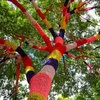
Yarn Bombing

2005Street art / physical meme / craftivismsemi-active

Also known as: Yarn storming · knit graffiti · guerrilla knitting · yarnstorming · crochet graffiti

Yarn Bombing is a 2005 street art movement by Houston artist Magda Sayeg, featuring handmade knitted and crocheted pieces attached to public objects.

Yarn bombing is a form of street art where knitters and crocheters attach handmade fiber pieces to public objects like trees, lampposts, statues, and benches. The practice originated in Houston, Texas around 2005 when artist Magda Sayeg wrapped a knitted cozy around her boutique's door handle and quickly escalated to tagging stop signs, car antennas, and eventually landmarks across the world1. Sometimes called "guerrilla knitting" or "knit graffiti," yarn bombing spread through craft blogs and social media throughout the late 2000s and early 2010s, turning the traditionally domestic craft of knitting into a global public art movement.

TL;DR

Yarn bombing is a form of street art where knitters and crocheters attach handmade fiber pieces to public objects like trees, lampposts, statues, and benches.

Overview

Yarn bombing works exactly like it sounds: people take colorful knitted or crocheted fabric and attach it to public objects. Targets range from small (door handles, bike racks, parking meters) to massive (buses, bridges, the Wall Street Charging Bull). The installations are non-permanent and can be removed with a pair of scissors, leaving no damage behind1. This soft, temporary quality sets yarn bombing apart from spray-paint graffiti and is a big part of its appeal.

Geographer Joanna Mann defined the practice as "stealthily attaching handmade fibre items to street fixtures or parts of the urban landscape"1. While technically illegal in many jurisdictions (it can fall under trespass, criminal damage, or antisocial behavior laws), yarn bombers generally face little enforcement1. The art form sits at a strange intersection: knitting's cozy domestic associations collide with graffiti's outlaw energy, creating something that reads as both rebellious and grandmotherly at the same time.

The roots trace back to at least June 2000, when Houston artist Bill Davenport began making sculptures housed in crocheted yarn objects resembling tea cozies5. The concept migrated to Portland, Oregon by 2002, when artist Shanon Schollian launched the Stump Cozy Project, recruiting knitters to cover tree stumps in yarn5.

But the term "yarn bombing" didn't exist until October 2005, when Houston artist Magda Sayeg knitted a blue and pink acrylic square around the door handle of her clothing boutique3. The reaction from passersby was immediately positive. Sayeg and her friend, who went by the handle AKrylik, decided to take their unfinished knitting projects to the streets. As the Houston Press reported in December 2005, the two working mothers began "stitching cozies onto boutique door handles, stop-sign poles, and car antennas" around Montrose and the Museum District on Friday nights and Sunday mornings2.

They formed a crew called Knitta Please (a play on a hip-hop phrase), adopting knitting-themed street names like Knotorious N.I.T., SonOfaStitch, and P-Knitty3. Each piece came with a paper tag reading "knitta, please!" or "whaddup knitta?" as their calling card2. Sayeg later described the motivation as a response to "the dehumanizing qualities of the urban environment"3.

Origin & Background

Platform
Real-world street art, spread via craft blogs and social media (Flickr, Tumblr, Reddit)
Key People
Magda Sayeg, AKrylik
Date
2005

The roots trace back to at least June 2000, when Houston artist Bill Davenport began making sculptures housed in crocheted yarn objects resembling tea cozies. The concept migrated to Portland, Oregon by 2002, when artist Shanon Schollian launched the Stump Cozy Project, recruiting knitters to cover tree stumps in yarn.

But the term "yarn bombing" didn't exist until October 2005, when Houston artist Magda Sayeg knitted a blue and pink acrylic square around the door handle of her clothing boutique. The reaction from passersby was immediately positive. Sayeg and her friend, who went by the handle AKrylik, decided to take their unfinished knitting projects to the streets. As the Houston Press reported in December 2005, the two working mothers began "stitching cozies onto boutique door handles, stop-sign poles, and car antennas" around Montrose and the Museum District on Friday nights and Sunday mornings.

They formed a crew called Knitta Please (a play on a hip-hop phrase), adopting knitting-themed street names like Knotorious N.I.T., SonOfaStitch, and P-Knitty. Each piece came with a paper tag reading "knitta, please!" or "whaddup knitta?" as their calling card. Sayeg later described the motivation as a response to "the dehumanizing qualities of the urban environment".

How It Spread

Knitta Please got their first press in December 2005 from the Houston Press. Throughout 2006, coverage spread across the blogosphere: Apartment Therapy, TreeHugger, LAist, and GammaBlog all featured the group's work. LAist praised the "ladies armed with needles and yarn and a mission of beautying up the world". The crew was still just two people at this point, but interest was building fast.

By January 2007, Knitta had expanded to eleven members across multiple cities. That same year, they traveled to Paris at the invitation of Bergère de France (a yarn manufacturer celebrating its 60th anniversary) and tagged Notre Dame. Also in 2007, British knitter Lauren O'Farrell, known as Deadly Knitshade, started creating knit graffiti throughout London.

In February 2009, O'Farrell established Knit the City, a collective that preferred the term "yarnstorming" as a more peaceful alternative. They incorporated amigurumi (small knitted toys) into their installations, debuting the approach in their August 2009 piece "Web of Woe". That same month, "yarnbombing" was added to Urban Dictionary, and a Flickr group called Yarn Bombing DIY launched on January 11, 2009, accumulating over 1,900 photos.

The movement went local in 2010 as community groups started forming. Yarn Bombing Los Angeles emerged that year, growing into a fiber arts collective that staged installations with museums, city governments, and alternative art spaces. In 2011, the New York Times ran a feature article with a photo of Wall Street's Charging Bull sculpture wrapped in pink and purple crochet, bringing yarn bombing to mainstream national attention. The piece quoted Philadelphia artist Jessie Hemmons, who had yarn-bombed the Rocky statue: "Street art and graffiti are usually so male dominated. Yarn bombing is more feminine. It's like graffiti with grandma sweaters".

June 2011 marked the first International Yarn Bombing Day (held every June 11), and a single-topic Tumblr dedicated to the art form launched that same month. The /r/yarnbombs subreddit arrived in July 2012.

Media coverage peaked in late 2012 and early 2013, with compilations appearing on Mental Floss, BuzzFeed, Mashable, the Huffington Post, and Time. On October 6, 2013, a Reddit submission to /r/Pics featuring yarn bombing pulled in over 21,000 upvotes and 760 comments in 24 hours. That same month, three members of Grand Rapids' Collective Wings installed dozens of yarn bombs throughout the city for the Michigan ArtPrize competition.

How to Use This Meme

Yarn bombing is one of the more accessible street art forms. Common approaches include:

1

Choose a target. Any public object works: trees, lampposts, bike racks, benches, railings, statues, or fences. Many yarn bombers start small with a pole or branch.

2

Create fabric pieces. Knit or crochet panels, tubes, or shapes in bright colors. Experienced yarn bombers often repurpose unfinished projects, practice swatches, and leftover yarn rather than making new pieces. Mixing different stitch patterns, colors, and textures adds visual interest.

3

Attach to the target. Button, sew, or tie the pieces around the object. Buttons and sewn seams tend to hold better than simple knots. The seaming and attaching typically takes longer than the actual knitting.

4

Tag it (optional). Some groups leave small paper tags or labels identifying their crew, following the Knitta Please tradition.

5

Document and share. Photograph the installation and post to social media, Flickr, or community boards. Part of yarn bombing's spread relies on online documentation since physical pieces are temporary.

Cultural Impact

The New York Times brought yarn bombing to a mainstream American audience in May 2011, framing it as a global movement with practitioners on every continent. The article noted crews in Paris, Denver, Seattle, Stockholm, London, and Melbourne, establishing the practice as a legitimate international art form rather than a quirky local trend.

Academic researchers studied yarn bombing through multiple lenses. The JSTOR Daily published a primer citing work by geographer Joanna Mann and criminologist Andrew Millie, both of whom analyzed the practice's relationship to public space, gender, and legality. Mann's concept of "whimsy as micro-political change" gave the movement intellectual credibility beyond the craft world.

The ArtPrize competition in Grand Rapids, Michigan featured yarn bombing as a formal entry in October 2013, with Collective Wings' Division Fibers Yarn Bomb project creating an interactive public art installation on one of the city's busiest streets. The project accepted donated materials and taught people to knit for free at twice-weekly socials, turning the art competition entry into a community building exercise.

Yarn Bombing Los Angeles partnered with city governments, museums (including a project outside MOCA), and the LAUSD school system, running workshops for teachers, students, and parents. In Mexico, yarn bombing took on an activist dimension, with artists using installations to raise awareness about women's rights and environmental protection.

Brands and institutions eventually embraced the practice. Etsy paid Magda Sayeg to yarn-bomb their New York City offices. The Blanton Museum of Art near the Texas state capitol invited Knitta to stage an installation of 99 "tree cozies" in Faulkner Plaza.

Full History

The earliest precursors to yarn bombing had nothing to do with street art. Bill Davenport's crocheted sculptures in 2000 were gallery pieces, and the Portland Stump Cozy Project in 2002 was a community craft event. Neither used the language of graffiti or tagging. What Sayeg did differently in 2005 was frame knitting explicitly as an act of artistic defiance against bland urban landscapes.

The Houston Press profile of Knitta Please in December 2005 captures the movement's origin energy perfectly. AKrylik and PolyCotN (Sayeg's street name) were described as "working mothers in their early thirties" who went tagging on school nights, sometimes interrupted by their kids calling to complain about homework. "We're taking graffiti and making it warm, fuzzy and more acceptable," AKrylik told the paper. "I like the duality there". The crew marked holidays with themed work (pink yarn for Valentine's Day, sparkly yarn for New Years) and left paper tags on every piece.

Knitta's growth was fueled by early internet culture. Images of their work spread through craft blogs and personal homepages at a time when platforms like Flickr and MySpace were the primary ways independent artists reached audiences. By 2006, the duo had executed their first large-scale piece in Seattle, wrapping the top half of a monorail column with more than 50 feet of donated knitted material. For the Houston Art Car parade in May 2006, they tagged all 25 trees in the Allen Parkway median.

The international expansion started in 2007. After tagging Notre Dame in Paris, Knitta held installations across Europe, Australia, El Salvador, Canada, and even on the Great Wall of China. Back in London, Knit the City pushed the form forward by incorporating three-dimensional knitted characters into their work, moving beyond the simple "cozy" model that dominated early yarn bombing.

Criminologist Andrew Millie, studying the practice in northern England, found that yarn bombers (all women in his research sample) considered arrest unlikely despite operating without permission. The legal gray area worked in their favor: unlike spray paint, yarn is temporary and easy to remove, making prosecution seem disproportionate. Millie described yarn bombing as a "seemingly spontaneous, ephemeral and fundamental change to the textural form of the street" that challenged accepted norms about what belongs in public space.

The academic lens revealed deeper dynamics. Geographer Joanna Mann identified a subset of yarn bombers who called themselves "craftivists," merging craft and activist interests to fight for social causes through knitted political statements. But Mann found that the majority yarn bombed "just for a fun way to use their craft skills, because they can". Ironically, she argued that this apolitical whimsy was itself political: the "capricious irrationality" of a brightly colored tree cozy disrupted the orderly "police order" of urban space and invited people to "think differently". Attempts to deliberately harness that whimsy for specific causes, even good ones like breast cancer awareness, tended to fail.

By the early 2010s, the craft had global infrastructure. Yarnbombing.org launched in January 2011 as a global community hub. Leanne Prain's book "Yarn Bombing: The Art of Crochet and Knit Graffiti" (Arsenal Pulp Press, 2009) gave practitioners a reference text. Local crews sprang up everywhere: Ladies Fancywork Society in Denver, YarnCore ("Hardcore Chicks With Sharp Sticks") in Seattle, Masquerade in Stockholm. In Melbourne, an artist known as Bali created cozies for bike racks and bus stops.

The 2013 peak brought both mainstream acceptance and creative evolution. Brooklyn artist London Kaye O'Donnell began a 30-day beautification challenge that grew into an 80-piece adventure, covering lamps, tree trunks, and mailboxes around Bed-Stuy with increasingly complex designs including hearts, text, and a "Breaking Bad" reference. In New Jersey, artist Lorna Watt crocheted an iPhone replica (apps and all) and slipped it over an abandoned pay phone, asking "How much of our real world has become invisible because the virtual world has become so visible?"

A particularly striking New Jersey story involved the "Midnight Knitter" of West Cape May in 2010. Residents woke to find knit cozies hugging tree branches and sign poles with no one taking credit. "We never did identify exactly who was responsible," Mayor Pam Kaithern told NJ.com. She described hoping birds would tug strands loose in spring "like some scene out of Cinderella," before someone cut the yarn down.

Yarn Bombing Los Angeles, founded in 2010, represents the movement's mature form. The group holds monthly meetings (now on Zoom), teaches knitting for free, and stages installations that blend street art, fiber art, social practice, and what they describe as "community-generated, site-specific public art". Their explicit mission includes "initiating dialogue about cross-generation connections and craft history". The group points out that yarn bombing "redefines both genres" by turning knitting from a domestic hobby into public art, and graffiti from a male-dominated, edgy practice into something accessible and collaborative.

Fun Facts

Knitta Please named themselves after an Ol' Dirty Bastard and Jay-Z phrase, and members adopted hip-hop-style aliases like Knotorious N.I.T. and P-Knitty.

The Houston Press's first profile of Knitta describes one of the founders' husbands putting photos of Divine (the John Waters actress) in place of missing relatives on a child's family tree project while the women went out tagging.

Criminologist Andrew Millie's yarn bombing research subjects, all women in northern England, unanimously thought they were unlikely to be arrested for their work, despite it being technically illegal.

Lorna Watt's 2013 yarn bomb of a broken New Jersey pay phone, designed to look like an iPhone with colorful tile-shaped apps, was meant as commentary on how smartphones have made the physical world invisible.

By the 2010s, Knitta Please's membership had dwindled back to just Sayeg, who ran the project as a solo blog and full-time art practice.

Derivatives & Variations

Knit the City / Yarnstorming:

Lauren O'Farrell's London collective rebranded the practice as "yarnstorming" and introduced amigurumi (small knitted characters) into installations, moving beyond simple fabric wrapping[5].

Craftivism:

A subset of yarn bombers who knit or crochet political statements as protest art, merging craft with activism. The term was documented by geographer Joanna Mann[1].

International Yarn Bombing Day:

Established in 2011 on the second Saturday of June (later fixed to June 11), founded by a Canadian yarn bomber to coordinate global installations[6].

Yarn-Two-Dee-Two:

A yarn-bombed bollard designed to look like R2-D2, created by Sarah Knepper Rudder in Bellingham, Washington. The pattern was shared on Ravelry, where 126 users added it to their "to knit" list[6].

Tree cozies and object cozies:

Extending the tea cozy concept to public objects, these became the most common yarn bomb format. The term references the traditional cloth teapot covers that inspired early practitioners like Bill Davenport[5].

Frequently Asked Questions

YarnBombing

2005Street art / physical meme / craftivismsemi-active

Also known as: Yarn storming · knit graffiti · guerrilla knitting · yarnstorming · crochet graffiti

Yarn Bombing is a 2005 street art movement by Houston artist Magda Sayeg, featuring handmade knitted and crocheted pieces attached to public objects.

Yarn bombing is a form of street art where knitters and crocheters attach handmade fiber pieces to public objects like trees, lampposts, statues, and benches. The practice originated in Houston, Texas around 2005 when artist Magda Sayeg wrapped a knitted cozy around her boutique's door handle and quickly escalated to tagging stop signs, car antennas, and eventually landmarks across the world. Sometimes called "guerrilla knitting" or "knit graffiti," yarn bombing spread through craft blogs and social media throughout the late 2000s and early 2010s, turning the traditionally domestic craft of knitting into a global public art movement.

TL;DR

Yarn bombing is a form of street art where knitters and crocheters attach handmade fiber pieces to public objects like trees, lampposts, statues, and benches.

Overview

Yarn bombing works exactly like it sounds: people take colorful knitted or crocheted fabric and attach it to public objects. Targets range from small (door handles, bike racks, parking meters) to massive (buses, bridges, the Wall Street Charging Bull). The installations are non-permanent and can be removed with a pair of scissors, leaving no damage behind. This soft, temporary quality sets yarn bombing apart from spray-paint graffiti and is a big part of its appeal.

Geographer Joanna Mann defined the practice as "stealthily attaching handmade fibre items to street fixtures or parts of the urban landscape". While technically illegal in many jurisdictions (it can fall under trespass, criminal damage, or antisocial behavior laws), yarn bombers generally face little enforcement. The art form sits at a strange intersection: knitting's cozy domestic associations collide with graffiti's outlaw energy, creating something that reads as both rebellious and grandmotherly at the same time.

The roots trace back to at least June 2000, when Houston artist Bill Davenport began making sculptures housed in crocheted yarn objects resembling tea cozies. The concept migrated to Portland, Oregon by 2002, when artist Shanon Schollian launched the Stump Cozy Project, recruiting knitters to cover tree stumps in yarn.

But the term "yarn bombing" didn't exist until October 2005, when Houston artist Magda Sayeg knitted a blue and pink acrylic square around the door handle of her clothing boutique. The reaction from passersby was immediately positive. Sayeg and her friend, who went by the handle AKrylik, decided to take their unfinished knitting projects to the streets. As the Houston Press reported in December 2005, the two working mothers began "stitching cozies onto boutique door handles, stop-sign poles, and car antennas" around Montrose and the Museum District on Friday nights and Sunday mornings.

They formed a crew called Knitta Please (a play on a hip-hop phrase), adopting knitting-themed street names like Knotorious N.I.T., SonOfaStitch, and P-Knitty. Each piece came with a paper tag reading "knitta, please!" or "whaddup knitta?" as their calling card. Sayeg later described the motivation as a response to "the dehumanizing qualities of the urban environment".

Origin & Background

Platform
Real-world street art, spread via craft blogs and social media (Flickr, Tumblr, Reddit)
Key People
Magda Sayeg, AKrylik
Date
2005

The roots trace back to at least June 2000, when Houston artist Bill Davenport began making sculptures housed in crocheted yarn objects resembling tea cozies. The concept migrated to Portland, Oregon by 2002, when artist Shanon Schollian launched the Stump Cozy Project, recruiting knitters to cover tree stumps in yarn.

But the term "yarn bombing" didn't exist until October 2005, when Houston artist Magda Sayeg knitted a blue and pink acrylic square around the door handle of her clothing boutique. The reaction from passersby was immediately positive. Sayeg and her friend, who went by the handle AKrylik, decided to take their unfinished knitting projects to the streets. As the Houston Press reported in December 2005, the two working mothers began "stitching cozies onto boutique door handles, stop-sign poles, and car antennas" around Montrose and the Museum District on Friday nights and Sunday mornings.

They formed a crew called Knitta Please (a play on a hip-hop phrase), adopting knitting-themed street names like Knotorious N.I.T., SonOfaStitch, and P-Knitty. Each piece came with a paper tag reading "knitta, please!" or "whaddup knitta?" as their calling card. Sayeg later described the motivation as a response to "the dehumanizing qualities of the urban environment".

How It Spread

Knitta Please got their first press in December 2005 from the Houston Press. Throughout 2006, coverage spread across the blogosphere: Apartment Therapy, TreeHugger, LAist, and GammaBlog all featured the group's work. LAist praised the "ladies armed with needles and yarn and a mission of beautying up the world". The crew was still just two people at this point, but interest was building fast.

By January 2007, Knitta had expanded to eleven members across multiple cities. That same year, they traveled to Paris at the invitation of Bergère de France (a yarn manufacturer celebrating its 60th anniversary) and tagged Notre Dame. Also in 2007, British knitter Lauren O'Farrell, known as Deadly Knitshade, started creating knit graffiti throughout London.

In February 2009, O'Farrell established Knit the City, a collective that preferred the term "yarnstorming" as a more peaceful alternative. They incorporated amigurumi (small knitted toys) into their installations, debuting the approach in their August 2009 piece "Web of Woe". That same month, "yarnbombing" was added to Urban Dictionary, and a Flickr group called Yarn Bombing DIY launched on January 11, 2009, accumulating over 1,900 photos.

The movement went local in 2010 as community groups started forming. Yarn Bombing Los Angeles emerged that year, growing into a fiber arts collective that staged installations with museums, city governments, and alternative art spaces. In 2011, the New York Times ran a feature article with a photo of Wall Street's Charging Bull sculpture wrapped in pink and purple crochet, bringing yarn bombing to mainstream national attention. The piece quoted Philadelphia artist Jessie Hemmons, who had yarn-bombed the Rocky statue: "Street art and graffiti are usually so male dominated. Yarn bombing is more feminine. It's like graffiti with grandma sweaters".

June 2011 marked the first International Yarn Bombing Day (held every June 11), and a single-topic Tumblr dedicated to the art form launched that same month. The /r/yarnbombs subreddit arrived in July 2012.

Media coverage peaked in late 2012 and early 2013, with compilations appearing on Mental Floss, BuzzFeed, Mashable, the Huffington Post, and Time. On October 6, 2013, a Reddit submission to /r/Pics featuring yarn bombing pulled in over 21,000 upvotes and 760 comments in 24 hours. That same month, three members of Grand Rapids' Collective Wings installed dozens of yarn bombs throughout the city for the Michigan ArtPrize competition.

How to Use This Meme

Yarn bombing is one of the more accessible street art forms. Common approaches include:

1

Choose a target. Any public object works: trees, lampposts, bike racks, benches, railings, statues, or fences. Many yarn bombers start small with a pole or branch.

2

Create fabric pieces. Knit or crochet panels, tubes, or shapes in bright colors. Experienced yarn bombers often repurpose unfinished projects, practice swatches, and leftover yarn rather than making new pieces. Mixing different stitch patterns, colors, and textures adds visual interest.

3

Attach to the target. Button, sew, or tie the pieces around the object. Buttons and sewn seams tend to hold better than simple knots. The seaming and attaching typically takes longer than the actual knitting.

4

Tag it (optional). Some groups leave small paper tags or labels identifying their crew, following the Knitta Please tradition.

5

Document and share. Photograph the installation and post to social media, Flickr, or community boards. Part of yarn bombing's spread relies on online documentation since physical pieces are temporary.

Cultural Impact

The New York Times brought yarn bombing to a mainstream American audience in May 2011, framing it as a global movement with practitioners on every continent. The article noted crews in Paris, Denver, Seattle, Stockholm, London, and Melbourne, establishing the practice as a legitimate international art form rather than a quirky local trend.

Academic researchers studied yarn bombing through multiple lenses. The JSTOR Daily published a primer citing work by geographer Joanna Mann and criminologist Andrew Millie, both of whom analyzed the practice's relationship to public space, gender, and legality. Mann's concept of "whimsy as micro-political change" gave the movement intellectual credibility beyond the craft world.

The ArtPrize competition in Grand Rapids, Michigan featured yarn bombing as a formal entry in October 2013, with Collective Wings' Division Fibers Yarn Bomb project creating an interactive public art installation on one of the city's busiest streets. The project accepted donated materials and taught people to knit for free at twice-weekly socials, turning the art competition entry into a community building exercise.

Yarn Bombing Los Angeles partnered with city governments, museums (including a project outside MOCA), and the LAUSD school system, running workshops for teachers, students, and parents. In Mexico, yarn bombing took on an activist dimension, with artists using installations to raise awareness about women's rights and environmental protection.

Brands and institutions eventually embraced the practice. Etsy paid Magda Sayeg to yarn-bomb their New York City offices. The Blanton Museum of Art near the Texas state capitol invited Knitta to stage an installation of 99 "tree cozies" in Faulkner Plaza.

Full History

The earliest precursors to yarn bombing had nothing to do with street art. Bill Davenport's crocheted sculptures in 2000 were gallery pieces, and the Portland Stump Cozy Project in 2002 was a community craft event. Neither used the language of graffiti or tagging. What Sayeg did differently in 2005 was frame knitting explicitly as an act of artistic defiance against bland urban landscapes.

The Houston Press profile of Knitta Please in December 2005 captures the movement's origin energy perfectly. AKrylik and PolyCotN (Sayeg's street name) were described as "working mothers in their early thirties" who went tagging on school nights, sometimes interrupted by their kids calling to complain about homework. "We're taking graffiti and making it warm, fuzzy and more acceptable," AKrylik told the paper. "I like the duality there". The crew marked holidays with themed work (pink yarn for Valentine's Day, sparkly yarn for New Years) and left paper tags on every piece.

Knitta's growth was fueled by early internet culture. Images of their work spread through craft blogs and personal homepages at a time when platforms like Flickr and MySpace were the primary ways independent artists reached audiences. By 2006, the duo had executed their first large-scale piece in Seattle, wrapping the top half of a monorail column with more than 50 feet of donated knitted material. For the Houston Art Car parade in May 2006, they tagged all 25 trees in the Allen Parkway median.

The international expansion started in 2007. After tagging Notre Dame in Paris, Knitta held installations across Europe, Australia, El Salvador, Canada, and even on the Great Wall of China. Back in London, Knit the City pushed the form forward by incorporating three-dimensional knitted characters into their work, moving beyond the simple "cozy" model that dominated early yarn bombing.

Criminologist Andrew Millie, studying the practice in northern England, found that yarn bombers (all women in his research sample) considered arrest unlikely despite operating without permission. The legal gray area worked in their favor: unlike spray paint, yarn is temporary and easy to remove, making prosecution seem disproportionate. Millie described yarn bombing as a "seemingly spontaneous, ephemeral and fundamental change to the textural form of the street" that challenged accepted norms about what belongs in public space.

The academic lens revealed deeper dynamics. Geographer Joanna Mann identified a subset of yarn bombers who called themselves "craftivists," merging craft and activist interests to fight for social causes through knitted political statements. But Mann found that the majority yarn bombed "just for a fun way to use their craft skills, because they can". Ironically, she argued that this apolitical whimsy was itself political: the "capricious irrationality" of a brightly colored tree cozy disrupted the orderly "police order" of urban space and invited people to "think differently". Attempts to deliberately harness that whimsy for specific causes, even good ones like breast cancer awareness, tended to fail.

By the early 2010s, the craft had global infrastructure. Yarnbombing.org launched in January 2011 as a global community hub. Leanne Prain's book "Yarn Bombing: The Art of Crochet and Knit Graffiti" (Arsenal Pulp Press, 2009) gave practitioners a reference text. Local crews sprang up everywhere: Ladies Fancywork Society in Denver, YarnCore ("Hardcore Chicks With Sharp Sticks") in Seattle, Masquerade in Stockholm. In Melbourne, an artist known as Bali created cozies for bike racks and bus stops.

The 2013 peak brought both mainstream acceptance and creative evolution. Brooklyn artist London Kaye O'Donnell began a 30-day beautification challenge that grew into an 80-piece adventure, covering lamps, tree trunks, and mailboxes around Bed-Stuy with increasingly complex designs including hearts, text, and a "Breaking Bad" reference. In New Jersey, artist Lorna Watt crocheted an iPhone replica (apps and all) and slipped it over an abandoned pay phone, asking "How much of our real world has become invisible because the virtual world has become so visible?"

A particularly striking New Jersey story involved the "Midnight Knitter" of West Cape May in 2010. Residents woke to find knit cozies hugging tree branches and sign poles with no one taking credit. "We never did identify exactly who was responsible," Mayor Pam Kaithern told NJ.com. She described hoping birds would tug strands loose in spring "like some scene out of Cinderella," before someone cut the yarn down.

Yarn Bombing Los Angeles, founded in 2010, represents the movement's mature form. The group holds monthly meetings (now on Zoom), teaches knitting for free, and stages installations that blend street art, fiber art, social practice, and what they describe as "community-generated, site-specific public art". Their explicit mission includes "initiating dialogue about cross-generation connections and craft history". The group points out that yarn bombing "redefines both genres" by turning knitting from a domestic hobby into public art, and graffiti from a male-dominated, edgy practice into something accessible and collaborative.

Fun Facts

Knitta Please named themselves after an Ol' Dirty Bastard and Jay-Z phrase, and members adopted hip-hop-style aliases like Knotorious N.I.T. and P-Knitty.

The Houston Press's first profile of Knitta describes one of the founders' husbands putting photos of Divine (the John Waters actress) in place of missing relatives on a child's family tree project while the women went out tagging.

Criminologist Andrew Millie's yarn bombing research subjects, all women in northern England, unanimously thought they were unlikely to be arrested for their work, despite it being technically illegal.

Lorna Watt's 2013 yarn bomb of a broken New Jersey pay phone, designed to look like an iPhone with colorful tile-shaped apps, was meant as commentary on how smartphones have made the physical world invisible.

By the 2010s, Knitta Please's membership had dwindled back to just Sayeg, who ran the project as a solo blog and full-time art practice.

Derivatives & Variations

Knit the City / Yarnstorming:

Lauren O'Farrell's London collective rebranded the practice as "yarnstorming" and introduced amigurumi (small knitted characters) into installations, moving beyond simple fabric wrapping[5].

Craftivism:

A subset of yarn bombers who knit or crochet political statements as protest art, merging craft with activism. The term was documented by geographer Joanna Mann[1].

International Yarn Bombing Day:

Established in 2011 on the second Saturday of June (later fixed to June 11), founded by a Canadian yarn bomber to coordinate global installations[6].

Yarn-Two-Dee-Two:

A yarn-bombed bollard designed to look like R2-D2, created by Sarah Knepper Rudder in Bellingham, Washington. The pattern was shared on Ravelry, where 126 users added it to their "to knit" list[6].

Tree cozies and object cozies:

Extending the tea cozy concept to public objects, these became the most common yarn bomb format. The term references the traditional cloth teapot covers that inspired early practitioners like Bill Davenport[5].

Frequently Asked Questions