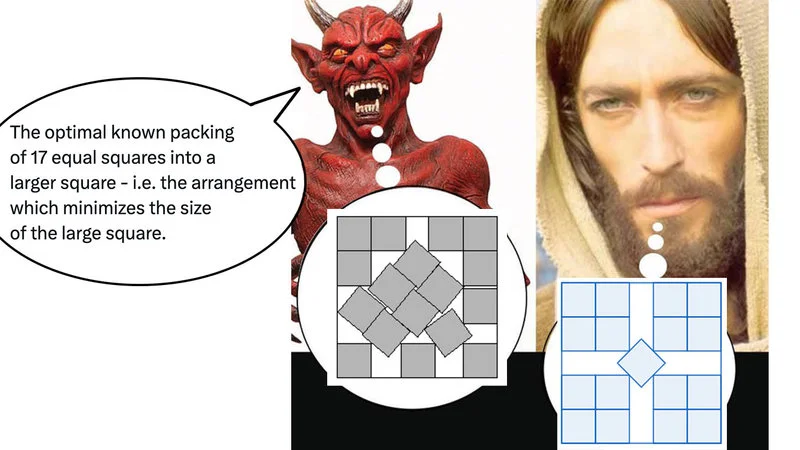
17 Squares In A Larger Square

2021Math joke / image memesemi-active

Also known as: Optimal Packing of 17 Equal Squares Into Larger Square

17 Squares In A Larger Square is a math meme based on the optimal known packing of 17 equal squares into a larger square, a configuration so asymmetric and ugly that it struck internet users as almost offensive. The image first gained traction on Twitter in December 2021 before going properly viral in February 2023, sparking jokes about God's design choices and the inherent chaos lurking beneath mathematics.

Overview

The meme centers on a single diagram showing the most compact known arrangement for fitting 17 unit squares inside a larger square. Unlike the tidy 4×4 grid that solves the 16-square version, the 17-square solution looks like a jigsaw puzzle gone wrong. One square sits at a tilted angle, breaking all symmetry, and the whole configuration feels deeply unsettling despite being mathematically correct1. The joke writes itself: how could the universe's underlying math produce something this ugly?

What makes it especially funny is the contrast with neighboring solutions. The packings for 16 and 18 squares both look clean and orderly. Seventeen sits right between them like a cursed middle child2.

The mathematical problem of square packing, finding the smallest possible square that can contain N unit squares, has been studied since the late 20th century. Mathematician John Bidwell published a key result in 1998, arriving at the jarring 17-square arrangement that would later become a meme1.

The image first entered internet consciousness on December 10, 2021, when Twitter user @KangarooPhysics posted a thread about "The best known packings of N equal circles into a square and a circle." The initial tweet picked up over 1,000 likes within a year2. The sixth tweet in the thread specifically highlighted the 17-square packing, with @KangarooPhysics writing, "Seeing that this is the best way we know to fit this many equal squares inside a square makes me feel a bit better about struggling to fit the plates in the dishwasher!" That post pulled in over 2,700 likes2.

Origin & Background

Platform
Twitter
Key People
@KangarooPhysics, John Bidwell
Date
2021

The mathematical problem of square packing, finding the smallest possible square that can contain N unit squares, has been studied since the late 20th century. Mathematician John Bidwell published a key result in 1998, arriving at the jarring 17-square arrangement that would later become a meme1.

The image first entered internet consciousness on December 10, 2021, when Twitter user @KangarooPhysics posted a thread about "The best known packings of N equal circles into a square and a circle." The initial tweet picked up over 1,000 likes within a year2. The sixth tweet in the thread specifically highlighted the 17-square packing, with @KangarooPhysics writing, "Seeing that this is the best way we know to fit this many equal squares inside a square makes me feel a bit better about struggling to fit the plates in the dishwasher!" That post pulled in over 2,700 likes2.

How It Spread

Reactions came fast. On December 11, 2021, @eigenrobot quote-tweeted the image with "vaguely offensive act by God if this holds up," collecting over 700 likes2. The next day, @arborelia posted what became one of the most-quoted responses: "you can feel the results of this problem in your soul. You look at the optimal packing of 28 squares in a square and say, oh that's nice, what an ingenious and satisfying solution / and then you see 17 squares and you're like, how could a caring god do this to their universe." That tweet earned over 2,800 likes2.

The meme's biggest moment came on February 14, 2023, when @KangarooPhysics reposted the diagram at higher resolution, describing it as "the arrangement which minimises the size of the large square." This repost blew up to over 35,000 likes in under a week2. The accompanying thread also noted that symmetric arrangements for 17 squares do exist, but they're not as compact as the cursed asymmetric solution2.

Around the same time, Twitter user @TetraspaceWest described the arrangement as a "platonic structure of mathematics visible in all possible worlds," a phrase that inspired a Medium article by Alexander Supertramp exploring the mathematical and philosophical implications1.

How to Use This Meme

The 17-square packing meme typically works in a few ways:

- Existential math horror: Post the diagram alongside reactions expressing discomfort, cosmic dread, or comedic outrage at the universe's design. - Comparison format: Show the clean 16-square grid next to the chaotic 17-square packing to highlight the contrast. - God's design joke: Frame the asymmetry as evidence of divine laziness, malice, or a glitch in reality. - Relatable analogy: Compare the packing to everyday frustrations like loading a dishwasher, fitting luggage in a trunk, or organizing furniture in a small room.

The meme works best when it leans into the gap between mathematical perfection and aesthetic ugliness. The humor comes from the fact that this isn't wrong or sloppy. It's the *best* solution, and it still looks like a mistake.

Cultural Impact

The 17-square packing became a go-to example in online math communities of how mathematical truth can feel intuitively wrong. It sparked broader conversations about asymmetry in mathematics and whether humans are biased toward expecting beauty in optimal solutions1. The Medium article noted that "even systems governed by chaotic dynamics typically exhibit more discernible patterns than this arrangement," placing it in a rare category of mathematical results that are correct but deeply uncomfortable1.

The meme also tapped into a wider genre of "unsettling math" content that performs well on Twitter, where users enjoy sharing counterintuitive results as a form of intellectual comedy.

Fun Facts

No one has proven that Bidwell's 1998 arrangement is actually the optimal solution for 17 squares. It's just the best one anyone has found so far1.

The packings for 16 squares (4×4 grid) and 25 squares (5×5 grid) are trivially obvious, making 17's chaos feel even more jarring2.

@KangarooPhysics also noted that symmetric arrangements for 17 squares exist but are less space-efficient than the tilted version2.

The Medium article's author credited @TetraspaceWest's tweet as the spark that led them to research the problem1.

Frequently Asked Questions