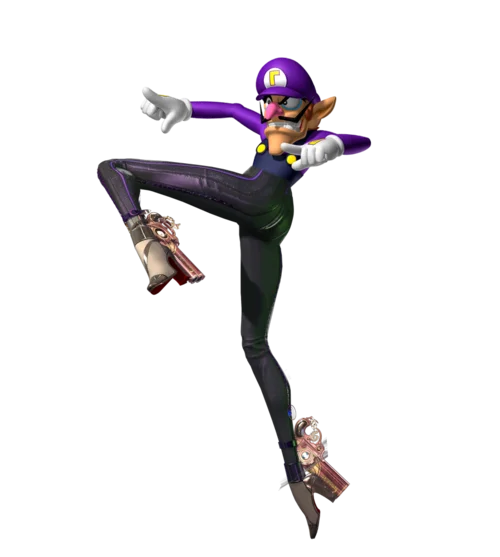
Bayonetta
Published August 16, 2026
Bayonetta is the titular gun-wielding witch of PlatinumGames' third-person action series, launched in 2009 and directed by Hideki Kamiya. The character crossed from a Devil May Cry-style action game into Nintendo's Super Smash Bros roster and later became the center of a 2022 pay dispute involving her original English voice actor.
Overview
Bayonetta is the titular witch of PlatinumGames' third-person action series that launched in 2009, set in the fictional European city of Vigrid where she fights angels and demons with a handgun strapped to each of her four limbs4. She summons giant Infernal Demons out of her ankle-length black hair, which doubles as her clothing and unravels off her body whenever she casts her strongest attacks1.
The look combines glasses, a beehive hairdo, and a bodysuit woven from that hair, all built around director Hideki Kamiya's brief for a modern witch with four guns1. Character designer Mari Shimazaki stretched the character's limbs beyond typical female game-character proportions so she'd read as an action lead, and gave the whole cast a shared "fashionable" aesthetic with intentionally subdued ornamentation2. Kamiya built the game as a second stylish action title after his work on Devil May Cry, and Bayonetta drops references to that earlier work throughout its runtime.
Gallery
Origin & Background
How It Spread
How to Use This Meme
Bayonetta gets used online as a shorthand for a specific kind of over-the-top, hyper-stylized action heroine, and often shows up in gaming discussions about character design, difficulty curves in the character-action genre, and PlatinumGames' back catalog. Urban Dictionary entries treat the name as a compliment for someone who dresses sharply, carries themselves with confidence, and gets what they want5. Fan communities also use the character in cosplay, fanart, and pinup-style illustration, with the beehive-plus-glasses silhouette being the easiest visual shorthand.
Cultural Impact
Fun Facts
Shimazaki spent roughly a full year iterating on Bayonetta's design before locking it in1.
Bayonetta's hair works as her outfit and as the summoning material for her Infernal Demons, so the outfit unravels when she uses her strongest attacks1.
Rival witch Jeanne's red palette was chosen specifically to mirror Bayonetta's black2.
Kamiya marked the Bayonetta 3 reveal at The Game Awards 2017 by posting a photo of a biscuit shaped like the new logo3.
Bayonetta 1 and 2 launched together on Switch on February 16, 2018, with the original bundled as a download code inside physical copies of the sequel3.
Derivatives & Variations
Bayonetta 2 (2014) - Wii U sequel published by Nintendo, later ported to Switch[4]
Bayonetta 3 (2022) - Switch exclusive with Jennifer Hale voicing the lead instead of Hellena Taylor[3]
Super Smash Bros 4 fighter appearance - Bayonetta was added as a playable character on Nintendo hardware[4]
Bayonetta Origins: Cereza and the Lost Demon - spin-off centered on the character's younger self, part of the Nintendo-published series[3]
Frequently Asked Questions
References (5)
- 1
- 2
- 3
- 4
- 5