Cookie Banner Meme

2018Image macro / screenshot humor / exploitable templateactive

Published March 10, 2026 · Updated March 23, 2026

Also known as: Cookie Consent Meme · GDPR Meme · Accept Cookies Meme · Cookie Pop-Up Meme

The Cookie Banner Meme refers to a broad category of internet humor mocking the cookie consent pop-ups that flooded websites after the European Union's General Data Protection Regulation (GDPR) took effect on May 25, 2018. The memes target the annoying, often manipulative design of these banners, where the "Accept All" button is large and colorful while the "Reject" or "Manage Preferences" option is buried, tiny, or requires fifteen extra clicks.

Overview

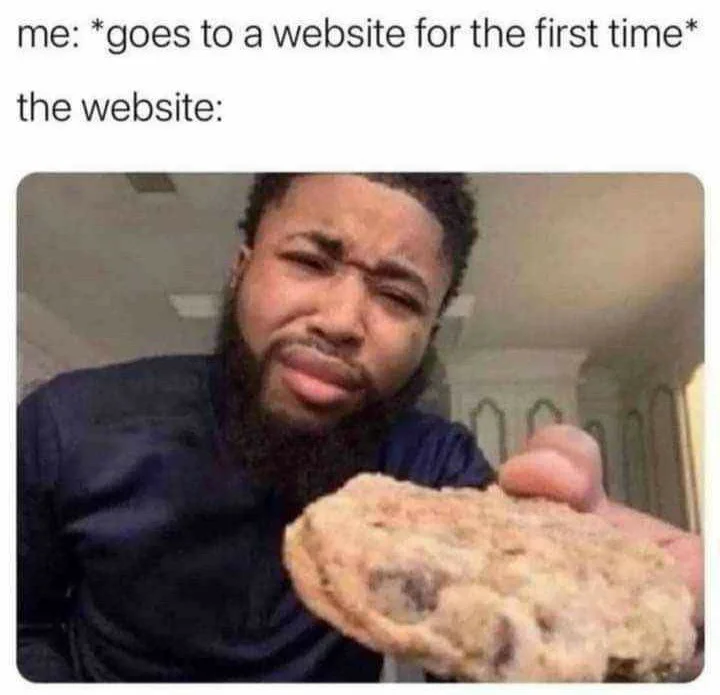
Cookie banner memes revolve around the cookie consent notices that websites display to comply with EU privacy regulations. The humor comes from the gap between the stated purpose of these banners (protecting user privacy) and the reality of their implementation (dark patterns designed to trick users into clicking "Accept All"). Common formats include screenshots of particularly absurd cookie banners, side-by-side comparisons of the massive "Accept" button versus the microscopic "Reject" link, and reaction images about mindlessly clicking "Accept All Cookies" on every site without reading a single word1.

The memes also target the sheer volume of these pop-ups. Visiting any website in the post-GDPR era means being greeted by a cookie banner before seeing actual content, and the memes capture the collective frustration of clicking through consent dialogs dozens of times a day.

Cookie consent requirements existed before 2018 under the EU's ePrivacy Directive (2009), but enforcement was lax and most websites ignored them. When GDPR went into effect on May 25, 2018, with potential fines of up to 4% of a company's global revenue, websites worldwide scrambled to add cookie consent mechanisms. Almost overnight, cookie banners appeared on virtually every major website, and the memes followed within weeks.

Early cookie banner memes appeared on Reddit (particularly r/assholedesign, r/mildlyinfuriating, and r/ProgrammerHumor) and Twitter throughout the summer of 2018. Users began screenshotting the worst cookie banners they encountered, highlighting dark pattern designs where "Accept" was a bright green button and "Decline" was gray text hidden in a corner.

Origin & Background

Platform
Reddit, Twitter (viral spread)
Creator
Unknown
Date
2018

Cookie consent requirements existed before 2018 under the EU's ePrivacy Directive (2009), but enforcement was lax and most websites ignored them. When GDPR went into effect on May 25, 2018, with potential fines of up to 4% of a company's global revenue, websites worldwide scrambled to add cookie consent mechanisms. Almost overnight, cookie banners appeared on virtually every major website, and the memes followed within weeks.

Early cookie banner memes appeared on Reddit (particularly r/assholedesign, r/mildlyinfuriating, and r/ProgrammerHumor) and Twitter throughout the summer of 2018. Users began screenshotting the worst cookie banners they encountered, highlighting dark pattern designs where "Accept" was a bright green button and "Decline" was gray text hidden in a corner.

How It Spread

The first wave of cookie banner memes in mid-2018 focused on the sudden flood of pop-ups appearing everywhere. Subreddits like r/assholedesign became a hub for screenshots of particularly manipulative consent interfaces. By late 2018, the format had expanded beyond screenshots into traditional meme templates. The Drake Hotline Bling format was commonly used to show "Reading the cookie policy" (rejected) versus "Clicking Accept All immediately" (approved).

In 2019 and 2020, cookie banner memes evolved alongside increasingly aggressive consent designs. The "cookie wall" (blocking all content until consent is given) and the multi-layered settings panel became new targets. The COVID-19 pandemic and increased time online in 2020 only amplified the frustration, producing a second wave of memes about the absurdity of being asked about cookies while trying to read critical health information.

By 2021-2022, the memes had become a staple of tech humor and UX design communities. The browser extension "I don't care about cookies" (which auto-dismisses cookie banners) itself became a meme, with users joking about it being the most essential software on their computers. When Avast acquired the extension in 2022, the irony of a data company buying a privacy tool spawned its own round of memes.

The format saw renewed energy in 2024 when the EU's Digital Markets Act introduced additional consent requirements, and cookie banners grew even more complex. The memes are a recurring fixture of internet life in any region affected by privacy regulation1.

Platforms

TwitterTwitter

Timeline

2023-01-15

First appears

2024-01-01

Cookie Banner Meme started spreading across social media platforms

2025-01-01

Cookie Banner Meme is still actively used and shared across platforms

View on Google Trends

How to Use This Meme

Cookie banner memes typically follow a few common formats:

1

Screenshot + commentary: Find or screenshot a particularly bad cookie consent banner (bonus points for dark patterns) and post it with a caption expressing frustration or disbelief.

2

Template adaptation: Apply an existing meme template (Distracted Boyfriend, Drake, Expanding Brain) to the theme of cookie consent. The punchline usually involves choosing the lazy option ("Accept All") over the responsible one ("Customize Settings").

3

Parody banners: Create a fake, exaggerated cookie consent pop-up that satirizes real ones. Common gags include banners that cover the entire screen, "Reject All" buttons that open ten more sub-menus, or consent dialogs that guilt-trip the user.

4

Real vs. expected: Compare what cookie banners claim to do (protect your privacy) with what they actually do (annoy you into surrendering your data).

Create Your Own

Cultural Impact

Cookie banner memes crossed over from internet humor into mainstream UX design discourse. Designers and privacy advocates use them to illustrate the concept of "dark patterns," where user interfaces are deliberately designed to manipulate behavior. The Norwegian Consumer Council's 2018 report "Deceived by Design" cited many of the same issues the memes highlighted, and the report itself was widely shared in meme-adjacent tech communities.

The memes also influenced actual regulation. The French data protection authority CNIL ruled in 2020 that cookie walls (blocking content until consent is given) were generally not valid consent, a decision that echoed complaints common in meme form for years. Several EU member state regulators have since fined companies for cookie consent designs that the meme community had been mocking since 2018.

Tech companies started acknowledging the meme. Google's "Reject All" button addition to cookie banners across its services in 2022 was widely seen as a response to both regulatory pressure and public ridicule. The change was celebrated and memed in equal measure.

Fun Facts

The average internet user encounters an estimated 1,000+ cookie consent banners per month if they browse without an ad blocker or consent auto-dismisser.

Some cookie consent pop-ups contain more text than the actual webpage content behind them.

The "I don't care about cookies" browser extension had over 500,000 users before Avast acquired it in 2022, proving that the frustration behind the memes was very real.

California's CCPA (2020) and Brazil's LGPD (2020) expanded cookie banner requirements beyond the EU, giving global meme creators fresh material from their own countries' implementations.

Some websites display cookie banners to users in countries with no cookie consent laws, a fact that became its own meme format about corporate overreaction.

Derivatives & Variations

"I Don't Care About Cookies" memes:

Jokes about the popular browser extension that auto-accepts or hides cookie banners, treating it as essential survival software for browsing the modern web.

Dark pattern bingo:

User-created bingo cards listing common manipulative design elements in cookie banners, shared across design and tech subreddits[1].

Cookie banner speedrun:

Satirical videos timing how long it takes to actually reject all cookies on a website with a particularly complex consent interface.

GDPR anniversary memes:

Annual posts on May 25 "celebrating" the anniversary of GDPR by posting the worst cookie banners encountered that year[1].

Consent fatigue memes:

A broader category joking about clicking "agree" to everything (terms of service, app permissions, cookie banners) without reading any of it.

Frequently Asked Questions

References (1)

  1. 1