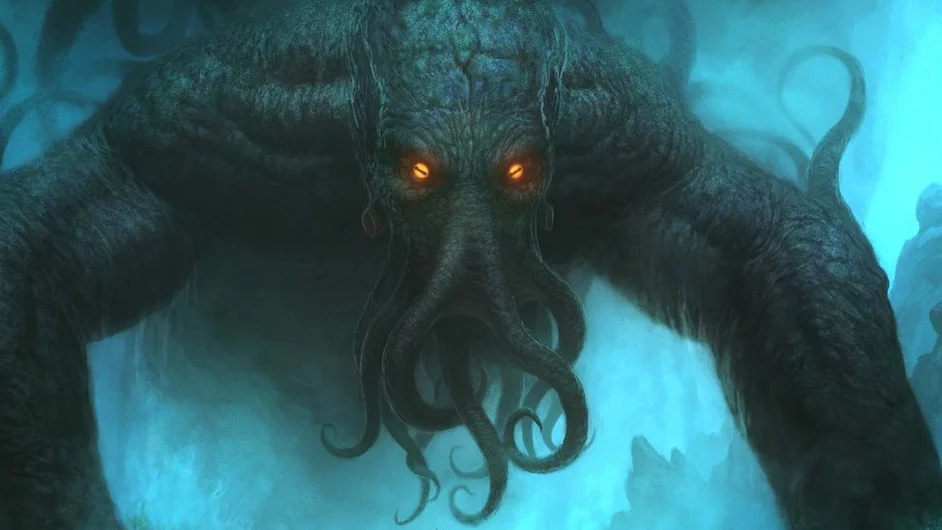
Cthulhu
Published August 17, 2026
Cthulhu is a fictional cosmic monster invented by horror writer H.P. Lovecraft, first appearing in his 1928 short story 'The Call of Cthulhu.' The tentacle-faced sea entity became a go-to internet reference for cosmic horror, spawning Dr. Seuss-style parodies, a cryptocurrency called Offerings, and years of fan art across Tumblr, deviantArt, and Reddit.
Overview
Cthulhu is a fictional monster invented by American pulp horror writer H.P. Lovecraft, usually drawn as a huge cephalopod-like being with a tentacled face, clawed hands, long narrow wings folded behind a bloated corpulent body, and slick scaly skin1. The name is supposed to be unpronounceable by human tongues, and Lovecraft never settled on a canonical pronunciation, though fans commonly use 'KAH-THOO-LOO' or 'CHA-THOO-LAH' in casual conversation6.
In the fictional mythology, Cthulhu is a hybrid of 'an octopus, a dragon, and a human caricature,' locked in a death-like sleep inside R'lyeh, a sunken city with non-Euclidean architecture generally placed near Valparaiso in the Pacific Ocean6. His status of 'dead but dreaming' is one of the most-quoted bits of the mythos, along with the ritual chant 'ph'nglui mglw'nafh Cthulhu R'lyeh wgah'nagl fhtagn,' translated as 'in his house at R'lyeh sleeping Cthulhu waits dreaming'5. Cthulhu ended up as the recognizable face of internet cosmic horror despite being a fairly minor character in Lovecraft's own writing, where he mostly worked as a vague plot device.
Gallery
Origin & Background
How It Spread
How to Use This Meme
Cthulhu is generally used as a shorthand for cosmic dread, inhuman scale, or things too weird to describe. Fans typically draw Cthulhu in his classic tentacle-face silhouette, drop the phrase 'ph'nglui mglw'nafh Cthulhu R'lyeh wgah'nagl fhtagn' as an ominous flourish, or splice the character into unrelated formats like LOLcat macros, Dr. Seuss picture books, cryptocurrency branding, and reaction images about impending doom5. The visual is common enough that even a rough silhouette of a tentacled head with wings is enough to signal 'Lovecraftian.'
Frequently Asked Questions
References (6)
- 1
- 2
- 3
- 4
- 5
- 6