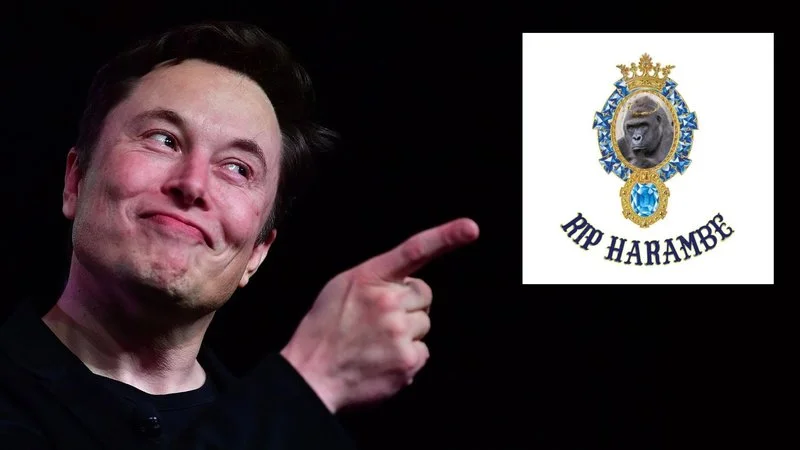
Elon Musks Rip Harambe

2019Novelty song / SoundCloud releasedead
Elon Musk's RIP Harambe is an Auto-Tuned SoundCloud rap song released March 30, 2019, paying tribute to the Cincinnati Zoo gorilla while embodying Musk's online troll persona.

"RIP Harambe" is a rap song released by Elon Musk on SoundCloud on March 30, 2019, under the fictional label Emo G Records. The Auto-Tuned track pays tribute to Harambe, the gorilla shot at the Cincinnati Zoo in 2016, and racked up over 910,000 streams in its first two days3. The song blended Musk's growing reputation as an online troll with the already-undead Harambe meme, producing a brief but chaotic moment of internet culture.

Overview

"RIP Harambe" is a two-minute, Auto-Tuned rap track uploaded to SoundCloud by Elon Musk under a fake record label called Emo G Records1. The song features bouncy production and lyrics mourning Harambe, the Western lowland gorilla who became one of the internet's most persistent memes after being killed at the Cincinnati Zoo in May 20162. The name "Emo G" is a play on "emoji," a callback to a joke Musk had made on Twitter earlier that same weekend1.

On March 30, 2019, Musk uploaded "RIP Harambe" to a SoundCloud page under the Emo G Records name3. He promoted the track between tweets about the Tesla Semi, calling it "This might be my finest work"1. At the same time, he changed his Twitter display name to "Jung Musk"2. When the label predictably didn't chart, Musk deadpanned: "I'm disappointed that my record label failed"4.

The track was not actually performed by Musk himself. Tweets from Musk and musician-producer BloodPop on March 31 indicated that BloodPop produced the song, while emoji artist Yung Jake performed the vocals and Caroline Polachek co-wrote it3.

Origin & Background

Platform
SoundCloud, Twitter
Key People
Yung Jake, BloodPop, Caroline Polachek, Elon Musk
Date
2019

On March 30, 2019, Musk uploaded "RIP Harambe" to a SoundCloud page under the Emo G Records name3. He promoted the track between tweets about the Tesla Semi, calling it "This might be my finest work"1. At the same time, he changed his Twitter display name to "Jung Musk"2. When the label predictably didn't chart, Musk deadpanned: "I'm disappointed that my record label failed"4.

The track was not actually performed by Musk himself. Tweets from Musk and musician-producer BloodPop on March 31 indicated that BloodPop produced the song, while emoji artist Yung Jake performed the vocals and Caroline Polachek co-wrote it3.

How It Spread

The song spread quickly through Twitter, where reactions ranged from amused to baffled3. Within its first day online, the track had been streamed over 250,000 times on SoundCloud1. By the end of the weekend, that number had climbed past 480,0002, and within two days it crossed 910,000 streams3.

Several major outlets covered the release. Rolling Stone ran a piece headlined "Hear Elon Musk's Surprise Rap Song 'RIP Harambe'"1, while Salon syndicated the story4. The Hill, A.V. Club, and GQ also published articles about the track3. The coverage generally treated it as a curiosity from a billionaire CEO rather than a serious musical effort.

How to Use This Meme

This isn't a meme template in the traditional sense. People shared the song itself, quoted its lyrics ("RIP Harambe / Sipping on some Bombay / We on our way to heaven / Amen, Amen"), or referenced the fact that Elon Musk made a Harambe rap song as a punchline1. The typical use was sharing the SoundCloud link or screenshots of Musk's tweets promoting it, often paired with reactions expressing disbelief.

Cultural Impact

The song arrived nearly three years after Harambe's death and well past peak Harambe meme saturation. By 2019, the gorilla meme had largely been declared dead, which made Musk's tribute feel like a deliberate resurrection2. Some commentators framed it as a "zombie meme apocalypse," wondering if other retired 2016 memes like Crying Jordan would follow Harambe back from the grave2.

The release also fit into Musk's broader pattern of internet trolling and meme participation. He was already known for posting memes on Twitter, and the "Jung Musk" name change (a nod to K-pop naming conventions) added another layer of absurdity2. The Emo G Records label itself became a minor meme, with one Twitter user declaring "Duck emoji defeats Emo G Records. Crushing victory"2.

Fun Facts

The song's opening line is simply "Harambe, we love you"2.

Musk changed his Twitter name to "Jung Musk" the same weekend, leading to jokes about him joining a K-pop group2.

BloodPop, who produced the track, is best known for his work with Lady Gaga and Justin Bieber3.

Caroline Polachek, credited as co-writer, was the lead singer of indie pop band Chairlift before her solo career3.

One popular theory suggested that Yung Jake, known for his emoji-based portrait art, was also behind the Emo G Records artwork2.

Frequently Asked Questions