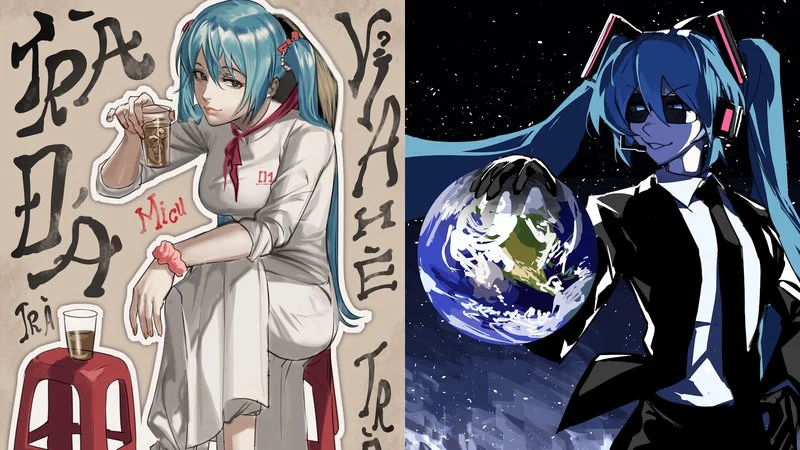
Every Countrys Miku Everything Miku

2024Fan art trend / character redesignsemi-active

Also known as: Everything Miku · Country Miku · National Miku

Every Country's Miku is a fan art trend where artists redesign the Vocaloid character Hatsune Miku to represent different nations, cultures, and concepts, dressing her in traditional clothing and surrounding her with cultural symbols. The trend exploded on X (formerly Twitter) in late August 2024, growing out of the earlier Brazilian Miku movement, and quickly expanded to cover dozens of countries, subcultures, and absurdist mashups like "Flubber Miku" and "Mikuchondria." A real-world twist hit when Brazil's government banned X on August 30, 2024, prompting artists worldwide to draw "the death of Brazilian Miku" in tribute before her triumphant return when the ban lifted in October.

Overview

Every Country's Miku follows a simple premise: take Hatsune Miku, the turquoise-twintailed Vocaloid mascot, and reimagine her as if she were from a specific country or culture. Artists typically dress Miku in traditional or nationally associated clothing, give her items linked to the country's identity, and adapt her color palette or hairstyle to match local aesthetics2. The trend sits in a long tradition of fans redesigning recognizable characters by region, similar to the Pokémon Variants meme where artists redrew Pokémon to fit different biomes or cultures1.

What set this trend apart was its sheer scale and speed. Within roughly one week of going viral, artists had produced versions for countries across every continent, and the concept quickly broke free of national boundaries entirely. Variant Mikus based on subcultures, crossover franchises, and pure absurdist comedy (Flubber Miku, Chainsaw Miku, Mikuchondria) flooded timelines alongside the country-themed ones1. Multiple fan-run archival websites sprang up to catalog the flood of artwork and help people find Mikus representing their own cultures1.

The roots of Every Country's Miku trace back to the Brazilian Miku art movement. On June 25, 2024, X user @ErinArtista posted an artwork reimagining Hatsune Miku as Brazilian2. The concept simmered for a few weeks before artist Doodly (@thecat_mitsu) posted their own Brazilian Miku artwork on August 17, 2024. That post blew up, pulling in over 2.9 million views, 24,000 reposts, and 161,000 likes on X within five days2.

Interestingly, an Argentine take on Miku actually predates the Brazilian version by a few days. On June 21, 2024, TikTok user tinatrash posted a compilation of Argentine Miku drawings2. But it was the Brazilian version that caught fire and set off the wider trend.

The jump from "Brazilian Miku" to "Every Country's Miku" happened on August 21, 2024, when artist @M3ruMeru posted the earliest known artwork depicting Miku as a national of a different country: Argentina. The post picked up over 3,000 reposts and 19,000 likes in five days2. From there, the floodgates opened.

Origin & Background

Platform
X / Twitter (viral spread), TikTok (early compilations)
Key People
@ErinArtista, Doodly / @thecat_mitsu, @M3ruMeru
Date
2024

The roots of Every Country's Miku trace back to the Brazilian Miku art movement. On June 25, 2024, X user @ErinArtista posted an artwork reimagining Hatsune Miku as Brazilian2. The concept simmered for a few weeks before artist Doodly (@thecat_mitsu) posted their own Brazilian Miku artwork on August 17, 2024. That post blew up, pulling in over 2.9 million views, 24,000 reposts, and 161,000 likes on X within five days2.

Interestingly, an Argentine take on Miku actually predates the Brazilian version by a few days. On June 21, 2024, TikTok user tinatrash posted a compilation of Argentine Miku drawings2. But it was the Brazilian version that caught fire and set off the wider trend.

The jump from "Brazilian Miku" to "Every Country's Miku" happened on August 21, 2024, when artist @M3ruMeru posted the earliest known artwork depicting Miku as a national of a different country: Argentina. The post picked up over 3,000 reposts and 19,000 likes in five days2. From there, the floodgates opened.

How It Spread

The trend ripped across X/Twitter in the final week of August 2024. On August 22, X user @elshovanni posted a Mexican Miku that hit over 400,000 views, 7,000 reposts, and 39,000 likes in four days2. Two days later, @Uirusu_chan's Vietnamese Miku pulled 11,000 reposts and 69,000 likes2. Artists from dozens of countries posted their own versions in rapid succession.

The Brazil-Argentina dynamic added a competitive edge to the trend. The historical soccer rivalry between the two nations carried over into the fan art, with Brazilian and Argentine Mikus often depicted as rivals when shown together2. But fans being fans, the two versions also got shipped as a romantic pair fairly often2.

On August 30, 2024, just days after the trend peaked, Brazil's government banned X/Twitter due to Elon Musk's refusal to comply with the country's laws1. Non-Brazilian fan artists responded by drawing fanart depicting the "death" of Brazilian Miku, mourning the loss of the Brazilian artists who had sparked the entire movement1. When the ban was lifted in October 2024, fans drew Miku being resurrected, and the trend saw a second wave of activity1.

Beyond country variants, the trend spilled into broader territory. Artists produced Mikus based on subcultures, fictional crossovers, and joke concepts. Flubber Miku, Mikuchondria (a biology pun), and Chainsaw Miku all gained traction as the "Everything Miku" side of the trend grew alongside the national versions1.

The trend also sparked discourse. Some users argued that an "American Miku" was impossible because America "has no culture." Others pushed back hard, pointing to Black American NYC Miku designs as evidence of deep cultural identity. As one fan wrote: "It's such a self report that you see the American hegemony, the American monolith, as a singularly white entity that's worthy of scorn. I want that person to look at the Black American NYC Miku design and tell me with their full chest that that isn't culture"1. Largely separate from that argument, artists quietly produced hundreds of Mikus representing different regions, cities, and communities across the United States1.

How to Use This Meme

Creating a Country Miku (or "Everything Miku") follows a loose formula:

1

Pick a country, culture, or concept. This can be a nation, a U.S. state, a subculture, a scientific concept, or anything else.

2

Redesign Miku's outfit. Dress her in traditional clothing, uniforms, or items associated with the chosen subject. A Mexican Miku might wear a traditional dress, while a Vietnamese Miku might wear an áo dài.

3

Add cultural props and symbols. Give Miku objects, food, animals, or instruments tied to the culture. The more specific and recognizable, the better.

4

Adjust the aesthetic. Some artists keep Miku's signature turquoise hair and twintails, while others adapt her color scheme to match a national flag or cultural palette.

5

Post with the trend. Artists typically tag their work with relevant country and Miku-related hashtags on X or TikTok.

Cultural Impact

Every Country's Miku became one of the largest collaborative fan art events of 2024. The sheer volume of artwork produced in a single week pushed multiple fan groups to create archival websites specifically to catalog and preserve the art1. These sites helped users discover Mikus for cultures that might otherwise be underrepresented in mainstream fan art.

The trend also became an unexpected case study in how platform bans affect online communities. When Brazil's X ban hit on August 30, the mourning art for Brazilian Miku turned a corporate regulatory dispute into an emotional fan art moment1. The "death and resurrection" arc of Brazilian Miku gave the trend a narrative structure that most fan art movements lack.

The discourse around American Miku opened broader conversations about cultural identity and representation in fan communities, particularly around whether American culture is monolithic or contains multitudes of distinct regional and racial identities1.

Fun Facts

The Argentine Miku TikTok compilation by tinatrash (June 21, 2024) actually predates the earliest known Brazilian Miku artwork (June 25, 2024) by four days, but the Brazilian version went viral first2.

Doodly's viral Brazilian Miku post on August 17 hit 2.9 million views in just five days, making it one of the fastest-growing fan art posts of 20242.

The trend shares DNA with the Pokémon Variants meme, where artists redesign Pokémon to fit different ecosystems1.

Fans created entire archival websites to document the flood of Miku variants, treating the trend as a cultural preservation project1.

The "death and resurrection" of Brazilian Miku, driven by Brazil's X ban and subsequent unbanning, gave the trend a narrative arc that most fan art movements never get1.

Derivatives & Variations

Brazilian Miku

— The original variant that launched the entire trend, depicting Miku in Brazilian cultural attire and settings[2].

Argentine Miku

— One of the most popular variants, often depicted as a rival to Brazilian Miku due to the countries' soccer rivalry, and also frequently shipped with her[2].

"Death of Brazilian Miku" art

— Fan art mourning the departure of Brazilian artists after Brazil's X ban on August 30, 2024[1].

"Resurrected" Brazilian Miku

— Art celebrating the return of Brazilian users after the October 2024 ban lift[1].

Concept Mikus

— Non-country variants like Flubber Miku, Mikuchondria, and Chainsaw Miku, expanding the trend beyond national identity[1].

Ancient creature Mikus

— Prehistoric and extinct animal-themed Miku designs, extending the concept into "prehistorical" territory[1].

Regional U.S. Mikus

— Hundreds of designs representing specific American cities, states, and cultural communities, including a notable Black American NYC Miku[1].

Frequently Asked Questions