Fidget Spinners
Published August 20, 2026
Fidget spinners are three-pronged handheld toys with a central ball bearing that lets them spin on a fingertip, sold as both a desk gadget and a focus aid for ADHD and autism. The toy exploded across YouTube, Reddit, and school yards in spring 2017, then folded into meme culture through image macros pairing spinners with jokes about autism and obsessive kid behavior.
Overview
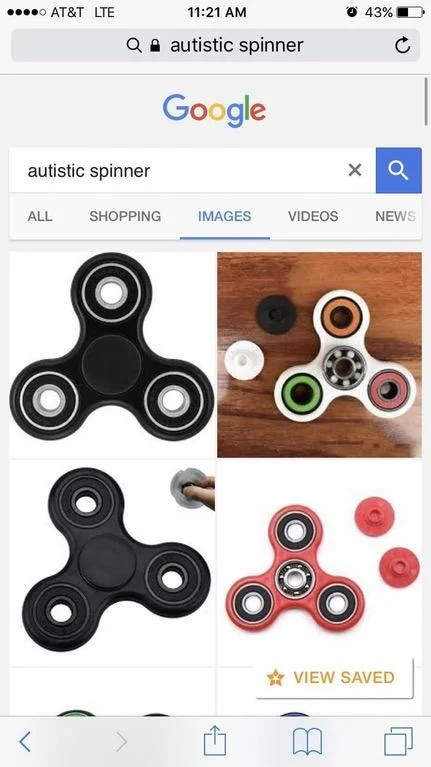
Fidget spinners are three-pronged handheld toys built around a central ball bearing that lets them spin freely on a fingertip2. The basic design pairs a stainless steel or ceramic bearing with three weighted lobes cut from plastic, brass, copper, or other metals, and a user can pinch the middle and flick one arm to send the outer body rotating for anywhere from thirty seconds to several minutes depending on bearing quality2.
By early 2017 the toys were being pitched two ways at once: as an office fidget for adults with restless hands, and as a focus aid for kids with ADD, ADHD, or autism1. Both angles drove sales, and the design's open patent status meant hundreds of cheap knock-offs flooded Amazon and gas-station counters within months of the trend hitting mainstream press3. Meme communities picked up the toy in parallel, turning it into shorthand for obsessive kid behavior and, briefly, for a fake white supremacy panic that made national headlines5.
Gallery
Origin & Background
How It Spread
How to Use This Meme
A basic spinner is pinched between thumb and finger at the center bearing, then flicked with the other hand to send the arms rotating2. Skilled users balance the spinner on a single fingertip, transfer it between fingers, or perform mid-air tosses captured for YouTube trick compilations2. Meme use is separate from actual spinning: image macros typically pair a photo of a spinner with a joke about autism, ADHD, or obsessive kid behavior, and the format often relies on captions written in broken all-caps English that mimic children's forum posts7.
Cultural Impact
Fun Facts
Catherine Hettinger let her original spinning-toy patent lapse in the mid-2000s after declining to pay a renewal fee, so she saw none of the 2017 boom money6
The Fidget Cube Kickstarter finished as roughly the 9th most-funded project in the platform's history at the time it closed1
Brass Torqbar spinners started at $140 and anodized builds reached $250, closer to jewelry pricing than to a toy2
Fox29's April 2017 report quoted Learning Express owner Susan McCredie saying she could not keep spinners in stock in her Richboro and Newtown, Pennsylvania stores3
The fidget spinner white supremacy panic began with a single 4chan /pol/ post on May 14, 2017, and made national news the very next day5
Derivatives & Variations
Fidget Cube by Antsy Labs, the six-sided predecessor with buttons and switches that raised roughly $6.4 million on Kickstarter in October 2016[1]
Torqbar by MD Engineering, a CNC-milled metal spinner sold in brass, copper, and stainless steel from $140 to $250[2]
Rotablade Stubby by EME Tools, a heavier premium spinner marketed to office collectors alongside the Torqbar[1]
Custom swastika-shaped spinner built and posted by YouTuber Craynonymous on May 10, 2017, which fed the /pol/ white supremacy prank[4]
Frequently Asked Questions
References (8)
- 1
- 2
- 3
- 4
- 5
- 6
- 7
- 8