Forced Memes 2
Published March 31, 2026
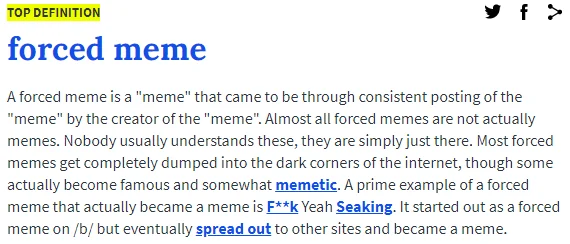
Forced memes are any memes artificially created and aggressively promoted rather than spreading organically through genuine community adoption5. The term emerged in mid-2000s imageboard culture, most notably on 4chan's /b/ board, where users would spam content in an attempt to manufacture viral status2. The concept became a meta-meme in its own right, spawning iconic responses like "Milhouse is not a meme" and sparking ongoing debate about whether any intentionally pushed content can ever become a "real" meme6.
Overview
A forced meme is any attempt to deliberately manufacture viral status for a phrase, image, or concept through repetition and coordinated promotion rather than letting it catch on naturally1. The term covers everything from a single user spamming their creation on /b/ to corporate marketing departments trying to engineer the next viral moment5.
The core tension behind forced memes is simple: internet culture prizes authenticity and organic discovery. People instinctively resist being told what to find funny1. Most forced memes die within hours. The rare exceptions that do break through often succeed for reasons their creators never intended, becoming funny precisely *because* they were forced6.
Gallery
Origin & Background
How It Spread
How to Use This Meme
"Forced meme" works primarily as a label and accusation in online discourse:
- Calling something out: When someone sees the same content being aggressively pushed across a platform, replying "forced meme" or "stop trying to force this" signals that the community hasn't organically adopted it. - Debating authenticity: Users often argue about whether a specific meme was forced or organic. The line is blurry. Something that starts as forced can become genuine if the community latches onto the *concept* of it being forced. - Self-aware forcing: Some users deliberately label their own content as a forced meme attempt, which can paradoxically help it succeed through ironic appreciation.
The key distinction people typically draw: an organic meme spreads because people find it funny. A forced meme spreads because someone keeps putting it in front of people until they either give in or push back1.
Cultural Impact
Fun Facts
Bud Light's "Wazzup" campaign from the early 2000s is often cited as a forced meme that actually worked, largely because the company let it die gracefully and become a nostalgic reference rather than pushing it forever1.
Encyclopedia Dramatica called "forced meme" an oxymoron, arguing that by definition, if something needs to be forced, it isn't really a meme2.
Pedro Pascal asked his Twitter fans to help make "Baby don't play. This is the way" a thing during *The Mandalorian* season 2 promotion. His fans eagerly agreed, making it one of the friendlier forced meme attempts1.
Burger King's "Whopper Whopper" jingle succeeded as a forced meme partly because "Whopper" sounded like a Pokémon name1.
Scott Adams, creator of *Dilbert*, admitted to several failed forced meme attempts including "porcelain cruise" (meaning a trip to the bathroom) and "Powerpoint Poisoning," yet accidentally created genuine memes like the Pointy-Haired Boss without trying1.
Derivatives & Variations
Milhouse is Not a Meme:
When users on 4chan's /b/ board tried to force Milhouse Van Houten as a meme in 2004-2005, other users fought back by spamming "Milhouse is not a meme." The rejection phrase became a meme while Milhouse himself did not, making it the most famous example of how forced memes can backfire[5].
Fuck Yeah Seaking:
Started as a forced meme on /b/ but actually broke through to genuine popularity across multiple sites. People acknowledge its forced origins, but that history faded as organic use took over[6].
X is Now a Meme:
A meta-format where someone declares something "is now a meme" as a transparent forcing attempt. Common on imageboards and forums as both sincere effort and ironic commentary[5].
Girugamesh:
A brief appearance of a gothic-dressed man in a 2009 Sakura-Con promotional video became an exploitable meme, though its forced promotional origins were always part of the joke[5].
Anti-memes:
Content created specifically to subvert or mock forced meme attempts. Cyle Gage's 2008 paper identified anti-memes as a direct counter-reaction to forced memes[5].
Frequently Asked Questions
References (9)
- 1Forced Meme - TV Tropesarticle
- 2
- 3
- 4Forced Memes - Know Your Memeencyclopedia
- 5Internet memeencyclopedia
- 6Forced Memes - Urban Dictionarydictionary
- 7Viral marketingencyclopedia
- 8Astroturfingencyclopedia
- 9Urban Dictionary: forced memedictionary