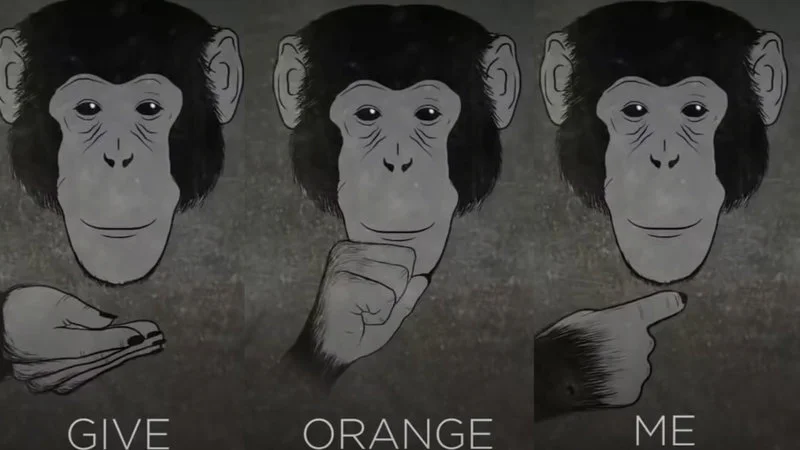
Give Orange Me Give Orange Me Give Eat Orange Me Eat Orange Give Me Eat Orange Give Me You

2017Catchphrase / audio memesemi-active

Also known as: Give Me Orange · Nim Chimpsky Quote

"Give Orange Me Give Eat Orange Me Eat Orange Give Me Eat Orange Give Me You" is a catchphrase meme based on the longest recorded sign language phrase produced by a non-human primate. The phrase was signed by Nim Chimpsky, a chimpanzee in a 1970s Columbia University language study, as an attempt to ask for food. The absurd, repetitive string of words went viral in 2020 after YouTube edits turned the phrase into a comedic punchline, and it later spread to TikTok as an ironic "deep quote" audio trend.

Overview

The meme centers on a famously garbled sign language phrase produced by Nim Chimpsky, a chimpanzee who was the subject of a controversial language acquisition study at Columbia University in the 1970s2. When Nim tried to ask for an orange, he signed what researchers recorded as "give orange me give eat orange me eat orange give me eat orange give me you." The phrase is recognized as the longest sentence ever communicated by a non-human animal1.

The humor comes from the sheer desperation and repetition of the request. Nim clearly wanted an orange and threw every combination of signs he knew at the problem. The phrase reads like someone mashing a keyboard with a single thought in mind, which made it perfect meme material.

Nim Chimpsky was born on November 19, 1973, at the Institute for Primate Studies in Norman, Oklahoma2. He was named as a pun on linguist Noam Chomsky, whose theory held that humans are biologically wired for language in a way animals are not2. Herbert S. Terrace, a psychology professor at Columbia University, led Project Nim to test whether a chimpanzee could learn American Sign Language well enough to challenge Chomsky's position2.

The project was troubled from the start. Nim was shuffled between roughly 60 different caregivers, most of whom were students or volunteers with little sign language proficiency2. Mary Wambaugh, a deaf woman fluent in ASL, joined the team three years in and raised concerns that Nim was being taught a pidgin version of the language rather than proper ASL2. Terrace eventually concluded that Nim was mimicking signs to get rewards rather than constructing meaningful sentences2.

The famous orange phrase came out of this study. On July 24, 2017, NPR's Skunk Bear published a YouTube segment titled "Can Apes Really 'Talk' To Humans?" which covered the history of primate language research1. The phrase appeared at the 5:00 mark of the video, and the segment picked up over 2.3 million views in six years1.

Origin & Background

Platform
YouTube (NPR's Skunk Bear segment), TikTok (audio trend)
Key People
NPR's Skunk Bear, Gabriel Landon, Nim Chimpsky
Date
2017 (viral spread), 1970s (original phrase)

Nim Chimpsky was born on November 19, 1973, at the Institute for Primate Studies in Norman, Oklahoma2. He was named as a pun on linguist Noam Chomsky, whose theory held that humans are biologically wired for language in a way animals are not2. Herbert S. Terrace, a psychology professor at Columbia University, led Project Nim to test whether a chimpanzee could learn American Sign Language well enough to challenge Chomsky's position2.

The project was troubled from the start. Nim was shuffled between roughly 60 different caregivers, most of whom were students or volunteers with little sign language proficiency2. Mary Wambaugh, a deaf woman fluent in ASL, joined the team three years in and raised concerns that Nim was being taught a pidgin version of the language rather than proper ASL2. Terrace eventually concluded that Nim was mimicking signs to get rewards rather than constructing meaningful sentences2.

The famous orange phrase came out of this study. On July 24, 2017, NPR's Skunk Bear published a YouTube segment titled "Can Apes Really 'Talk' To Humans?" which covered the history of primate language research1. The phrase appeared at the 5:00 mark of the video, and the segment picked up over 2.3 million views in six years1.

How It Spread

The phrase sat quietly in the NPR video for a few years before meme creators found it. On August 5, 2020, YouTube user Udge uploaded a DK Rap remix of the phrase, an early sign that people saw comedic potential in Nim's garbled request1. The video earned around 14,000 views in three years.

The real breakout came on September 22, 2020, when YouTube user Gabriel Landon uploaded an edit that took the original five-second clip and artificially stretched it to eighteen seconds by repeating the middle portion1. The loop made the already absurd phrase even more overwhelming, and the video racked up over 8.7 million views in three years1.

On TikTok, the phrase took on a second life as an ironic "deep quote" format. On June 28, 2022, TikTok user coffee_withcreamer posted a video with the setup that a chimpanzee quote could never make them cry, followed by the full Nim Chimpsky phrase appearing on screen while the creator pretended to weep1. This template spread across the platform, with users treating Nim's food request as though it were profound poetry.

How to Use This Meme

The meme works in two main formats:

The ironic deep quote: Set up any scenario where someone says a particular type of content could never make them emotional. Then reveal the "give orange me" phrase as the thing that broke them. The joke is the gap between how the phrase is presented (as something meaningful) and what it actually is (a chimp asking for fruit).

The extended loop edit: Take audio or text of the phrase and repeat or stretch it for comedic effect. The humor comes from the relentless, almost panicked repetition of the same few words rearranged in every possible order.

In both cases, the full phrase is typically included. Shortening it defeats the purpose, since the length and repetition are the joke.

Cultural Impact

The meme brought renewed attention to Project Nim and the broader debate over animal language studies. Nim Chimpsky's story was already the subject of Elizabeth Hess's 2008 biography *Nim Chimpsky: The Chimp Who Would Be Human* and James Marsh's 2011 documentary film *Project Nim*2. The meme introduced a younger internet audience to the ethical questions surrounding the study, including the revolving door of untrained caregivers, the use of cattle prods for discipline, and Nim's repeated separation from attachment figures2.

Terrace's conclusion that Nim was simply performing signs for food rather than engaging in real communication actually makes the meme funnier in context2. The phrase everyone finds so amusing was, to Terrace, evidence that the whole project had failed. Nim wasn't constructing a sentence. He was doing the sign language equivalent of hitting every button on a vending machine.

Fun Facts

Nim Chimpsky's name was a direct pun on Noam Chomsky, the very linguist whose theories the study aimed to disprove2.

The study involved about 60 different caregivers over its duration, and Terrace himself was romantically involved with at least two of them2.

Nim was born in Oklahoma but raised in a New York City brownstone where his caretaker breastfed him (despite having no milk) and smoked pot with him2.

Gabriel Landon's elongated edit of the phrase stretched a five-second clip into eighteen seconds and outperformed the original NPR video in views1.

Nim lived until March 10, 2000, spending his final years at the Black Beauty Ranch animal sanctuary in Texas2.

Frequently Asked Questions