I Can Has Cheezburger

2007Image macro / blog / catchphraseclassic

Also known as: ICHC · Cheezburger

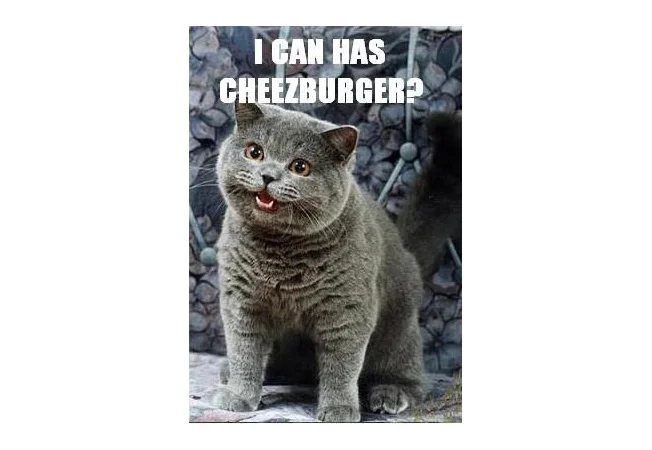
I Can Has Cheezburger (ICHC) is a blog-format website and internet meme that launched in January 2007, built around a single image of a smiling gray cat (known as Happycat) captioned with the grammatically mangled question "I can has cheezburger?"1. Created by Eric Nakagawa and Kari Unebasami, the site became one of the most important hubs for lolcat culture and animal-based image macros, pulling in up to 1.5 million daily hits at its peak1. ICHC didn't just popularize lolspeak and captioned cat photos. It proved that internet memes could be a real business, leading to a $2 million acquisition and an entire network of humor sites1.

Overview

I Can Has Cheezburger is both a specific image macro and the website that grew around it. The original image shows a round-faced, grinning British Shorthair cat (nicknamed Happycat) with the Impact-font caption "I CAN HAS CHEEZBURGER?" in the classic lolcat style3. The deliberately broken English, swapping grammar rules for cuteness, became the template for thousands of user-submitted animal photos with similar captions1.

The site ran on a simple formula: funny animal pictures plus lolspeak captions. Readers could submit their own creations using the site's built-in "LOL Builder" tool, and the best ones got posted to the front page3. At its height, ICHC was receiving 8,000 submissions per day, though only about a dozen made the cut3.

On January 11, 2007, Hawaiian blogger Eric Nakagawa posted an image he'd found on the comedy forum Something Awful3. The photo showed a chubby gray cat with a wide, almost pleading smile. Nakagawa slapped on the now-iconic caption "I can has cheezburger?" and uploaded it to a simple blog. Kari Unebasami helped co-create and develop the site alongside him3.

The image itself, featuring the cat that would become known as Happycat, had been floating around various corners of the internet before Nakagawa grabbed it. The lolspeak caption format, with its butchered grammar and phonetic spelling, was already a feature of image macros circulating on Something Awful and 4chan3. But Nakagawa's blog gave these scattered jokes a permanent home. He kept posting similar images and eventually converted the site into a monetized blog with regular updates3.

Origin & Background

Platform
Something Awful (source image), Blogger (website)
Key People
Eric Nakagawa, Kari Unebasami
Date
2007

On January 11, 2007, Hawaiian blogger Eric Nakagawa posted an image he'd found on the comedy forum Something Awful3. The photo showed a chubby gray cat with a wide, almost pleading smile. Nakagawa slapped on the now-iconic caption "I can has cheezburger?" and uploaded it to a simple blog. Kari Unebasami helped co-create and develop the site alongside him3.

The image itself, featuring the cat that would become known as Happycat, had been floating around various corners of the internet before Nakagawa grabbed it. The lolspeak caption format, with its butchered grammar and phonetic spelling, was already a feature of image macros circulating on Something Awful and 4chan3. But Nakagawa's blog gave these scattered jokes a permanent home. He kept posting similar images and eventually converted the site into a monetized blog with regular updates3.

How It Spread

ICHC took off fast. By May 2007, the site was pulling 1.5 million daily hits3. The timing was perfect: internet users were primed for silly cat content, and the barrier to participation was low. Anyone with a cat photo and a sense of humor could contribute.

In July 2007, the site was receiving around 500 submissions per day from readers3. By January 2008, that number had ballooned to 8,000 daily submissions, though only about twelve images per day actually made it onto the site3. Updates were strategically timed to match when readers were most likely to visit: mornings, lunch breaks, and evenings3. As of 2008, ICHC was pulling roughly 2 million page views daily3.

The financial validation came in September 2007, when a group of investors acquired the blog for $2 million3. Under the leadership of Ben Huh, ICHC became the flagship property of the Cheezburger Network, which eventually expanded to include FAIL Blog and Know Your Meme3. The acquisition proved that internet humor communities could generate real revenue, not just pageviews.

The site encouraged interactivity through a voting system where users rated images on a scale of one to five "cheezburgers"3. Running themes developed organically: Ceiling Cat (a white cat peering through a hole), Basement Cat (a black cat as the evil counterpart), the Lolrus and his "bukkit," "invisible" objects, "om nom nom" eating sounds, and "monorail kitteh"3. The site also popularized snowclone phrases like "I'm in your [noun], [verb]ing your [noun]" and "[activity], ur doin it right/wrong"3.

ICHC also ran a lolspeak wiki at SpeakLolSpeak.com until 2013, designed as a collection of important lolspeak phrases and translations3. The use of Impact font became so standardized across the site and its network that it defined the visual language of an entire generation of image macros3. This font choice traced back to Something Awful, where Impact was the default for image macros, and ICHC's LOL Builder tool kept it as the standard option3.

By 2016, the Cheezburger Network was acquired by Literally Media3. By 2017, the site had shifted away from user-generated content entirely, relying instead on a full editorial team to create original posts3.

Platforms

RedditTwitterTikTokInstagram

Timeline

2007

I Can Has Cheezburger first appears online

2007

Gains traction on social media

2008

Reaches peak popularity

2009-01-01

I Can Has Cheezburger reached mainstream popularity and media coverage

2010-01-01

Brands and companies started using I Can Has Cheezburger in marketing

2012-01-01

I Can Has Cheezburger entered the broader pop culture conversation

2025-01-01

I Can Has Cheezburger is still actively used and shared across platforms

View on Google Trends

How to Use This Meme

The classic ICHC format is straightforward:

1

Find a photo of a cat (or other animal) in a funny, expressive, or awkward pose

2

Write a caption in lolspeak: swap "have" for "has," "the" for "teh," add extra letters, and use phonetic spelling ("cheezburger" instead of "cheeseburger")

3

Set the text in Impact font, white with a black outline, typically split between the top and bottom of the image

4

Common caption structures include asking for something ("I can has [thing]?"), declaring ownership ("I has a [thing]"), or commenting on an activity ("[thing], ur doin it wrong")

Create Your Own

Cultural Impact

ICHC was one of the first internet properties to prove that memes could be monetized at scale. The $2 million acquisition in 2007 sent a clear signal to investors that online humor communities had real financial value3.

The Cheezburger Network expanded into television with LOLwork, a reality show on Bravo that followed Ben Huh and his staff as they created content for the site3. The show gave mainstream audiences a look at the weird business of professional meme curation.

ICHC produced two books: *I Can Has Cheezburger?: A LOLcat Colleckshun* in 2008 and *How To Take Over The Wurld: An LOLcat Guide 2 Winning* in 20093. FAIL Blog also released *Fail Nation: A Visual Romp Through the World of Epic Fails* in October 20093.

The site's influence on internet language was significant. Lolspeak phrases like "oh hai," "kthxbai," and "om nom nom" spread well beyond the ICHC community3. The academic world even got in on it: the hashtag #ICanHazPDF, derived directly from the site's name, became a tool researchers used on Twitter to request free copies of paywalled academic papers3.

The related meme "I has a shuvel" (lolspeak for "I have a shovel") followed a similar trajectory through early meme culture. The image first appeared on YTMND in March 2006, was posted on eBaum's World Forums in July 2006, and made its way to ICHC by January 20072. It shared the same "I has a [thing]" grammatical structure that defined lolspeak humor2.

Fun Facts

The original Happycat image came from Something Awful, not from Nakagawa's own cat3.

At its peak, ICHC rejected over 99% of daily submissions, posting only about 12 out of 8,0003.

The Impact font became the standard for lolcat images because it was the default choice in Something Awful image macros, and ICHC's LOL Builder kept the tradition going3.

ICHC ran a dedicated lolspeak dictionary wiki at SpeakLolSpeak.com for six years before shutting it down in 20133.

The site's name is technically a grammatically incorrect question: the "correct" lolspeak would arguably be "I can haz cheezburger?" but the "has" spelling stuck1.

Derivatives & Variations

Ceiling Cat / Basement Cat

— A white cat peeking through a ceiling hole became "Ceiling Cat" (an omniscient watcher), while a black cat took on the role of "Basement Cat" as its evil counterpart[3].

Lolrus and his Bukkit

— A walrus (lolrus) declaring ownership of a bucket ("I has a bukkit") became one of the site's most enduring recurring characters[3].

FAIL Blog

— Spun off from the ICHC community's use of "fail" as a reaction, FAIL Blog became its own major site within the Cheezburger Network[3].

I Has A Hotdog

— A spinoff site dedicated to loldogs, using the same captioned-animal format but focused on dogs[1].

#ICanHazPDF

— Academics on Twitter adapted the ICHC catchphrase into a hashtag system for requesting free copies of paywalled research papers[3].

"I has a shuvel"

— An image macro using the same lolspeak grammar structure, originating from a Muppet Babies book illustration and spreading through 4chan and YTMND before appearing on ICHC[2].

Memebase

— Another Cheezburger Network site that expanded beyond animals into general meme content[3].

Frequently Asked Questions