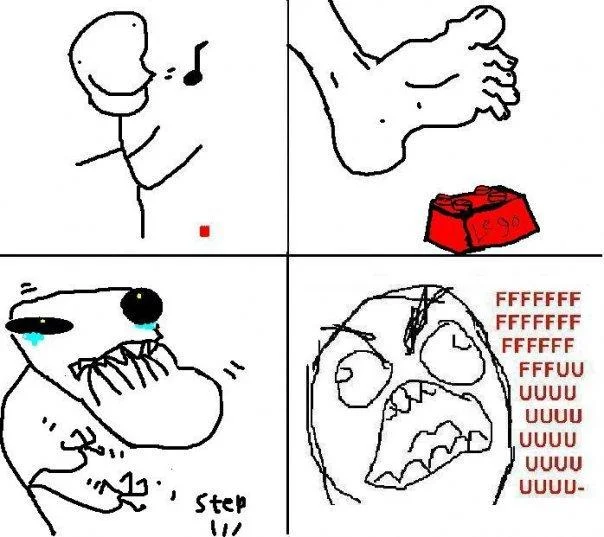
I Hope You Step on a LEGO
Published August 29, 2026
"I Hope You Step on a LEGO" is the internet's go-to petty curse for wishing minor but exquisite suffering on someone you dislike. The phrase surfaced in rage comics on 4chan around late 2009, then broke out on Tumblr in February 2011 when blogger suriikufu's screenshot pulled more than 60,000 notes, kicking off years of rage-comic reaction images and fan pages.
Overview
The joke works because anyone who has ever owned or lived near LEGO bricks knows the particular agony of a bare foot meeting a corner-first plastic stud1. Rather than wishing death or damnation, users deploy the line as an oddly specific curse, the internet equivalent of "I hope your headphone wire snags on a doorknob." Urban Dictionary defined it plainly as a wish "for someone to be in pure agony," treated by contributors as roughly equal in weight to being told to burn in hell1.
Rage comics leaned on the phrase as a punchline panel, usually paired with the FFFFFUUUUUUUU face reacting to whatever transgression the previous panel set up3. Aggregators like RageGenerator hosted countless variations where the offending character changed but the retort itself stayed intact, cementing it as a stock closing beat for the format2.
Gallery
Origin & Background
Parenting blogs and forums had already joked about the barefoot-brick pain as early as 2007, but the exact phrasing "I hope you step on a LEGO" first appeared in an FFFFFUUUUUUUU rage comic posted to 4chan sometime in late 20093. The comic paired the standard rage-face template with the curse as a bitter comeback, and the layout was copied and remixed on rage-comic sites through 2010.
How It Spread
How to Use This Meme
Drop the line as a retort whenever a target's offense feels too petty for real anger but too annoying to let slide. It lands better in text than out loud, and pairs well with a rage face or reaction image in the reply. Common convention is to stick to the plain "step on a LEGO," though variants like "step on a LEGO in the dark" or "barefoot" upgrade the specificity without breaking the format.