I Made This
Published November 21, 2026
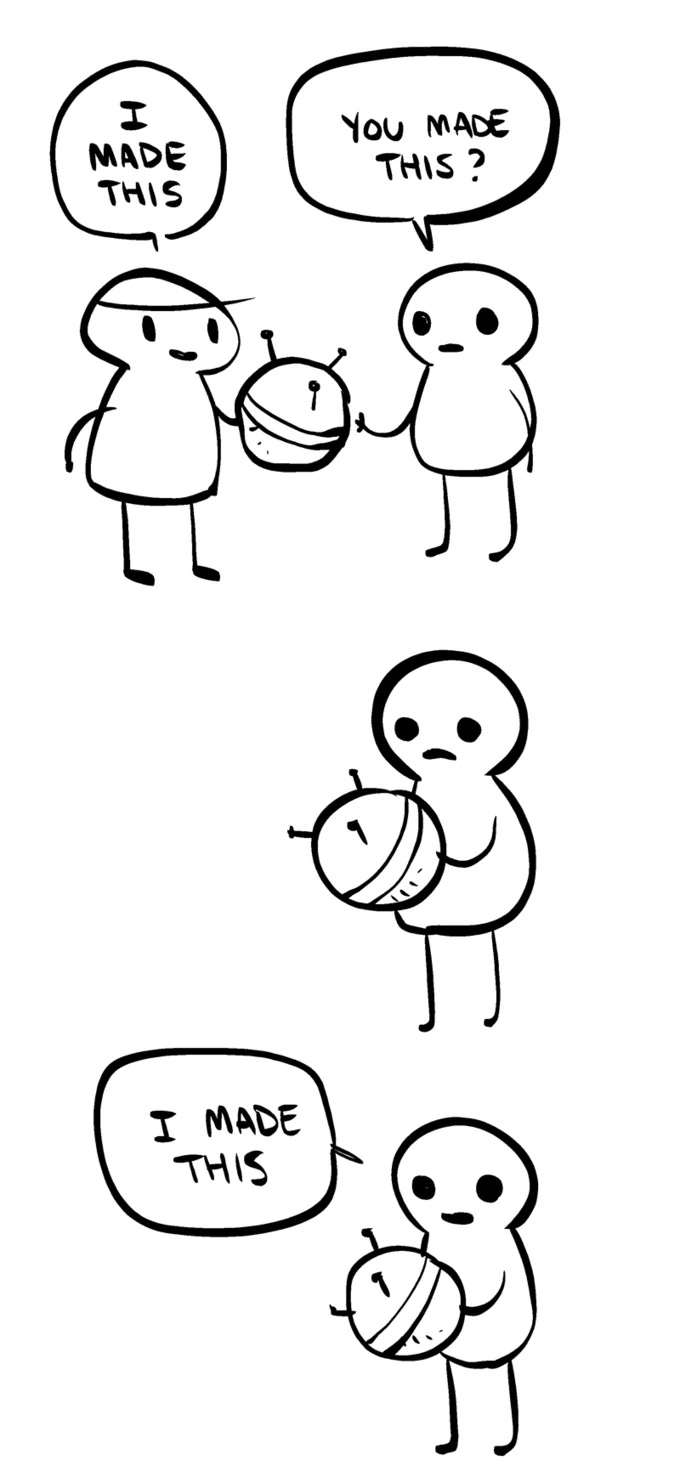
"I Made This" started as a Nedroid comic from January 30, 2013, where one character takes credit for another character's drawing. After Tumblr and Imgur accounts began reposting it without crediting creator Anthony Clark, the irony turned the panel into an exploitable about creative theft, with a 2013 Tesla vs. Edison lightbulb edit becoming one of the format's best-known versions.
Overview
The joke runs on a two-panel setup where one character finishes making something, and a second character immediately grabs it to announce "I made this." Captioners swap the drawn object or label the characters to point at a real-world case of someone claiming credit for work they didn't do14.
Many edits rename the figures as famous rivals so the strip reads as a quick visual accusation of plagiarism, like the Tesla and Edison version about competing lightbulb designs3. Writers and bloggers have also used the comic to illustrate "I Made This" attribution disputes in stories about artists whose work gets lifted online5.
Gallery
Origin & Background
Anthony Clark, who draws as Nedroid, posted the original strip to his Tumblr on January 30, 2013, with the caption "The Internet"1. Clark has run the Nedroid comic site since 20017. The strip shows one character finishing a drawing, then a second character snatching it and taking credit. The post gained over 65,000 notes in three years4.
How It Spread
Timeline
2013-01-30
Anthony Clark (Nedroid) posts the original comic to Tumblr with the caption "The Internet."
2013-03-09
Imgur user mousestar reposts the comic uncredited, drawing 2.3 million views.
2013-10-09
Imgur user Efreeti uploads the Tesla and Edison lightbulb edit, which collects over 3,500 points.
2013-11-12
RVA Magazine cites the exploitable in an article about Lil' Kim's "Dead Gal Walking" cover art dispute.
2013-12-03
An r/outoftheloop thread explains the format as a comment on online art theft.
How to Use This Meme
People typically crop the two panels and relabel the figures or the object being made, with the "stealer" often standing in for a well-known person, company, or community accused of lifting someone else's work. A common convention is to swap only the object, keep the dialogue, and let the new framing do the accusing3.
Frequently Asked Questions
References (7)
- 1
- 2
- 3
- 4
- 5
- 6
- 7