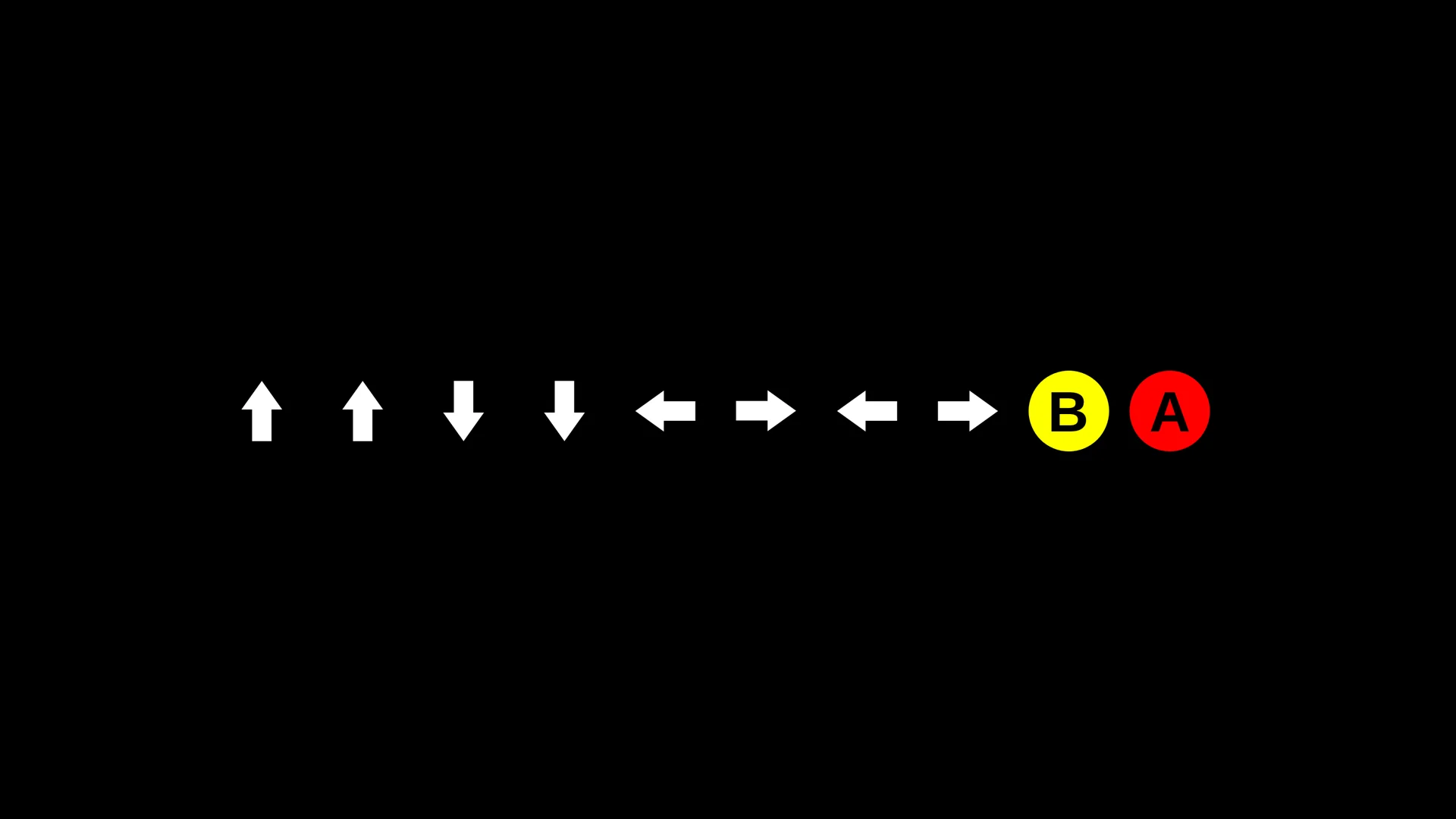
Konami Code

1986catchphraseclassic

Published September 4, 2026

The Konami Code is a ten-button cheat sequence (Up, Up, Down, Down, Left, Right, Left, Right, B, A) first buried in the 1986 NES port of Gradius by programmer Kazuhisa Hashimoto1. It jumped from arcade lore into wider web culture in the late 2000s, when sites like Facebook and ESPN.com wired it into their pages as a hidden trigger, spawning one of the internet's longest-running easter egg traditions2.

Overview

The Konami Code is the button string Up, Up, Down, Down, Left, Right, Left, Right, B, A, sometimes followed by Start or Select depending on the game3. It works as a shorthand for old-school gaming itself, referenced in songs, TV shows and merch, and treated as a kind of secret handshake between people who grew up with 8-bit consoles3.

On the web, the format is simple: type the sequence on your keyboard while a page is loaded and something silly happens. ESPN.com covered the page in unicorns and rainbows, Facebook triggered lens flares on every click, and Digg used it to auto-expand nested comment threads2. The joke is that the payoff is never useful, only a wink at people who recognize the input2.

Origin & Background

Platform
Nintendo Entertainment System (Gradius) / web (viral spread)
Creator
Kazuhisa Hashimoto
Date
1986

The code first appeared in the 1986 NES release of the shooter Gradius, published by Konami1. Programmer Kazuhisa Hashimoto added it as a dev tool because he could not clear parts of the game during testing, later explaining that he built it to be easy to remember since he was the one who would use it1.

Hashimoto's shortcut was left in the shipped code and spread by word of mouth. Its most famous appearance came in the 1988 NES version of Contra, where entering the sequence on the title screen gave the player thirty extra lives, earning it the nickname the '30 lives code'1.

How It Spread

Konami reused the input across dozens of its own titles through the late 1980s and 1990s, and outside developers began slipping it in as a nod to players1. Urban Dictionary entries from the 2000s treat it as shorthand for arcade nostalgia, and note that punk band The Ataris named a track after the code on their album End Is Forever3.

The web easter egg era kicked off in the late 2000s. On April 26, 2009, an ESPN.com designer wired the code to 'Cornify' the site with unicorns and rainbows4. Facebook followed the same year with a lens flare effect triggered by the sequence plus Enter, and Google Reader, Digg and GameSpot added their own variations2. A tracking site, Konami Code Sites, popped up to catalogue pages using the trick, and required visitors to enter the code to view the list2.

On YTMND, users spun the code itself into site jokes, with pages parodying its use and its Contra association1. In 2010, Newsweek.com joined the trend by swapping every headline for zombie-invasion versions when the sequence was entered1.

How to Use This Meme

The typical execution on a controller is Up, Up, Down, Down, Left, Right, Left, Right, B, A, often finished with Start on a second player pad or on the title screen3. On websites, users usually press the arrow keys in the same order followed by the letters B and A on the keyboard, and sometimes Enter, while a page is focused2. Developers commonly hide small visual gags behind it rather than functional features, keeping with the wink-to-gamers spirit of the original2.

Frequently Asked Questions