orz
Published October 24, 2026
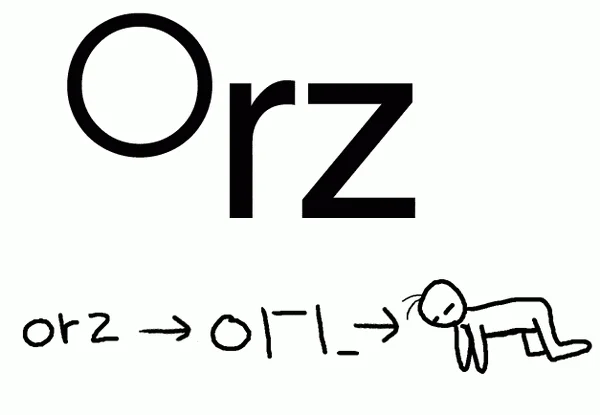
A tiny row of characters that reads as a figure on hands and knees, orz was born on a Japanese forum in late 2002 after a poster typed '_| ̄|○' to describe a cable cover and readers saw a defeated human instead1. From Techside the symbol reached Futaba Channel and, by 2003, Korean imageboard DCInside, where fans made 'Despair Not Allowed' image macros of characters frozen in the same slumped pose3.
Overview
Each letter of orz stands in for a piece of a kneeling human body, with 'o' as the hanging head, 'r' as the arms and curled torso, and 'z' as the folded legs. In East Asian cultures that silhouette lines up with dogeza, the formal, floor-touching bow used in serious apologies, which gives the small text joke a sting of real humiliation under the humor3. Users rotate letters and cases for mood: OTL and OTZ in capitals look like a bigger, more dramatic kneel, and the original ASCII prototype '_| ̄|○' is still typed on image boards where fixed-width fonts render it cleanly2.
A typical post tacks orz onto the end of a sentence about a small defeat, e.g., failing a test, missing a train, or getting dumped. Users in Japan, China and Korea chain two or three copies in a row for exaggerated groveling, closer to a sulk than a sob1.
Gallery
Origin & Background
How It Spread
Timeline
2002-12-23
Earliest surviving Techside Chitchat Forum post using the kneeling ASCII shape '_| ̄|○'.
2003
Shortened orz, OTL and OTZ variants appear on Futaba Channel (2chan) and Nico Nico Douga.
2003
Korean imageboard DCInside launches the 'Despair Not Allowed' (좌절금지) image macro format.
2004-05-10
First documented English-language reference to orz, submitted as an Urban Dictionary definition.
2005-02-08
BoingBoing publishes 'All about Orz,' an English-language explainer of the emoticon's spread across East Asia.
How to Use This Meme
Writers typically drop orz, OTL or OTZ at the end of a sentence about a small failure, often without any additional punctuation, e.g., 'left my laptop charger at home orz.' Repeating the sequence (orz orz orz) exaggerates the groveling, and the capitalized OTL version is common when a bigger, more theatrical kneel suits the joke4.