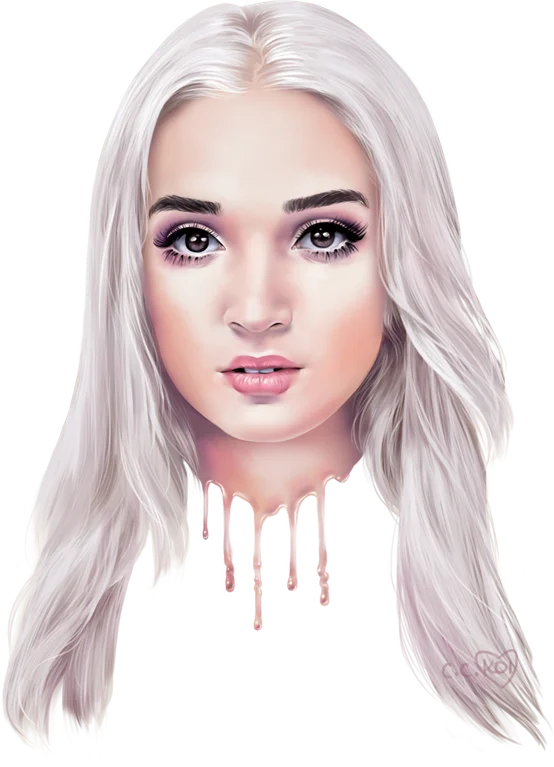
Poppy

2014viral videoclassic

Published September 24, 2026

Poppy is the doll-like YouTube persona of Moriah Pereira, launched in November 2014 with collaborator Titanic Sinclair, whose brief, off-kilter monologues against a stark white backdrop pulled in millions of views per video. Her breakthrough clip, a ten-minute loop of her repeating 'I'm Poppy,' turned an unnerving art project into a signature act of the weird-YouTube era.

Overview

The Poppy format is stripped down and instantly recognizable. She stands against a bare white backdrop, hair the color of milk, and speaks in a hushed monotone about the internet, followers, phones, and pop culture2. Videos usually run about a minute, sometimes far shorter, sometimes stretched into ten-minute loops of a single phrase, and they mix cute doll aesthetics with occult symbolism and casual references to death and hidden forces1.

Titanic Sinclair, the collaborator behind the camera, directs, produces, and co-writes almost everything Poppy puts out1. Her tone sits somewhere between David Lynch and Hello Kitty2, and the videos deliberately blur the line between the performer Moriah Pereira and the fictional Poppy character. The whole project reads as satire of influencer fame while also functioning as a real pop career, complete with tours, music videos, and a studio album1. Over 300 videos were uploaded to the channel, with many pulling in millions of views apiece2.

Origin & Background

Platform
YouTube
Creator
Moriah Pereira and Titanic Sinclair
Date
2014

The ThatPoppy YouTube channel launched in November 2014, with the first upload showing Poppy eating a stick of cotton candy in silence7. A follow-up titled 'My Phone Is Not Plugged In' went live on December 3rd, 2014, featuring short skits of her alone with a guitar and a rotary phone8. The channel was built by Poppy, born Moriah Pereira, and Titanic Sinclair, both of whom had previously collaborated with YouTuber Mars Argo on visually similar work1.

The clip that turned the character into an internet fixture arrived on January 6th, 2015, when Poppy released a ten-minute video of her repeating 'I'm Poppy' in different inflections4. That bit became her signature and later gave her YouTube Red special its title1.

How It Spread

By mid-2015 the project moved into music. The ThatPoppyVEVO channel released the 'Lowlife' music video on July 24th, 2015, from her debut EP Bubblebath5. That November, Poppy posted 'young girl makes crazy video on YouTube,' a short mocking clickbait headlines while thanking her viewers, followed on December 15th by 'Everyone was a Baby Once,' a monologue about the internet and life on Earth7. On May 4th, 2016, 'I love the internet so much' went up, with Poppy talking about her use of web apps over ominous background music7.

Coverage picked up sharply in 2017 and 2018. Poppy won Breakthrough Artist at the 7th annual Streamy Awards on September 26th, 2017, beating a field that included 21 Savage and Zara Larsson3. Her studio album Poppy.Computer landed that fall, followed by a live tour, and a fan community calling itself the Poppy Seeds spawned an offshoot religion called Poppyism1. In January 2018, the 24-minute YouTube Red special I'm Poppy premiered at Sundance, written and produced by Titanic Sinclair as a metatextual parody of YouTube stardom1.

On April 17th, 2018, TMZ reported that Mars Argo had filed a lawsuit accusing Poppy and Titanic Sinclair of copyright infringement and emotional distress, claiming the Poppy character was a knockoff of the earlier Mars Argo persona7. Poppy answered on May 7th with a statement calling the suit a 'publicity campaign'6. Judge Manuel L. Real dismissed the case on September 14th, 2018, with court records showing a 'settlement in principle' between the parties7.

How to Use This Meme

The Poppy format is a specific persona rather than a template, but the recognizable elements are the stark white backdrop, monotone whisper delivery, and short unsettling monologues about internet culture12. Fans often reference the ten-minute 'I'm Poppy' loop as shorthand for eerie repetition, and the doll-in-a-white-room aesthetic turned into a common reference point for creepy-YouTube style videos2.

Frequently Asked Questions