Preferred Pronouns

2013linguistic conceptclassic

Published September 23, 2026

Preferred Pronouns are gender-neutral or self-selected pronouns used in place of he/she, often adopted by LGBT and non-binary speakers. The concept dates back to the 1884 coinage of 'thon' by attorney Charles Crozat Converse4, but blew up as an internet talking point in 2013 when Tom Scott's viral explainer video kicked off years of Tumblr, Reddit and YouTube debate1.

Overview

Preferred Pronouns are non-standard or gender-neutral pronouns that a speaker asks others to use for them instead of the default he or she4. The list includes older neologisms like 'thon,' 'co,' and the Spivak set ('E,' 'Em,' 'Eir'), plus modern singular 'they' and 'nounself' pronouns that turn any noun into a pronoun set4.

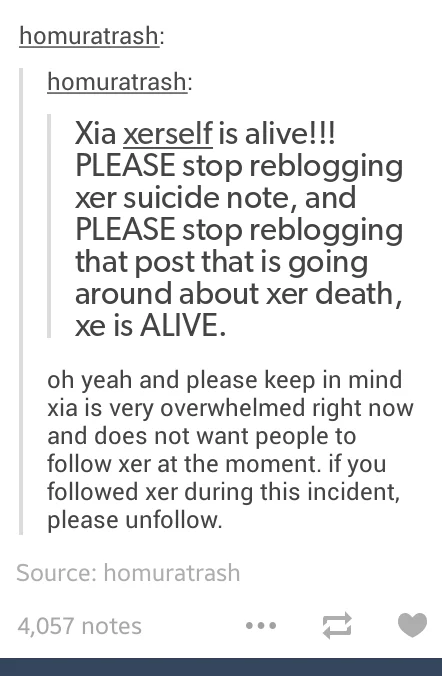
As an internet topic, the meme lives less in a single image format and more in a running debate. Tumblr posts explaining nounself pronouns get screenshotted and reposted to Reddit for mockery, while YouTube explainer videos rack up dueling like-to-dislike ratios and comment wars12. The recognizable shape is the pairing: a sincere first-person post about pronoun preference, then a sarcastic quote-repost from a critic community, then a defense video from someone directly affected3.

Origin & Background

Platform
YouTube / Tumblr (viral spread)
Date
2013

The earliest English pronoun neologism on record is 'thon,' a shortening of 'that one' proposed by United States attorney Charles Crozat Converse in 18844. Feminist writer Mary Orovan coined 'Co' in 1970, and in 1983 mathematician Michael Spivak used 'E,' 'Em' and 'Eir' in the AMS-TeX manual The Joy of TeX; those same forms were added as selectable gender options on the LambdaMOO online community in May 19914.

The modern meme-era conversation kicked off on July 5th, 2013, when British YouTuber Tom Scott uploaded 'Gender Neutral Pronouns: They're Here, Get Used to Them,' a short lecture criticizing grammatical gender in English1. The video became the go-to link for explaining the topic, and set up the 2014-2015 Tumblr and Reddit fights that gave the term its meme-adjacent status4.

How It Spread

After Tom Scott's July 2013 video, the topic bounced between explainer content and pushback1. On July 14th, 2014, the EmersonOrientation YouTube channel posted 'Pronouns 101,' a college orientation clip walking through how to ask for and use preferred pronouns2. On August 30th, 2014, that video was cross-posted to r/TumblrInAction, where commenters pilloried the speaker's delivery and arguments4.

The backlash pipeline hit its peak in early 2015. On February 23rd, 2015, Redditor bees_knees_ posted a Tumblr screenshot titled 'Ive gotta say.. these crazy pronouns make it hard not to laugh at such an issue' to r/TumblrInAction, and it pulled more than 3,500 votes at 95% upvoted with 640 comments over the following four months4. Three weeks later, on March 16th, 2015, the BuzzFeedYellow channel published 'Why Pronouns Matter For Trans People,' a first-person video that pulled over 1.1 million views and 4,800 comments in its first three months3.

Beyond that flashpoint, 'nounself' pronouns kept the topic alive on Tumblr, especially inside the otherkin community, where users assembled pronoun sets out of nouns like 'star' or 'bun'4. That practice, more than the Spivak set, is what most 2015-era jokes about 'crazy pronouns' were pointing at.

Frequently Asked Questions