Ransomware
Published March 31, 2026
Also known as: Crypto-ransomware · cryptoviral extortion
Ransomware is a type of malicious software that locks or encrypts a victim's files and demands payment for their release. First deployed in 1989 via floppy disk, ransomware grew from an obscure cybercrime tactic into one of the internet's most feared and widely discussed digital threats, spawning countless news cycles, Reddit threads, and online discourse about cybersecurity. Major attacks like WannaCry in 2017 and the REvil operations in 2021 turned ransomware into a household term and a recurring subject of internet culture, with discussions, warnings, and dark humor spreading across every major platform.
Overview
Ransomware works by infecting a computer, encrypting or restricting access to the user's files, and then displaying a ransom note demanding payment in exchange for restoring access. Early versions used simple lock screens, while modern variants employ strong encryption that makes recovery without paying nearly impossible. Payment is typically demanded in hard-to-trace digital currencies like Bitcoin2. The malware spreads through phishing emails, compromised websites, infected software downloads, and in some cases, self-propagating network worms8.
The concept became a major part of internet discourse as attacks grew in scale and frequency. From individual users panicking on Reddit to hospitals and corporations losing access to critical data, ransomware discussions pop up across every corner of the internet. The topic blends genuine cybersecurity concern with dark humor, PSA sharing, and community-driven efforts to help victims recover their files7.
Gallery
Origin & Background
How It Spread
How to Use This Meme
Ransomware is not a meme template in the traditional sense. Instead, it typically appears in internet culture in several ways. Users share screenshots of ransomware lock screens as cautionary tales or dark comedy on Reddit, Twitter, and tech forums. PSA-style posts warning about new strains regularly circulate across platforms. The concept often shows up in meme formats about cybersecurity, with jokes about clicking suspicious links, ignoring software updates, or the absurdity of attackers using customer-service-style ransom notes. Dark humor around ransomware usually involves the gap between the polite tone of ransom messages and the reality of having your entire digital life held hostage.
Cultural Impact
Full History
Fun Facts
The first ransomware ever created was distributed on 20,000 floppy disks mailed to AIDS researchers in 1989. The payment address was a P.O. box in Panama4.
Marcus Hutchins stopped WannaCry's spread by registering a domain name for about $11, not realizing it was a kill switch built into the malware5.
Despite receiving over $33,000 in Bitcoin payments during WannaCry, researchers at Check Point found no evidence that any victim actually had their files decrypted. It was unclear whether the attackers even had the ability to do so5.
Kaspersky Lab left the Business Software Alliance in 2012 over its support for SOPA, the same act that a ransomware variant later impersonated12.
The Websense case in 2005, one of the earliest documented ransomware attacks, was resolved without payment after security researchers reverse-engineered the encryption1.
Derivatives & Variations
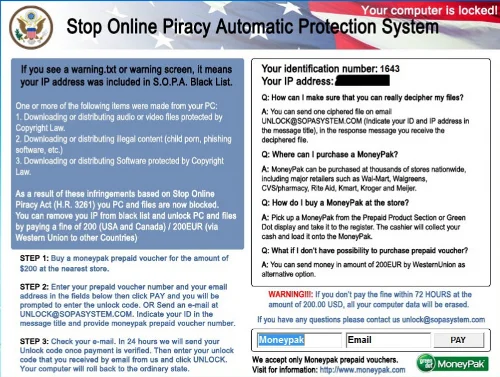
SOPA Ransomware (2012):
A variant that falsely claimed victims' IP addresses were blacklisted under the Stop Online Piracy Act, demanding $200 via MoneyPak[3].
Reveton/Police Ransomware (2012):
Displayed fake law enforcement warnings accusing users of piracy or child pornography, demanding payment to avoid prosecution[4].
CryptoLocker (2013):
One of the first widely successful crypto-ransomware strains, collecting an estimated $3 million before being shut down[2].
WannaCry/WannaCrypt0r (2017):
Self-propagating ransomware worm that infected over 200,000 systems globally using leaked NSA tools[5].
No More Ransom (2016):
A cooperative initiative offering free decryption tools and ransomware identification, run by law enforcement and security companies[7].
Ransomware-as-a-Service (RaaS):
A business model where ransomware developers lease their tools to affiliates, popularized by groups like REvil, Hive, and ALPHV/BlackCat[10].
Frequently Asked Questions
References (12)
- 1
- 2
- 3
- 4Ransomware - Know Your Memeencyclopedia
- 5Ransomwareencyclopedia
- 6Ransomware - Urban Dictionarydictionary
- 7Kaspersky Labencyclopedia
- 8
- 9
- 10Ransomware - Defend Edgearticle
- 11
- 12Darkodearticle