The Great Toilet Paper Debate
Published March 30, 2026
Also known as: Over vs Under Debate · Toilet Paper Orientation Debate · TP Debate
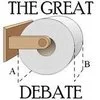
The Great Toilet Paper Debate is the perennial argument over whether a toilet paper roll should hang with the loose sheet going "over" the top or tucked "under" the back. The question entered mainstream American discourse through Ann Landers' advice column in 1977, where it became the most popular topic in the column's history, drawing 15,000 letters by 19864. The debate migrated online in the mid-1990s through personal homepages and forum polls, then surged again in 2015 when Seth Wheeler's 1891 patent illustration, which clearly shows the "over" orientation, went viral on Twitter7.
Overview
At its core, the debate is simple: when you place a roll of toilet paper on a horizontal holder mounted to the wall, should the loose end hang over the front of the roll (the "over" position) or drape down behind it (the "under" position)? That's it. That's the entire argument. And yet it has generated millions of words of discussion, academic papers, corporate marketing campaigns, and an absurd amount of passion from people on both sides.
Surveys consistently show that roughly 70% of Americans prefer the "over" method1. Proponents of "over" point to easier access, better hygiene (less wall contact), and the fact that the original patent shows it that way8. The "under" camp fires back with aesthetics, cat-proofing, and toddler-proofing2. Neither side has ever conceded.
Gallery
Origin & Background
How It Spread
How to Use This Meme
The Great Toilet Paper Debate typically functions as a conversation starter, social media poll, or relationship compatibility test rather than a visual meme template. Common formats include:
Poll format: Post "Over or under?" with images of both orientations and let the comments erupt
Patent drop: Share the image of Seth Wheeler's 1891 patent to "settle" the debate (it won't)
Relationship test: Frame it as a compatibility question ("My partner does X and I'm reconsidering everything")
Personality reveal: Reference Dr. Carle's study to claim one side is dominant and the other passive
Cat/kid defense: Post videos of cats or toddlers unraveling toilet paper as evidence for the "under" position
Cultural Impact
Full History
Fun Facts
At the Amundsen-Scott Research Station at the South Pole, toilet paper orientation has been a documented source of complaints among crew members4.
The average American uses 8.6 sheets of toilet paper per trip, totaling about 20,805 sheets per year8.
In public restrooms, it takes an average of 71.48 separate visits to fully use one roll8.
49% of Americans surveyed chose toilet paper as the one "necessity" they'd want if stranded on a desert island, beating out food8.
40% of toilet paper users are "wadders" and 40% are "folders," with the remaining 20% being "wrappers"8.
Derivatives & Variations
The 1891 Patent Image
Seth Wheeler's patent illustration became a standalone viral image, shared as "proof" that "over" is the correct orientation. Owen Williams' 2015 tweet of the patent image was the single biggest viral moment in the debate's history[7].
Cottonelle Roll Poll
A branded marketing campaign that formalized the debate into survey data, featuring Tori Spelling and Dean McDermott and a Funny or Die comedy video called *Under Suspicion*[9].
Personality Typing
Dr. Gilda Carle's study linking "over" preference to dominant personalities and "under" to submissive ones spawned its own sub-genre of toilet paper discourse[1].
Early Web Poll Pages
Dedicated websites like the Purdue-hosted "Great Toilet Paper Debate" (1997) and the Angelfire voting page (2001) represented some of the earliest interactive web content around the topic[10][11].
Frequently Asked Questions
References (15)
- 1
- 2
- 3
- 4List of Internet phenomenaencyclopedia
- 5Toilet paper orientation - Wikipediaencyclopedia
- 6
- 7
- 8
- 9Yahoo Search - Web Searcharticle
- 10
- 11
- 12
- 13
- 14
- 15