The Social Contract
Published November 17, 2026
The Social Contract began as a French-language infographic in April 2020, charting how one taxpayer named Nicolas funded pensioners and welfare recipients before the money looped back to him as consumer spending1. English-language versions by @kunley_drukpa in November 2024 drove the format into Anglophone timelines, with the American edition hitting 18,000 likes in a week7.
Overview
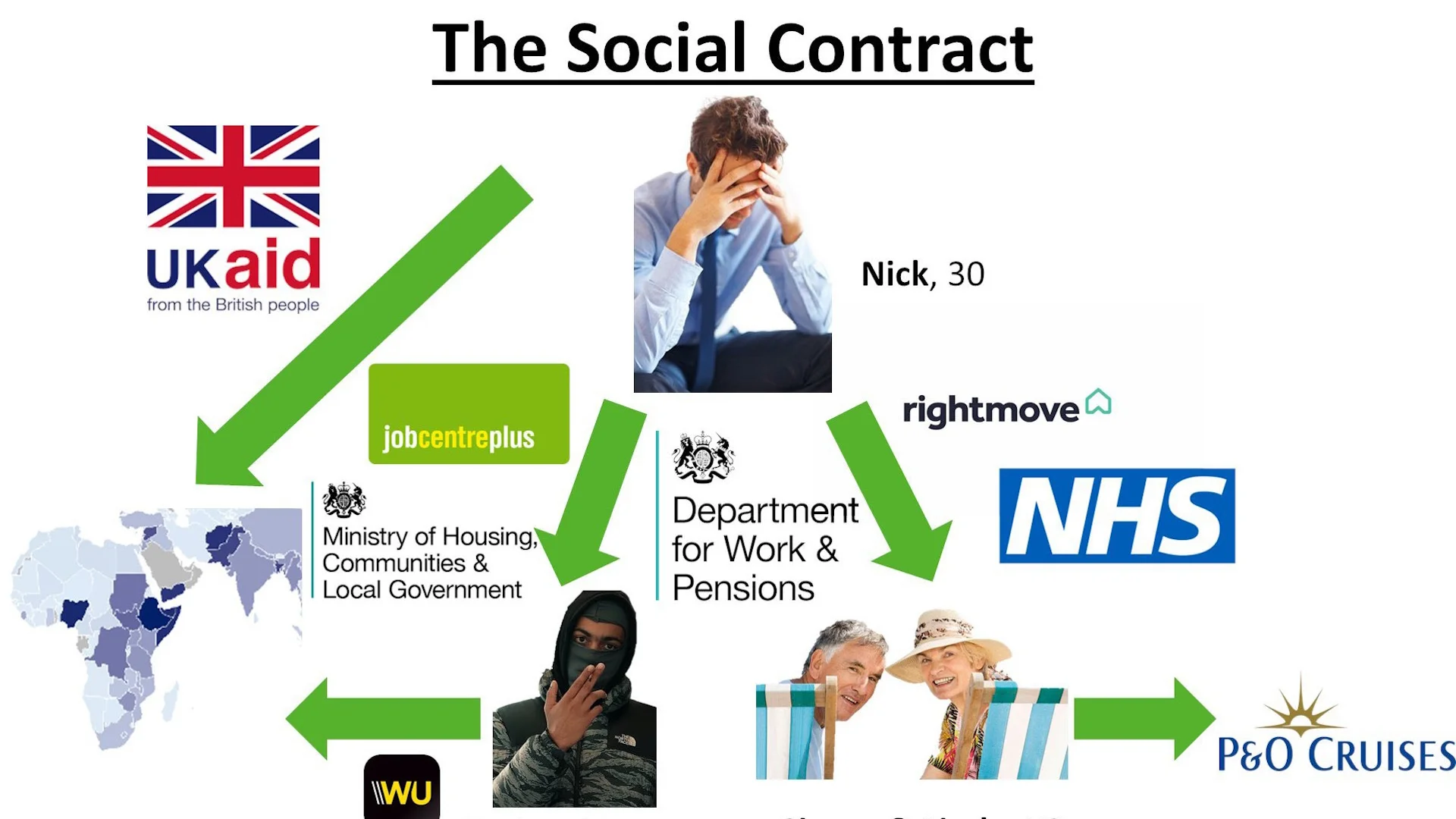
Each Social Contract chart places an exhausted-looking man in his 30s at the center of a diagram, with arrows drawing money out of his paycheck toward government programs, retirees, immigrants and civil servants, before those recipients spend the same money on goods he also helped produce3. The joke lands on the circular absurdity: taxes pay for someone else's groceries, that store pays its wages, those wages get taxed again, and the central figure foots every stage of the loop.
Country-specific versions swap the taxpayer's name and the beneficiaries, so the French original features a 30-year-old named Nicolas while German, Dutch, British, Spanish, Portuguese and American editions substitute their own local stereotypes and welfare programs2. The title nods at Jean-Jacques Rousseau's 1762 treatise on how free citizens agree to coexist under shared rules9, though the meme flattens that philosophy into a flowchart of one man subsidizing everyone else.
Gallery
Origin & Background
How It Spread
Timeline
How to Use This Meme
Most versions position a tired thirtysomething man as the taxpayer at the diagram's center, with arrows mapping every direction his paycheck travels toward retirees, migrants, civil servants or subsidized programs3. Captions usually exaggerate the beneficiaries' idleness while the central figure looks visibly drained, and localized editions swap names and institutions so the same chart reads as French, German, Dutch or American2.
Frequently Asked Questions
References (9)
- 1
- 2
- 3
- 4
- 5
- 6
- 7
- 8
- 9