Boomer

2018Catchphrase / character archetype / reaction imageclassic

Also known as: 30-Year-Old Boomer · OK Boomer · Okay Boomer

"Boomer" started as a 4chan joke about millennials who act old and grew into one of the internet's sharpest generational weapons. The "30-Year-Old Boomer" Wojak variant appeared on 4chan's /biz/ board in April 2018, depicting an out-of-touch millennial clutching a Monster Energy drink1. By late 2019, the phrase "OK Boomer" had exploded on TikTok as a two-word dismissal aimed at anyone with outdated attitudes, eventually reaching the New Zealand Parliament and U.S. Supreme Court2.

Overview

The Boomer meme operates on two levels. First, there's the "30-Year-Old Boomer" character: a Wojak-derived figure wearing sunglasses and holding a can of Monster Energy, representing millennials born in the late '80s who already seem out of touch with internet culture3. Second, there's "OK Boomer," a dismissive catchphrase lobbed at anyone displaying attitudes associated with the Baby Boomer generation, particularly around technology, climate change, and generational gatekeeping1.

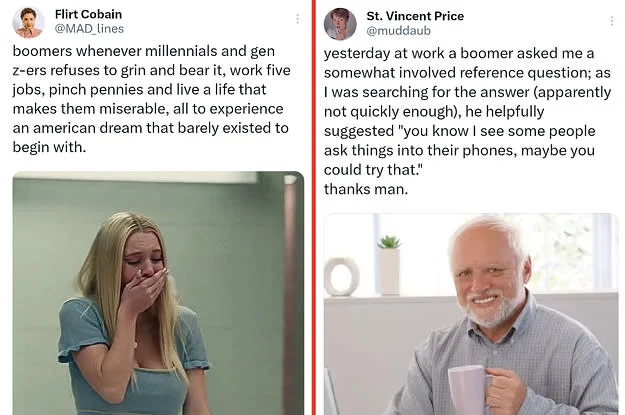
The meme detached "boomer" from its strict demographic meaning (people born 1946-1964) and turned it into a state of mind2. You don't have to be 60 to get called a boomer. You just have to prefer arena shooters over battle royales or think kids spend too much time on their phones.

The expression "30-year-old boomer" first appeared on April 7, 2018, when an anonymous user on 4chan's /biz/ (business and finance) board used the phrase3. On April 23, 2018, another /biz/ user paired the phrase with a Brainlet Wojak illustration3.

The character's visual identity solidified quickly. On May 1, 2018, a Brainlet Wojak wearing sunglasses showed up in a /biz/ thread3. The next day, someone captioned the image with ">that 30 year old boomer that thinks arena shooters are good," linking the meme to gaming nostalgia for the first time3. Then on May 4, 2018, a /biz/ user posted what became the definitive version: the sunglasses-wearing Wojak holding a can of Monster Energy drink3.

The "OK Boomer" catchphrase has a separate, older origin. The first recorded use appeared in a Reddit comment on September 29, 20091. It showed up on 4chan starting around 2015, used against people who seemed disconnected from modern internet culture1.

Origin & Background

Platform
4chan /biz/ (30-Year-Old Boomer character), Reddit (earliest "OK boomer" text, 2009), TikTok (viral "OK Boomer" wave, 2019)
Key People
Anonymous 4chan /biz/ users, Senzawa
Date
2018

The expression "30-year-old boomer" first appeared on April 7, 2018, when an anonymous user on 4chan's /biz/ (business and finance) board used the phrase3. On April 23, 2018, another /biz/ user paired the phrase with a Brainlet Wojak illustration3.

The character's visual identity solidified quickly. On May 1, 2018, a Brainlet Wojak wearing sunglasses showed up in a /biz/ thread3. The next day, someone captioned the image with ">that 30 year old boomer that thinks arena shooters are good," linking the meme to gaming nostalgia for the first time3. Then on May 4, 2018, a /biz/ user posted what became the definitive version: the sunglasses-wearing Wojak holding a can of Monster Energy drink3.

The "OK Boomer" catchphrase has a separate, older origin. The first recorded use appeared in a Reddit comment on September 29, 20091. It showed up on 4chan starting around 2015, used against people who seemed disconnected from modern internet culture1.

How It Spread

The 30-Year-Old Boomer character spread rapidly across 4chan through May and June 2018, especially on /biz/ and /v/ (video games). Users created variations showing the character wearing a VR headset, grilling at a barbecue, or drinking different beverages3. By June 15, 2018, there were already 22 pages of 4chan posts containing "30 year old boomer"3. A Facebook page dedicated to the meme launched around the same time, eventually reaching over 41,900 followers by January 20203.

"OK Boomer" followed a different trajectory. Journalist Taylor Lorenz helped popularize the phrase through coverage declaring "the end of friendly generational relations"1. The real explosion came in November 2019, when a TikTok video went viral responding to an older man who called millennials and Gen Z the "Peter Pan syndrome" generation who "don't ever want to grow up"1. Thousands of users fired back with "OK Boomer" in what observers described as "a sophisticated, mass retaliation"1. By November 2022, TikTok videos tagged with #OkBoomer had been viewed roughly 4 billion times1.

A July 2019 song titled "OK Boomer" acted as an anthem for the movement1. On March 2, 2020, streamer Neekolul posted a video lip-syncing to "Oki Doki Boomer" by YouTube creator Senzawa while wearing a Bernie 2020 shirt, pulling in over 30 million views that month1.

Platforms

RedditTwitterTikTokInstagramYouTube

Timeline

2019-01-01

Boomer begins gaining traction

2020-01-01

Boomer started spreading across social media platforms

2021-01-01

Boomer reached mainstream popularity and media coverage

2022-01-01

Brands and companies started using Boomer in marketing

2024-01-01

Boomer entered the broader pop culture conversation

View on Google Trends

How to Use This Meme

The Boomer meme works in several formats:

30-Year-Old Boomer image: Post the sunglasses-wearing Wojak (often holding a Monster Energy can) alongside a greentext-style caption starting with ">that 30 year old boomer who..." followed by something nostalgic or out of touch. Common examples include praising old video games, mowing the lawn at 7 AM, or calling everything after 2010 trash3.

"OK Boomer" response: Drop "OK boomer" as a reply to anyone expressing dismissive, condescending, or outdated views about younger generations, technology, or social issues1. Typically deployed when someone lectures about participation trophies, screen time, or "kids these days."

Boomer-coded content: Share or create content that parodies "boomer behavior" like minion memes, Facebook wine posts, or complaints about self-checkout machines. The humor comes from recognizing the pattern, not necessarily the person's actual age2.

Create Your Own

Cultural Impact

"OK Boomer" crossed from meme into political language faster than almost any internet phrase before it. Swarbrick's parliamentary use made international headlines and sparked genuine debate about generational power dynamics1. The phrase's appearance in a U.S. Supreme Court hearing showed how deeply internet language had penetrated formal institutions1.

Media coverage was enormous. The New York Times, Financial Times, The Guardian, and The Independent all ran analysis pieces1. Clémence Michallon of The Independent called the phrase "just the right amount of dismissive"1. Miyo McGinn of Grist framed it as "righteous indignation" from a generation blamed for "killing everything from restaurant chains to department stores to relationships"1.

The meme also fed into real commercial activity. "OK Boomer" merchandise flooded platforms like Redbubble and Etsy in late 2019. The phrase became a shorthand in political commentary, used by pundits and politicians to frame generational policy debates around climate, housing, and economic inequality.

Full History

The Boomer meme evolved through distinct phases, each expanding its reach and sharpening its cultural edge.

The 4chan phase (April-June 2018) established the visual language. What started as a /biz/ board joke about aging crypto investors quickly migrated to /v/, where the 30-Year-Old Boomer became a caricature of any gamer who still praised Quake or Half-Life while younger players moved on to Fortnite3. The Monster Energy can became the character's defining prop, a tongue-in-cheek symbol of millennial dad energy. This phase stayed mostly contained to imageboard culture, though the Facebook page showed early signs of crossover appeal3.

The "OK Boomer" phase (2019-2020) turned a niche insult into a global catchphrase. The November 2019 TikTok that set things off was deceptively simple: an older man lecturing the camera about young people's "utopian ideals," met with a wave of two-word responses1. The New York Times reported that "teenagers use it to reply to cringey YouTube videos, Donald Trump tweets, and basically any person over 30 who says something condescending about young people"1.

The phrase jumped into institutional spaces with startling speed. On November 5, 2019, New Zealand MP Chlöe Swarbrick was giving a speech supporting a climate change bill when fellow MP Todd Muller interrupted her. Swarbrick shot back with "OK boomer" on the parliamentary floor1. She later wrote in The Guardian that the comment "symbolised exhaustion of multiple generations"1. The moment went viral, drawing both praise and accusations of ageism.

On January 9, 2020, "OK Boomer" appeared as a Jeopardy! clue during the Greatest of All Time tournament. Ken Jennings answered by saying "I get to say it to Alex! What is 'OK, boomer?'" drawing audience laughter1. Six days later, U.S. Supreme Court Chief Justice John Roberts used the phrase during oral arguments in Babb v. Wilkie, an age discrimination case1. On November 23, 2019, climate change protesters at the Harvard-Yale football game rushed the field during halftime and chanted "OK boomer"1.

The backlash was swift and predictable. Conservative radio host Bob Lonsberry called "boomer" the "N-word of ageism" in a tweet he soon deleted1. The Late Show with Stephen Colbert mocked him with a mock game show segment: "'Is This The New N-Word?' No, it's not. Thank you for playing"1. The Guardian's Francine Prose worried about cultural acceptance of age-based discrimination, while writer Bhaskar Sunkara argued that boomers "need solidarity" rather than mockery1. India Ross of the Financial Times noted that attacks on the phrase from boomers may have only increased its power1.

The Neekolul video in March 2020 represented perhaps the meme's peak viral moment, blending "OK Boomer" energy with political messaging. The clip racked up 6 million views in four days1. By this point, "boomer" had fully shed its strict generational definition. It meant anyone resistant to change, anyone who dismissed younger people's concerns, anyone who said "back in my day" without irony.

Fun Facts

The first known "OK boomer" appeared in a 2009 Reddit comment, a full decade before the phrase went mainstream1.

U.S. Supreme Court Chief Justice John Roberts quoted "OK boomer" during arguments in an age discrimination case, making it possibly the most prestigious legal citation of a meme1.

Bob Lonsberry's comparison of "boomer" to a racial slur became its own meme, with The Late Show creating an entire comedy bit around it1.

The 30-Year-Old Boomer Wojak spawned an entire family of "-oomer" characters that are still widely used in meme culture3.

The Monster Energy can in the original character wasn't random. It plays on the drink's association with a specific type of millennial masculinity and "just vibing" energy3.

Derivatives & Variations

Doomer, Zoomer, Bloomer, and Coomer:

Character archetypes that spun off from the 30-Year-Old Boomer Wojak, each representing a different generational or personality stereotype. The Doomer (depressed twenty-something), Zoomer (hyperactive Gen Z kid), and others formed a whole "-oomer" character family[3].

Neekolul "Oki Doki Boomer" video:

Streamer Neekolul's March 2020 lip-sync to Senzawa's song became its own viral moment, earning over 30 million views and sparking its own discourse[1].

Monster Energy Boomer:

A specific sub-variant focusing on the Monster Energy drink association, often paired with lawn care, early morning routines, and classic rock references[3].

"OK Boomer" merchandise:

T-shirts, phone cases, and stickers bearing the phrase flooded online marketplaces in late 2019[1].

Frequently Asked Questions

References (3)

  1. 1
    OK boomerencyclopedia
  2. 2
  3. 3