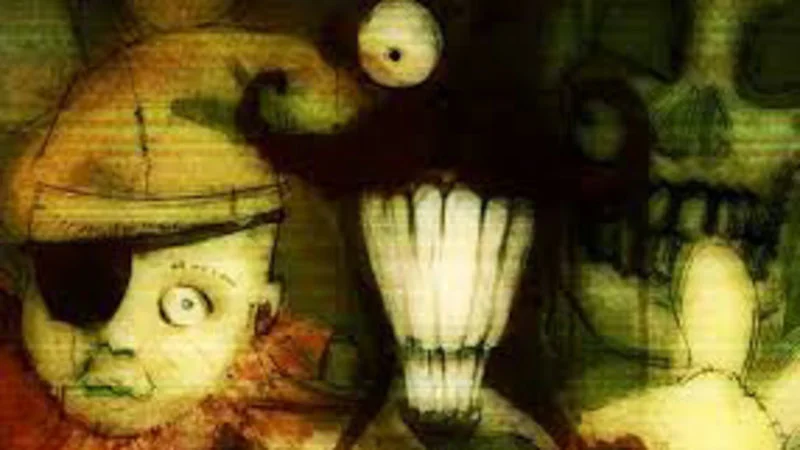
Candle Cove

2009Creepypasta / horror fiction / forum-format storyclassic
Candle Cove is Kris Straub's 2009 creepypasta, a forum-thread narrative about a nonexistent 1970s children's puppet show that so skillfully mimics real conversation that readers believe it's authentic nostalgia.

Candle Cove is a creepypasta short story written by Kris Straub in 2009, presented as a forum thread where adults piece together unsettling memories of a fictional 1970s children's puppet show1. The story's genius lies in its format: it mimics a real nostalgia forum so convincingly that readers often mistake it for an actual conversation, and its final twist reveals the "show" was nothing but television static2. It became one of the most iconic creepypastas ever written, spawning a massive fan community, a dedicated wiki, and the SyFy television series Channel Zero in 20163.

TL;DR

Candle Cove is a creepypasta short story written by Kris Straub in 2009, presented as a forum thread where adults piece together unsettling memories of a fictional 1970s children's puppet show.

Overview

Candle Cove takes the form of a message board thread on the fictional "NetNostalgia Forums," where a handful of users swap increasingly disturbing memories of a low-budget children's puppet show they watched in the early 1970s in the Ironton, Ohio area4. The show supposedly aired on Channel 58 and featured a girl named Janice, a cowardly pirate captain called Percy, a living pirate ship named the Laughingstock, and the terrifying Skin-Taker, a skeleton marionette in a top hat and cape made from children's skin8.

What makes Candle Cove so effective is how it builds dread through the everyday rhythms of internet conversation2. Forum users correct each other's memories, disagree on minor details, and gradually recall darker elements, like the Skin-Taker's grinding jaw and a nightmare episode where all the characters just screamed for thirty minutes straight1. The story ends when one user reports asking his mother about the show. She told him that whenever he said he was watching Candle Cove, he was just staring at a dead channel of static for half an hour8.

Kris Straub, a webcartoonist known for Checkerboard Nightmare, Starslip, and Chainsawsuit, wrote Candle Cove and published it on his horror fiction site Ichor Falls on March 15, 20095. The site collected short stories revolving around a fictional West Virginia town of the same name, inspired by Lovecraftian horror and the short fiction of Steven Millhauser6.

Straub traced his specific inspiration to a satirical March 2000 article in The Onion titled "Area 36-Year-Old Still Has Occasional Lidsville Nightmare," about an adult haunted by childhood memories of the Sid and Marty Krofft puppet show Lidsville7. In a 2011 interview with Kindertrauma, Straub said the premise struck him as frighteningly accurate: "So many things that scare us as kids start from this innocuous desire to entertain children, but it's produced carelessly, or some special effect comes out way more ponderous or ugly than the creators intended, and it lingers as we, as children, try to make it fit with our limited understanding of the world"6.

He published the story under a Creative Commons license, writing it mainly "just to get the idea out of my head"6. The choice to frame the horror as a forum thread, rather than a traditional narrative, proved to be the story's defining strength.

Origin & Background

Platform
Ichor Falls (Straub's horror fiction website)
Creator
Kris Straub
Date
2009

Kris Straub, a webcartoonist known for Checkerboard Nightmare, Starslip, and Chainsawsuit, wrote Candle Cove and published it on his horror fiction site Ichor Falls on March 15, 2009. The site collected short stories revolving around a fictional West Virginia town of the same name, inspired by Lovecraftian horror and the short fiction of Steven Millhauser.

Straub traced his specific inspiration to a satirical March 2000 article in The Onion titled "Area 36-Year-Old Still Has Occasional Lidsville Nightmare," about an adult haunted by childhood memories of the Sid and Marty Krofft puppet show Lidsville. In a 2011 interview with Kindertrauma, Straub said the premise struck him as frighteningly accurate: "So many things that scare us as kids start from this innocuous desire to entertain children, but it's produced carelessly, or some special effect comes out way more ponderous or ugly than the creators intended, and it lingers as we, as children, try to make it fit with our limited understanding of the world".

He published the story under a Creative Commons license, writing it mainly "just to get the idea out of my head". The choice to frame the horror as a forum thread, rather than a traditional narrative, proved to be the story's defining strength.

How It Spread

On June 5, 2009, Candle Cove was copied to Creepypasta.com, where it earned a 9.2 out of 10 rating and over 600 comments. By July 2009, YouTube creators had started uploading their own interpretations of supposed Candle Cove episodes, including clips of static and disturbing puppet footage. Throughout the second half of 2009, the story spread across 4chan's /x/ board, Reddit, IGN forums, TVForum.co.uk, and Horror.com.

A key part of the spread was the "play-along" behavior the story encouraged. Fans on real forums would re-enact the story post by post, as if they were actually reminiscing about a show they'd watched as children, tricking unsuspecting readers into believing it was real. This made Candle Cove function less like a traditional story and more like a digital urban legend, detached from its author and passed around as anonymous folklore.

By March 2010, fan art appeared on DeviantArt, and the Role Playing Public Radio podcast completed a six-hour World of Darkness tabletop game based on the premise of finding a Candle Cove VHS tape. On August 8, 2010, pages for the story went up on TV Tropes and the Creepypasta Wiki. In April 2011, fans established the Candle Cove Wiki, a collaborative project that fleshed out fake episode guides, character backstories, and a fictional 1767 book called The Nickerbocker's Tale that supposedly inspired the show. That June, the story got an Urban Dictionary entry.

Straub addressed the story's runaway growth in his November 2011 Kindertrauma interview, acknowledging the tension between his copyright and the story's natural behavior as an urban legend. "I know that serves the mythos way more than me being a litigious dick about it," he said, though he also noted discomfort with people profiting from his work without permission. He was particularly surprised by Rule 34 content featuring the Skin-Taker and Horace Horrible.

How to Use This Meme

Candle Cove isn't a meme template in the traditional sense. It's typically engaged with in a few ways:

1

Play-along threads: Post on a forum or social media as if you genuinely remember watching Candle Cove as a child. Add your own invented details about episodes, characters, or the Skin-Taker. Other fans will join in and build out the fiction together.

2

Static videos: Upload a video of television static and title it as a "recovered episode" of Candle Cove. Use the description and comments to maintain the bit.

3

Fan content: Create fan art of the characters (Janice, Percy, the Skin-Taker, the Laughingstock) or write original creepypasta set in the Candle Cove universe.

4

Reference the twist: In discussions about false memories, childhood nostalgia, or creepy children's media, drop the punchline: "My mom said I was just watching static."

Cultural Impact

Candle Cove's influence on internet horror is hard to overstate. It helped define what creepypasta could be as a literary form, proving that format and medium mattered as much as content. The forum-thread structure inspired countless imitators and showed that the internet itself could be a storytelling device, not just a distribution channel.

The SyFy adaptation Channel Zero ran for four seasons from 2016 to 2018, with each season adapting a different creepypasta. The show's existence proved that internet-born horror could support prestige television production. Straub's work also drew academic attention: Balanzategui's 2019 paper in the Journal of Visual Culture analyzed it as an example of "digital gothic," examining how the story weaponized the affordances of web forums to produce horror.

The play-along behavior Candle Cove inspired became a template for how internet communities engage with collaborative fiction. When fans re-enacted the forum thread on real message boards, they were doing something new: turning fiction into a participatory social performance, blurring the line between author and audience in a way that anticipated later trends in ARGs and collaborative worldbuilding.

Full History

Candle Cove arrived at a pivotal moment for internet horror. In 2009, the creepypasta format was still coalescing as a genre, and most entries were anonymous stories passed around /x/ threads and copy-paste archives. Straub's story stood apart because it came from a known author and had a specific publication date, something The Verge later noted was unusual for a form that typically had "an anonymous folkloric quality".

The forum-thread format was the key innovation. Unlike traditional horror fiction, there was no omniscient narrator guiding the reader toward a scare. Instead, the horror emerged organically through the gaps between what different users remembered. One poster recalled the show's villain being Pirate Percy; another corrected him, explaining that was just the sidekick, Horace Horrible. The real villain was the Skin-Taker. These small disagreements mirrored how people actually remember childhood media: imperfectly, in fragments, with the creepiest details returning last.

Line Henriksen, a doctoral candidate at Sweden's Linköping University studying hauntology and creepypasta, attributed the story's rabid fandom both to its verisimilitude and its open-endedness. "This type of horror is fairly common when it comes to creepypasta, which often claims to be presenting you with a glimpse of a terrible truth that cannot be unseen and that may infect, contaminate and haunt you forever," she told Atlas Obscura. The ambiguity around what Candle Cove actually was, whether supernatural broadcast, shared hallucination, or something else, gave fans enormous creative space.

That space got filled quickly. The fan-built Candle Cove Wiki grew to include detailed descriptions of two full "seasons" of the show, complete with episode synopses and character arcs, all invented by the community. YouTube became a major hub for Candle Cove content, splitting into two camps that TV Tropes documented: videos of actual puppet footage that fans presented as "recovered" episodes, and videos of pure static where commenters played along by insisting they could see the show. One YouTuber uploaded thirty minutes of static and used the description and comments to build the illusion of a real broadcast. This created a recurring problem where newcomers unfamiliar with the twist ending were genuinely confused about why they were watching dead air.

The story's biggest mainstream moment came in February 2016 when SyFy greenlit Channel Zero, a horror anthology series with each season adapting a different creepypasta. The first season, Channel Zero: Candle Cove, expanded the short story into a six-episode arc starring Paul Schneider as Mike Painter, a child psychologist returning to his hometown of Iron Hill, Ohio, to investigate decades-old disappearances linked to the mysterious puppet show. Fiona Shaw played his mother Marla. The season premiered on October 11, 2016. A trailer uploaded to SyFy's YouTube channel on September 26, 2016, hit the front page of Reddit's r/creepy with over 2,200 upvotes.

The television adaptation took significant creative liberties. It introduced a supernatural "Tooth Monster" as a physical manifestation of Mike's dead twin brother Eddie, reimagined the Skin-Taker as a creature wandering the real world, and set the story in the 1980s rather than the 1970s. The season ended with Mike willingly trapping himself in a dimension called Candle Cove to contain Eddie's spirit. While the show brought the creepypasta to a wider audience, Straub had previously cautioned against over-explaining the mystery. "I think Candle Cove works because it is brief and vague and interrupted," he told Kindertrauma. "I think to put a name or face to whatever is behind the making of the show is to spoil the magic".

Critical reception for the original story was strong. Will Wiles of Aeon called it "among the best creepypastas out there" and praised its use of the forum format as a storytelling method. Adi Robertson of The Verge described it as "a perfectly dark spin on our nostalgia for the half-remembered stories of our childhood, that realization that the things we liked as kids were much, much creepier than we thought". Jessica Balanzategui published an academic paper in the Journal of Visual Culture in 2019 examining Candle Cove through the lens of the "digital gothic".

Straub later went on to create LOCAL 58, a web series using a similar concept of corrupted television broadcasts, which drew connections from fans who recognized the shared DNA. In 2015, he self-published the story in a collection titled Candle Cove and Other Stories.

Fun Facts

Straub looked up real call letters for a TV station near Ironton, Ohio, and the names of nearby towns to give the story geographic believability.

The Onion article that inspired Candle Cove was about Lidsville, a real 1971 Sid and Marty Krofft show featuring Charles Nelson Reilly cavorting with sentient hats.

The original Ichor Falls domain where Candle Cove was first published is now a parked domain for sale at $6,395.

Some fans insist on commenting that YouTube videos of Candle Cove footage are "just static," while others comment on actual static videos describing what they "see," creating a layered meta-joke.

Straub wrote the story under a Creative Commons license, which both helped and complicated its spread as an urban legend.

Derivatives & Variations

Candle Cove Wiki:

A fan-built wiki with invented episode guides, character pages, and lore expansions including a fictional 18th-century book called The Nickerbocker's Tale[3].

YouTube "episodes":

Fan-made videos ranging from puppet footage presented as recovered broadcasts to pure static with elaborate in-character comment sections[5].

Channel Zero: Candle Cove:

SyFy's six-episode television adaptation premiering October 2016, expanding the story into a supernatural thriller about a child psychologist and his dead twin brother[4].

World of Darkness tabletop game:

The Role Playing Public Radio podcast ran a pen-and-paper RPG scenario based on characters finding a Candle Cove VHS tape[5].

Fan fiction sequels:

Various stories attempting to explain what Candle Cove actually was, with explanations ranging from a secret NASA experiment to sentient puppets to Nazis, a trend Straub himself cautioned against[9].

LOCAL 58:

Straub's later web series about corrupted local television broadcasts, sharing thematic DNA with Candle Cove's premise of sinister signals hidden in normal TV[9].

Rule 34 content:

Acknowledged by Straub himself in his Kindertrauma interview with bemused discomfort[6].

Frequently Asked Questions

CandleCove

2009Creepypasta / horror fiction / forum-format storyclassic
Candle Cove is Kris Straub's 2009 creepypasta, a forum-thread narrative about a nonexistent 1970s children's puppet show that so skillfully mimics real conversation that readers believe it's authentic nostalgia.

Candle Cove is a creepypasta short story written by Kris Straub in 2009, presented as a forum thread where adults piece together unsettling memories of a fictional 1970s children's puppet show. The story's genius lies in its format: it mimics a real nostalgia forum so convincingly that readers often mistake it for an actual conversation, and its final twist reveals the "show" was nothing but television static. It became one of the most iconic creepypastas ever written, spawning a massive fan community, a dedicated wiki, and the SyFy television series Channel Zero in 2016.

TL;DR

Candle Cove is a creepypasta short story written by Kris Straub in 2009, presented as a forum thread where adults piece together unsettling memories of a fictional 1970s children's puppet show.

Overview

Candle Cove takes the form of a message board thread on the fictional "NetNostalgia Forums," where a handful of users swap increasingly disturbing memories of a low-budget children's puppet show they watched in the early 1970s in the Ironton, Ohio area. The show supposedly aired on Channel 58 and featured a girl named Janice, a cowardly pirate captain called Percy, a living pirate ship named the Laughingstock, and the terrifying Skin-Taker, a skeleton marionette in a top hat and cape made from children's skin.

What makes Candle Cove so effective is how it builds dread through the everyday rhythms of internet conversation. Forum users correct each other's memories, disagree on minor details, and gradually recall darker elements, like the Skin-Taker's grinding jaw and a nightmare episode where all the characters just screamed for thirty minutes straight. The story ends when one user reports asking his mother about the show. She told him that whenever he said he was watching Candle Cove, he was just staring at a dead channel of static for half an hour.

Kris Straub, a webcartoonist known for Checkerboard Nightmare, Starslip, and Chainsawsuit, wrote Candle Cove and published it on his horror fiction site Ichor Falls on March 15, 2009. The site collected short stories revolving around a fictional West Virginia town of the same name, inspired by Lovecraftian horror and the short fiction of Steven Millhauser.

Straub traced his specific inspiration to a satirical March 2000 article in The Onion titled "Area 36-Year-Old Still Has Occasional Lidsville Nightmare," about an adult haunted by childhood memories of the Sid and Marty Krofft puppet show Lidsville. In a 2011 interview with Kindertrauma, Straub said the premise struck him as frighteningly accurate: "So many things that scare us as kids start from this innocuous desire to entertain children, but it's produced carelessly, or some special effect comes out way more ponderous or ugly than the creators intended, and it lingers as we, as children, try to make it fit with our limited understanding of the world".

He published the story under a Creative Commons license, writing it mainly "just to get the idea out of my head". The choice to frame the horror as a forum thread, rather than a traditional narrative, proved to be the story's defining strength.

Origin & Background

Platform
Ichor Falls (Straub's horror fiction website)
Creator
Kris Straub
Date
2009

Kris Straub, a webcartoonist known for Checkerboard Nightmare, Starslip, and Chainsawsuit, wrote Candle Cove and published it on his horror fiction site Ichor Falls on March 15, 2009. The site collected short stories revolving around a fictional West Virginia town of the same name, inspired by Lovecraftian horror and the short fiction of Steven Millhauser.

Straub traced his specific inspiration to a satirical March 2000 article in The Onion titled "Area 36-Year-Old Still Has Occasional Lidsville Nightmare," about an adult haunted by childhood memories of the Sid and Marty Krofft puppet show Lidsville. In a 2011 interview with Kindertrauma, Straub said the premise struck him as frighteningly accurate: "So many things that scare us as kids start from this innocuous desire to entertain children, but it's produced carelessly, or some special effect comes out way more ponderous or ugly than the creators intended, and it lingers as we, as children, try to make it fit with our limited understanding of the world".

He published the story under a Creative Commons license, writing it mainly "just to get the idea out of my head". The choice to frame the horror as a forum thread, rather than a traditional narrative, proved to be the story's defining strength.

How It Spread

On June 5, 2009, Candle Cove was copied to Creepypasta.com, where it earned a 9.2 out of 10 rating and over 600 comments. By July 2009, YouTube creators had started uploading their own interpretations of supposed Candle Cove episodes, including clips of static and disturbing puppet footage. Throughout the second half of 2009, the story spread across 4chan's /x/ board, Reddit, IGN forums, TVForum.co.uk, and Horror.com.

A key part of the spread was the "play-along" behavior the story encouraged. Fans on real forums would re-enact the story post by post, as if they were actually reminiscing about a show they'd watched as children, tricking unsuspecting readers into believing it was real. This made Candle Cove function less like a traditional story and more like a digital urban legend, detached from its author and passed around as anonymous folklore.

By March 2010, fan art appeared on DeviantArt, and the Role Playing Public Radio podcast completed a six-hour World of Darkness tabletop game based on the premise of finding a Candle Cove VHS tape. On August 8, 2010, pages for the story went up on TV Tropes and the Creepypasta Wiki. In April 2011, fans established the Candle Cove Wiki, a collaborative project that fleshed out fake episode guides, character backstories, and a fictional 1767 book called The Nickerbocker's Tale that supposedly inspired the show. That June, the story got an Urban Dictionary entry.

Straub addressed the story's runaway growth in his November 2011 Kindertrauma interview, acknowledging the tension between his copyright and the story's natural behavior as an urban legend. "I know that serves the mythos way more than me being a litigious dick about it," he said, though he also noted discomfort with people profiting from his work without permission. He was particularly surprised by Rule 34 content featuring the Skin-Taker and Horace Horrible.

How to Use This Meme

Candle Cove isn't a meme template in the traditional sense. It's typically engaged with in a few ways:

1

Play-along threads: Post on a forum or social media as if you genuinely remember watching Candle Cove as a child. Add your own invented details about episodes, characters, or the Skin-Taker. Other fans will join in and build out the fiction together.

2

Static videos: Upload a video of television static and title it as a "recovered episode" of Candle Cove. Use the description and comments to maintain the bit.

3

Fan content: Create fan art of the characters (Janice, Percy, the Skin-Taker, the Laughingstock) or write original creepypasta set in the Candle Cove universe.

4

Reference the twist: In discussions about false memories, childhood nostalgia, or creepy children's media, drop the punchline: "My mom said I was just watching static."

Cultural Impact

Candle Cove's influence on internet horror is hard to overstate. It helped define what creepypasta could be as a literary form, proving that format and medium mattered as much as content. The forum-thread structure inspired countless imitators and showed that the internet itself could be a storytelling device, not just a distribution channel.

The SyFy adaptation Channel Zero ran for four seasons from 2016 to 2018, with each season adapting a different creepypasta. The show's existence proved that internet-born horror could support prestige television production. Straub's work also drew academic attention: Balanzategui's 2019 paper in the Journal of Visual Culture analyzed it as an example of "digital gothic," examining how the story weaponized the affordances of web forums to produce horror.

The play-along behavior Candle Cove inspired became a template for how internet communities engage with collaborative fiction. When fans re-enacted the forum thread on real message boards, they were doing something new: turning fiction into a participatory social performance, blurring the line between author and audience in a way that anticipated later trends in ARGs and collaborative worldbuilding.

Full History

Candle Cove arrived at a pivotal moment for internet horror. In 2009, the creepypasta format was still coalescing as a genre, and most entries were anonymous stories passed around /x/ threads and copy-paste archives. Straub's story stood apart because it came from a known author and had a specific publication date, something The Verge later noted was unusual for a form that typically had "an anonymous folkloric quality".

The forum-thread format was the key innovation. Unlike traditional horror fiction, there was no omniscient narrator guiding the reader toward a scare. Instead, the horror emerged organically through the gaps between what different users remembered. One poster recalled the show's villain being Pirate Percy; another corrected him, explaining that was just the sidekick, Horace Horrible. The real villain was the Skin-Taker. These small disagreements mirrored how people actually remember childhood media: imperfectly, in fragments, with the creepiest details returning last.

Line Henriksen, a doctoral candidate at Sweden's Linköping University studying hauntology and creepypasta, attributed the story's rabid fandom both to its verisimilitude and its open-endedness. "This type of horror is fairly common when it comes to creepypasta, which often claims to be presenting you with a glimpse of a terrible truth that cannot be unseen and that may infect, contaminate and haunt you forever," she told Atlas Obscura. The ambiguity around what Candle Cove actually was, whether supernatural broadcast, shared hallucination, or something else, gave fans enormous creative space.

That space got filled quickly. The fan-built Candle Cove Wiki grew to include detailed descriptions of two full "seasons" of the show, complete with episode synopses and character arcs, all invented by the community. YouTube became a major hub for Candle Cove content, splitting into two camps that TV Tropes documented: videos of actual puppet footage that fans presented as "recovered" episodes, and videos of pure static where commenters played along by insisting they could see the show. One YouTuber uploaded thirty minutes of static and used the description and comments to build the illusion of a real broadcast. This created a recurring problem where newcomers unfamiliar with the twist ending were genuinely confused about why they were watching dead air.

The story's biggest mainstream moment came in February 2016 when SyFy greenlit Channel Zero, a horror anthology series with each season adapting a different creepypasta. The first season, Channel Zero: Candle Cove, expanded the short story into a six-episode arc starring Paul Schneider as Mike Painter, a child psychologist returning to his hometown of Iron Hill, Ohio, to investigate decades-old disappearances linked to the mysterious puppet show. Fiona Shaw played his mother Marla. The season premiered on October 11, 2016. A trailer uploaded to SyFy's YouTube channel on September 26, 2016, hit the front page of Reddit's r/creepy with over 2,200 upvotes.

The television adaptation took significant creative liberties. It introduced a supernatural "Tooth Monster" as a physical manifestation of Mike's dead twin brother Eddie, reimagined the Skin-Taker as a creature wandering the real world, and set the story in the 1980s rather than the 1970s. The season ended with Mike willingly trapping himself in a dimension called Candle Cove to contain Eddie's spirit. While the show brought the creepypasta to a wider audience, Straub had previously cautioned against over-explaining the mystery. "I think Candle Cove works because it is brief and vague and interrupted," he told Kindertrauma. "I think to put a name or face to whatever is behind the making of the show is to spoil the magic".

Critical reception for the original story was strong. Will Wiles of Aeon called it "among the best creepypastas out there" and praised its use of the forum format as a storytelling method. Adi Robertson of The Verge described it as "a perfectly dark spin on our nostalgia for the half-remembered stories of our childhood, that realization that the things we liked as kids were much, much creepier than we thought". Jessica Balanzategui published an academic paper in the Journal of Visual Culture in 2019 examining Candle Cove through the lens of the "digital gothic".

Straub later went on to create LOCAL 58, a web series using a similar concept of corrupted television broadcasts, which drew connections from fans who recognized the shared DNA. In 2015, he self-published the story in a collection titled Candle Cove and Other Stories.

Fun Facts

Straub looked up real call letters for a TV station near Ironton, Ohio, and the names of nearby towns to give the story geographic believability.

The Onion article that inspired Candle Cove was about Lidsville, a real 1971 Sid and Marty Krofft show featuring Charles Nelson Reilly cavorting with sentient hats.

The original Ichor Falls domain where Candle Cove was first published is now a parked domain for sale at $6,395.

Some fans insist on commenting that YouTube videos of Candle Cove footage are "just static," while others comment on actual static videos describing what they "see," creating a layered meta-joke.

Straub wrote the story under a Creative Commons license, which both helped and complicated its spread as an urban legend.

Derivatives & Variations

Candle Cove Wiki:

A fan-built wiki with invented episode guides, character pages, and lore expansions including a fictional 18th-century book called The Nickerbocker's Tale[3].

YouTube "episodes":

Fan-made videos ranging from puppet footage presented as recovered broadcasts to pure static with elaborate in-character comment sections[5].

Channel Zero: Candle Cove:

SyFy's six-episode television adaptation premiering October 2016, expanding the story into a supernatural thriller about a child psychologist and his dead twin brother[4].

World of Darkness tabletop game:

The Role Playing Public Radio podcast ran a pen-and-paper RPG scenario based on characters finding a Candle Cove VHS tape[5].

Fan fiction sequels:

Various stories attempting to explain what Candle Cove actually was, with explanations ranging from a secret NASA experiment to sentient puppets to Nazis, a trend Straub himself cautioned against[9].

LOCAL 58:

Straub's later web series about corrupted local television broadcasts, sharing thematic DNA with Candle Cove's premise of sinister signals hidden in normal TV[9].

Rule 34 content:

Acknowledged by Straub himself in his Kindertrauma interview with bemused discomfort[6].

Frequently Asked Questions