Liminal Spaces
Published March 10, 2026 · Updated March 18, 2026
Also known as: Liminal Space Aesthetic · Spaces Liminaux
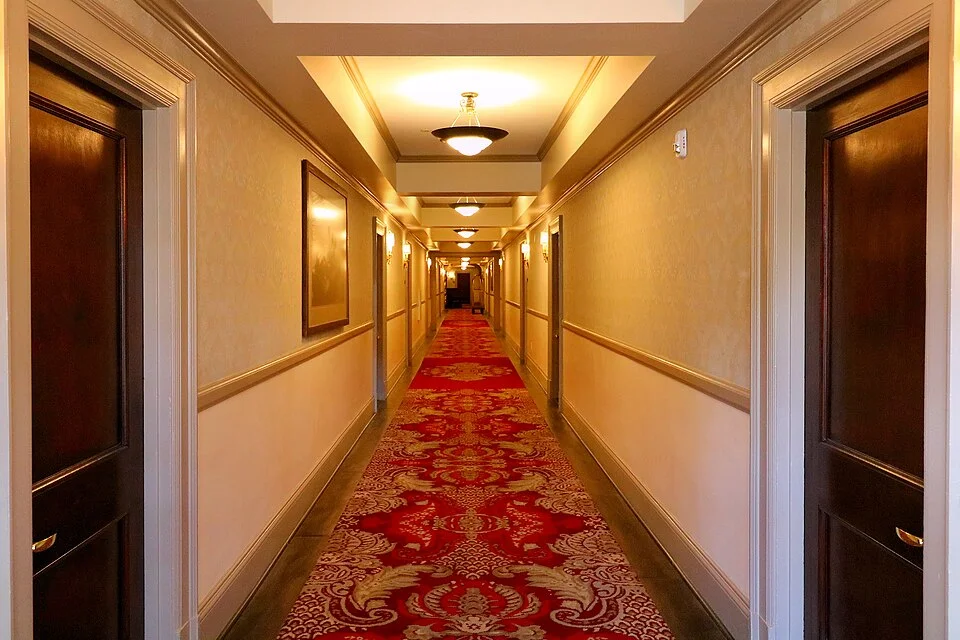
Liminal Spaces is an internet aesthetic built around photos of empty, transitional places that feel eerily familiar yet deeply unsettling. The trend exploded in 2019 after a 4chan post introduced The Backrooms creepypasta, and it grew into one of the internet's most recognizable visual movements during the COVID-19 pandemic. The aesthetic taps into a psychological sweet spot between nostalgia and dread, turning mundane locations like empty hallways, vacant malls, and deserted parking lots into something that feels fundamentally wrong.
Overview
Liminal Spaces as an internet aesthetic centers on images of places that should be full of people but aren't. Empty school hallways at night, deserted shopping malls with the lights still on, hotel corridors stretching into nowhere, parking garages without a single car. The images share a few key traits: artificial lighting (usually fluorescent), a complete absence of people, low image quality or compression artifacts, and architecture from roughly the 1980s through early 2000s27.
What makes these images hit different from regular photos of empty buildings is the psychological tension they create. The spaces are recognizable. You've been in rooms like these. But stripped of their usual context, your brain flags something as off7. MIT professor Carlo Ratti describes this as a break from "spatial narratives," the story a given space tells you about what should be happening there7. When a school has no students or a stadium has no fans, the expected script falls apart.
The aesthetic draws heavily on concepts like kenopsia (the eeriness of abandoned places) and anemoia (nostalgia for a time you never experienced), both coined by The Dictionary of Obscure Sorrows2. Many viewers report feeling like they've visited these exact rooms before, possibly in dreams, even when they know they haven't5.
Gallery
Origin & Background
How It Spread
How to Use This Meme
Liminal space content typically follows a few conventions:
Find the right location. Transitional spaces work best: hallways, stairwells, empty malls, hotel lobbies, parking structures, school corridors. The space should be one that people normally associate with crowds or activity27.
Remove all signs of life. The power of the image comes from the absence. No people, ideally no personal belongings or evidence of recent use. The space should look like everyone just vanished2.
Lean into the lighting. Fluorescent overhead lights are the classic choice. Harsh, slightly yellow or green-tinted artificial lighting adds to the unsettling quality. Natural light tends to break the effect6.
Embrace low fidelity. Many effective liminal space images have visible compression artifacts, slight blur, or the washed-out quality of early digital cameras. This mimics the look of photos from the late 1990s and early 2000s, which adds a layer of temporal displacement6.
Post without much context. The standard format on Reddit, Twitter, and TikTok is to share the image with minimal or no caption, letting the visual do the work. Some creators add ambient drone music or the hum of fluorescent lights for video content.
Cultural Impact
Fun Facts
The specific shade of yellow in The Backrooms image became so iconic that fans call it "mono-yellow," a term also used to describe the color palette in Stanley Kubrick's *The Shining*46.
The original Backrooms image is believed to be from an emptied-out HobbyTown USA store, though the exact location was never confirmed6.
The term "noclip," central to The Backrooms lore, comes from a cheat command in id Software's *Quake* engine that lets players walk through walls24.
Sports architect Michael Lockwood told *Popular Mechanics* that truly liminal feelings require familiarity, saying the effect doesn't work for spaces like freighter ships because "my body doesn't relate to the thing"7.
The Dictionary of Obscure Sorrows coined two words that became central to how people talk about liminal spaces: "kenopsia" (the eeriness of places left behind) and "anemoia" (nostalgia for a time you never knew)2.
Derivatives & Variations
Backrooms (horror fiction set in liminal spaces)
A variation of Liminal Spaces
(2019)Vaporwave (aesthetic sharing some liminal qualities)
A variation of Liminal Spaces
(2019)AI-Generated Liminal Spaces (machine learning creations)
A variation of Liminal Spaces
(2019)Liminal Space Photography (documentary-style collections)
A variation of Liminal Spaces
(2019)Liminal Horror (combining aesthetic with horror elements)
A variation of Liminal Spaces
(2019)Frequently Asked Questions
References (7)
- 1
- 2
- 3
- 4Liminal space (aesthetic)encyclopedia
- 5Liminal Spaces - Urban Dictionarydictionary
- 6
- 7