Check Your Privilege
Published March 24, 2026
"Check Your Privilege" is an online expression used in social justice circles to tell someone they should recognize the unearned advantages their identity (race, gender, class, sexuality) gives them before weighing in on issues affecting less privileged groups. The phrase entered internet discourse through activist blogs around 2006, building on Peggy McIntosh's foundational 1989 essay on white privilege2. It became one of the most recognizable and polarizing catchphrases of the 2010s culture wars, exploding on Tumblr, sparking mainstream media coverage, generating waves of parody content, and resurfacing as a viral TikTok challenge during the 2020 Black Lives Matter protests10.
Overview
"Check Your Privilege" is a directive telling someone to recognize the social advantages they carry based on identity markers like race, gender, sexuality, class, or physical ability. In online arguments, it gets deployed when someone from a more privileged background makes a complaint or claim that others view as tone-deaf. The phrase works as both a sincere call for self-awareness and a conversation-ending shutdown, depending on who's using it and how.
The expression draws from academic privilege theory, specifically the idea that members of dominant groups move through life unaware of advantages that marginalized people notice daily2. Peggy McIntosh described white privilege as "an invisible weightless knapsack of special provisions, maps, passports, codebooks, visas, clothes, tools and blank checks"2. On the internet, "check your privilege" became shorthand for this entire framework: that personal experiences are shaped by structural inequalities, and failing to account for those inequalities makes your perspective incomplete.
Over time, the phrase became a lightning rod. Supporters saw it as a necessary corrective to blind spots in public discourse. Critics, including some progressives, argued it had devolved into a rhetorical weapon used to silence disagreement rather than foster genuine dialogue6.
Gallery
Origin & Background
How It Spread
How to Use This Meme
"Check your privilege" typically gets used in one of three ways:
As a sincere request: When someone makes a complaint or argument that ignores advantages they have. For example, a wealthy person complaining about minor inconveniences to someone struggling financially might be told to check their privilege as a genuine invitation to consider their relative position.
As a debate tactic: Deployed in online arguments to signal that someone's perspective is limited by their social position. This usage is common on social media platforms when discussions about race, gender, or class get heated.
As ironic commentary: Used sarcastically or in meme format to mock both the phrase itself and the discourse around it. Parody accounts and satirical content often exaggerate the concept to absurd extremes8.
The phrase also works as a TikTok challenge format: hold up ten fingers, lower one for each experience of discrimination you've faced, and compare results with others to visualize privilege differences11.
Cultural Impact
Full History
Fun Facts
Peggy McIntosh's original 1989 essay listed exactly 26 daily advantages of being white, and she repeatedly forgot each realization until she wrote it down, calling white privilege "an elusive and fugitive subject"2.
The Guardian article comparing privilege-checking to "GOD HATES FAGS" sign-wavers noted that the author once had to put a trigger warning on a post about balloons because a reader was globophobic6.
The Shrub.com blog post that popularized the phrase was written as a response to a specific man's frustration at always being told what *not* to do but never what *to* do1.
The WMST-L academic listserv discussed McIntosh's essay for over a decade, from 1992 through at least 2003, with ongoing debates about whether her framework adequately addressed class and Jewish identity17.
Princeton freshman Tal Fortgang's 2014 privilege essay was described by the *Ordinary Times* blog as "so humdrum and repetitive" that the real mystery was why *this* particular incident went viral12.
Derivatives & Variations
Children Who Need To Check Their Privilege
— A parody Tumblr blog launched in August 2012 that posted satirical privilege-checking commentary on photos of babies and small animals, mocking the extremes of social justice blogging[8].
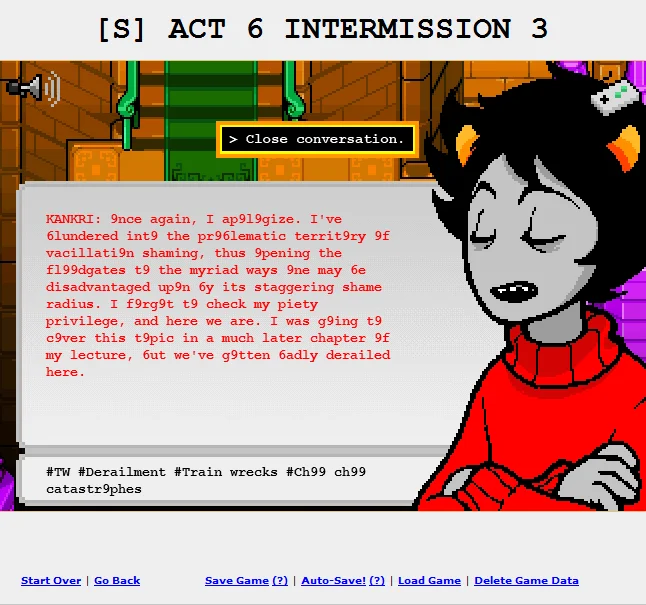
Kankri (Homestuck)
— A character introduced on August 31, 2012 in the webcomic Homestuck, designed as a parody of stereotypical Tumblr social justice bloggers who references "checking his piety privilege"[7].
"Put a Finger Down" Privilege Challenge
— A TikTok format created by @boss_bigmamma in June 2020 that turned the concept into a participatory video game, asking viewers to lower fingers for experiences of racial discrimination[10].
Female/Male Privilege Counter-Lists
— Various bloggers created counter-checklists adapting McIntosh's framework, including FeministCritics' 24-item female privilege list and Alas! A Blog's compilation of fifteen different privilege checklists[15][14].
American Privilege
— CounterPunch extended the framework to national identity, arguing Americans enjoy structural advantages including "the luxury of obliviousness" about other countries[16].
Straight Privilege Checklist
— Earlham College students adapted McIntosh's white privilege framework into a list examining daily effects of heterosexual privilege[7].
Frequently Asked Questions
References (25)
- 1
- 2
- 3
- 4Check Your Privilege - Know Your Memeencyclopedia
- 5Marriage Storyencyclopedia
- 6Check Your Privilege - Urban Dictionarydictionary
- 7
- 8
- 9
- 10
- 11
- 12
- 13
- 14
- 15White Privilegearticle
- 16
- 17
- 18Private Sitearticle
- 19One moment, please...article
- 20
- 21
- 22
- 23die+cis+scum | Tumblrarticle
- 24
- 25