Cult Of Kek
Published August 14, 2026
The Cult of Kek is a satirical religion that emerged from 4chan in 2015-2016, worshipping an ancient Egyptian frog deity named Kek and connecting Pepe the Frog to 'meme magic' during the 2016 U.S. presidential election. The movement blurred lines between ironic trolling and genuine belief, becoming one of the internet's strangest intersections of mythology, politics, and imageboard culture.
Overview
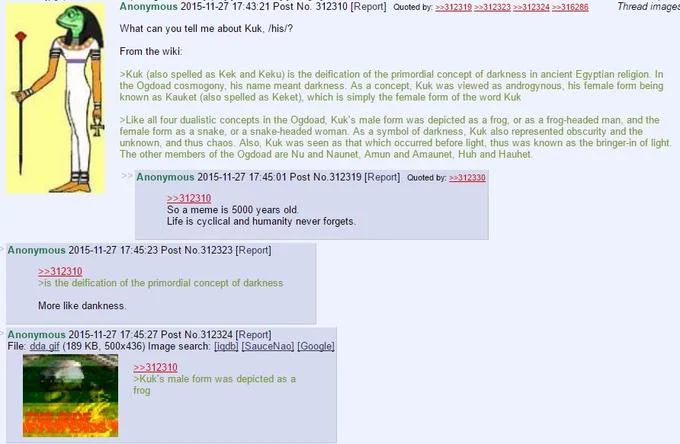
The Cult of Kek, also known as the Church of Kek, is a satirical religion created by 4chan users that centers on worshipping Kek, a genuine ancient Egyptian deity of darkness and chaos3. Kek was traditionally depicted as a frog or frog-headed man, which 4chan users connected to Pepe the Frog, treating Pepe as Kek's modern avatar1. The belief system holds that followers can use 'meme magic' to influence reality, particularly through posts that end in repeating numbers known as 'dubs' or 'trips'3.
The movement sits at a strange intersection of irony and sincerity. When users on r/The_Donald were asked if they actually worshipped Pepe, responses were notably mixed2. For some participants, Kek worship is pure satire. For others, it functions as a genuine prayer system intended to 'twist reality around the memes we make'4. This ambiguity is by design, using what researchers call 'an ironic and irrelevant mode of communication' that lets believers hide their politics while openly promoting them4.
Practitioners frequently write 'praise Kek' and ironically call their church 'a religion of peace'3. The ideology was codified in a series of eight books published under the pseudonym 'Saint Obamas Momjeans' in 2016-2017, deliberately using a satirical name to deflect serious analysis4. Posts ending in sevens hold special significance, as seven is considered holy in many cultures, with triple sixes (666) representing satanic opposition3.
Gallery
Origin & Background
How It Spread
How to Use This Meme
Participating in Kek worship typically involves posting 'praise Kek' in threads, especially when posts achieve repeating digits. The core belief is that memes can influence reality through collective will, with posts ending in dubs (11, 22), trips (111, 222), or quads having more 'power.' Users often frame predictions or wishes as posts, hoping for a lucky number sequence to 'confirm' them. The format blends genuine community ritual with obvious irony, making it difficult to distinguish believers from trolls.
Fun Facts
The term 'kek' originated from Korean StarCraft players typing 'ㅋㅋㅋ' for laughter, which rendered as 'kekeke' in Roman letters since the game didn't support Korean characters5.
Kek is a real Egyptian deity from the Ogdoad cosmogony, depicted as a frog-headed man representing primordial darkness before creation1.
The 77777777 GET (a post numbered with eight consecutive sevens) that read 'Trump will win' became a central piece of Kek mythology, treated as prophecy fulfilled after the 2016 election1.
Wired noted that the Cult of Kek is in many ways the opposite of Tumblr's witchblr community: predominantly male versus predominantly female, but both represent online communities mixing irony with occult aesthetics3.
The ideology behind the Cult of Kek was explained in eight books written under the pseudonym 'Saint Obamas Momjeans', a satirical name designed to prevent serious analysis4.
Frequently Asked Questions
References (6)
- 1
- 2
- 3
- 4
- 5
- 6