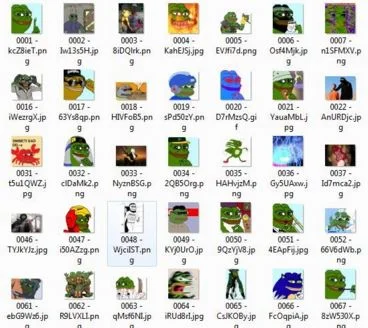
Rare Pepe
Published March 10, 2026 · Updated March 17, 2026
Also known as: Rare Pepes · Pepe trading cards · RARE PEPE DO NOT SAVE
Rare Pepe is a meme economy built around collecting, trading, and hoarding unique illustrations and photoshops of Pepe the Frog, treating them like scarce trading cards with fluctuating value. The concept emerged on 4chan's /r9k/ board around 2014-2015 as a satirical response to Pepe going mainstream, complete with watermarked images reading "RARE PEPE DO NOT SAVE"1. What started as an ironic joke about artificial scarcity evolved into a real blockchain-based trading ecosystem, with individual Rare Pepe cards selling for tens of thousands of dollars3.
Overview
Rare Pepe refers to the practice of treating custom-made Pepe the Frog illustrations as collectible items with artificial scarcity. The core joke is simple: if a Pepe image is unique or unusual enough, it's "rare," and sharing it freely would crash its value. Users watermarked their best Pepes with warnings like "RARE PEPE DO NOT SAVE" to signal exclusivity1. The concept plays on stock market language and trading card culture, turning a free internet image into a mock commodity.
The meme operates on two levels. On the surface, it's an absurdist bit about treating JPEGs like fine art. Underneath, it's a sharp satire of how the internet assigns value to things, how scarcity drives demand, and how communities gatekeep culture1. The irony deepened when blockchain technology made the joke real, allowing Rare Pepes to function as actual scarce digital assets years before the mainstream NFT boom3.
Gallery
Origin & Background
How It Spread
How to Use This Meme
The Rare Pepe concept works on two levels: the joke and the actual trading system.
The joke format: Find or create a unique Pepe the Frog illustration. The weirder, more detailed, or more unexpected the design, the "rarer" it is. Slap a watermark on it reading "RARE PEPE DO NOT SAVE" or similar warning text. Share it sparingly, acting as though copying the image would crash an imaginary market. The humor comes from treating a freely copyable JPEG like a scarce commodity.
The trading card format: On platforms like RarePepeWallet.com or Pepe.wtf, Rare Pepes are formatted as trading cards with limited supply36. Artists submit original Pepe artwork for curation review. Accepted submissions are minted as blockchain tokens with a fixed quantity. Collectors buy, sell, and trade the cards using PepeCash or other cryptocurrencies. The community values originality and "dankness" over technical skill3.
Cultural Impact
Full History
Fun Facts
The 1,200-image Pepe dump known as "the Peppening" was labeled "the end is nigh, hope you cash out now" by its poster3.
Peter Kell's Homer Pepe card appreciated roughly 710% in three years, going from $38,500 to $312,0004.
Matt Furie himself contributed an original illustration to the Rare Pepe series in October 2021, effectively endorsing the project7.
The Rare Pepe submission guidelines specifically required that Pepes be "dank," making dankness an official quality standard3.
An Israeli television clip with fake subtitles discussing a "Rare Pepe economic crash" was uploaded to YouTube in May 2015, blending real-world financial language with meme culture4.
Derivatives & Variations
PepeCash:
A dedicated cryptocurrency used for trading Rare Pepe cards on the Counterparty platform, trading at roughly 302 per dollar as of early 2017[3].
Fake Rares and Dank Rares:
Spinoff collections hosted on pepe.wtf that expanded the Rare Pepe format beyond the original Counterparty directory[7].
Memeables:
A digital art collection connected to the Rare Pepe ecosystem, described as aiming to "expand those original mediums and make you laugh"[7].
Homer Pepe (HOMERPEPE):
The most famous individual Rare Pepe card, a one-of-one Homer Simpson-themed design that sold for $38,500 in 2018 and $312,000 in 2021[4].
/r/rarepepemarket:
A subreddit launched April 1, 2015 for discussion and trading of Rare Pepe images[4].
Frequently Asked Questions
References (14)
- 1
- 2
- 3
- 4Rare Pepe - Know Your Memeencyclopedia
- 5Pepe the Frogencyclopedia
- 6Rare Pepe - Urban Dictionarydictionary
- 7Pepe.wtfarticle
- 8
- 91,272 Rare Pepesarticle
- 10
- 11Down for maintenance.article
- 12
- 13
- 14