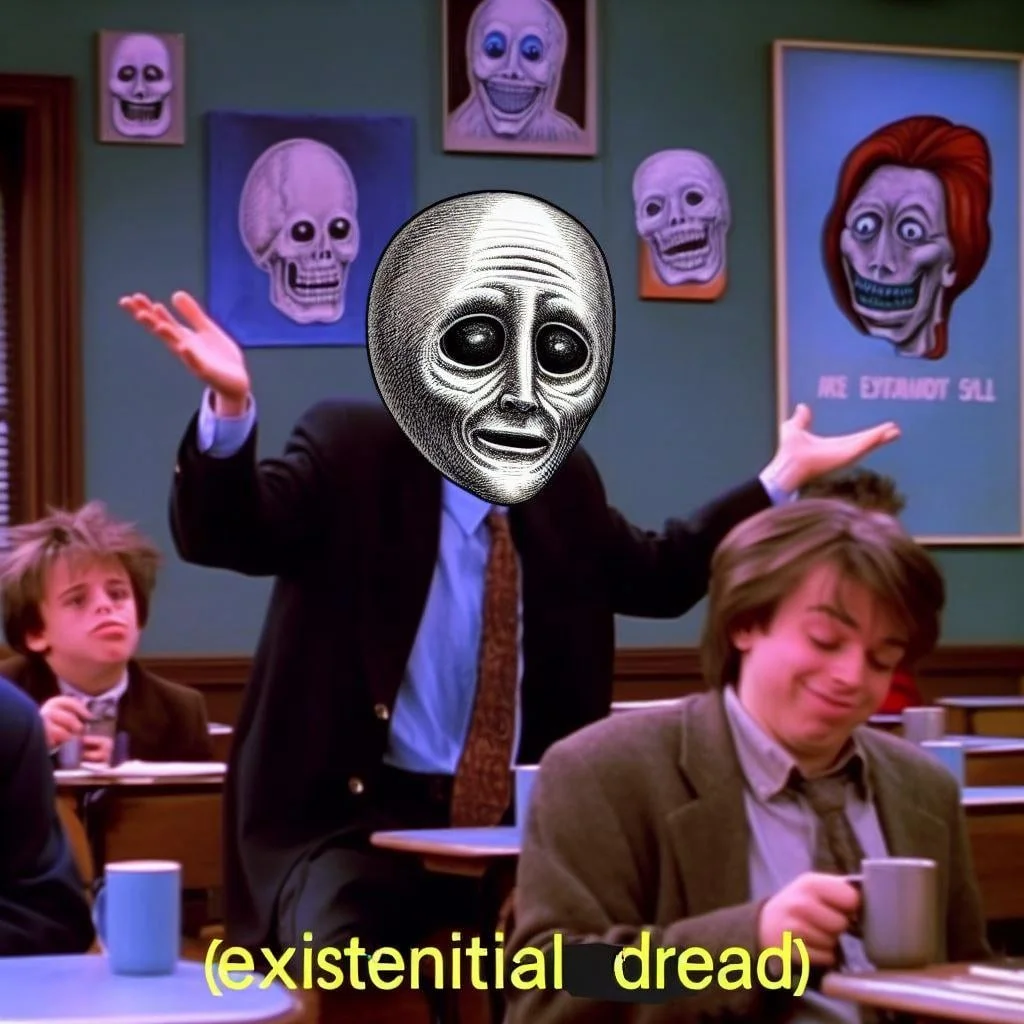
Existential Dread

2015Genre / meme themeactive

Also known as: Existential Crisis Memes · Nihilist Memes · Void Memes

Existential dread memes are a genre of internet humor built around anxiety about mortality, cosmic insignificance, and the apparent meaninglessness of existence. Gaining traction across Tumblr, Reddit, and Twitter through the mid-2010s, these memes channel genuine philosophical unease into shareable, darkly funny content. The format draws on everything from late-night overthinking to liminal space imagery, turning universal human fears into relatable punchlines12.

Overview

Existential dread memes take the raw discomfort of questioning one's place in the universe and package it as humor. The typical format pairs an everyday situation with an overwhelming awareness of life's futility. Common setups include "me at 3am," characters staring into the void, or absurd scenarios where mundane tasks collide with cosmic horror. The tone ranges from dry and deadpan to deeply surreal.

The genre overlaps heavily with nihilist memes, depression memes, and liminal space content. What sets existential dread memes apart is their specific focus on the feeling itself: that creeping awareness that nothing might matter, rendered as a joke you can send to your group chat2. Urban Dictionary defines the term as "the intense fear associated with the belief that all potential catastrophes capable of annihilating human existence could occur simultaneously"2, though most meme usage is far less dramatic and far more self-deprecating.

The phrase "existential dread" predates the internet by centuries, rooted in existentialist philosophy from Kierkegaard and Heidegger. As a meme genre, existential dread humor grew out of early 2010s Tumblr culture, where users turned personal anxiety into shareable posts. Subreddits like r/2meirl4meirl and r/ExistentialCrisis became gathering points for this style of humor by the mid-2010s.

The genre picked up momentum alongside the broader liminal space aesthetic, which gained major traction after a 2019 4chan post introduced The Backrooms creepypasta1. That thread, started on /x/ (4chan's paranormal board), asked users to "post disquieting images that just feel 'off'"1. The resulting aesthetic of empty, uncanny spaces tapped directly into the same psychological territory as existential dread memes: the feeling that something is fundamentally wrong with reality.

Origin & Background

Platform
Tumblr, Reddit (meme genre), 4chan (liminal space crossover)
Creator
Unknown
Date
~2015 (mainstream meme usage)

The phrase "existential dread" predates the internet by centuries, rooted in existentialist philosophy from Kierkegaard and Heidegger. As a meme genre, existential dread humor grew out of early 2010s Tumblr culture, where users turned personal anxiety into shareable posts. Subreddits like r/2meirl4meirl and r/ExistentialCrisis became gathering points for this style of humor by the mid-2010s.

The genre picked up momentum alongside the broader liminal space aesthetic, which gained major traction after a 2019 4chan post introduced The Backrooms creepypasta1. That thread, started on /x/ (4chan's paranormal board), asked users to "post disquieting images that just feel 'off'"1. The resulting aesthetic of empty, uncanny spaces tapped directly into the same psychological territory as existential dread memes: the feeling that something is fundamentally wrong with reality.

How It Spread

Existential dread memes spread across platforms in waves. Tumblr hosted the earliest wave of nihilist-flavored existential humor in 2013-2015, with text posts and simple image macros about wanting to scream into the void. Reddit's meme communities picked up the theme, with subreddits dedicated to increasingly specific flavors of existential humor.

By 2019, the liminal space movement brought a visual dimension to the genre. The Backrooms became one of the best-known examples of the liminal space aesthetic1, and the #liminalspaces hashtag accumulated nearly 100 million views on TikTok1. This visual branch fed directly into existential dread content, where empty rooms, abandoned malls, and uncanny photographs evoked a wordless sense of wrongness.

The genre hit mainstream recognition through Twitter and TikTok, where short-form existential humor thrived. "Me at 3am realizing..." became a staple setup. The COVID-19 pandemic in 2020 gave existential dread memes a massive boost, as millions of people suddenly had more time alone with their thoughts and fewer distractions from the big questions.

Platforms

RedditTwitterTikTokInstagramYouTube

Timeline

2018-01-01

Existential Dread begins gaining traction

2019-01-01

Existential Dread started spreading across social media platforms

2020-01-01

Existential Dread reached mainstream popularity and media coverage

2021-01-01

Brands and companies started using Existential Dread in marketing

2023-01-01

Existential Dread entered the broader pop culture conversation

View on Google Trends

How to Use This Meme

Existential dread memes follow a loose formula:

1

Start with a relatable, mundane trigger (lying in bed, doing dishes, sitting in traffic)

2

Introduce an overwhelming existential realization (nothing matters, the universe is indifferent, time is running out)

3

Present the contrast as humor, usually through an image macro, reaction image, or short video

Create Your Own

Cultural Impact

Existential dread memes sit at the intersection of internet humor and genuine mental health discourse. The genre helped normalize conversations about anxiety, depression, and existential questioning, particularly among millennials and Gen Z users who grew up treating memes as emotional shorthand.

The Backrooms, one of the genre's most successful visual offshoots, moved from 4chan creepypasta to mainstream media property. In early 2022, YouTuber Kane Parsons started a series of Backrooms short films that went viral and were credited with taking the concept mainstream1. Parsons later directed a film adaptation produced by A241. Academics noted that the appeal of spaces like The Backrooms lies in what they don't show: "scary because [they invite] you to interpret what's not shown," as Tama Leaver, professor of internet studies at Curtin University, put it1.

The color yellow itself became associated with existential unease through the genre. Paste magazine's Phoenix Simms connected the Backrooms' "fungal, sickly yellow" to "a long tradition of the liminal in horror" and yellow as a symbol of caution, deterioration, and existential distress1.

Fun Facts

The original Backrooms photograph that launched an entire horror franchise was taken during a furniture store renovation in Oshkosh, Wisconsin, in 20021.

The Backrooms image source wasn't identified until May 2024, when a Discord community traced it to an archived webpage from March 2003 using the Wayback Machine1.

Dan Erickson, creator of the Apple TV+ series Severance, named The Backrooms as one of his influences1.

Urban Dictionary's definition of existential dread focuses on "catastrophic singularity," which is far more dramatic than how most meme creators use the term2.

The room in the original Backrooms photo no longer exists. It was converted into a radio-controlled car racing track called Revolution Racing1.

Derivatives & Variations

Liminal Space Memes:

Empty, uncanny photographs of normally busy places. Grew from the same 2019 4chan thread that spawned The Backrooms[1].

The Backrooms:

A collaborative fiction and meme universe built around impossible empty rooms, featuring its own levels, entities, and lore. Spawned games, YouTube series, and an A24 film[1].

Void Memes:

Surreal, often deep-fried images featuring characters being consumed by or staring into black voids.

3am Memes:

A subgenre specifically focused on late-night intrusive thoughts, using the "me at 3am" framing[2].

SCP Foundation Crossovers:

The Backrooms was grouped with SCP Foundation content as part of an "emerging genre of collaborative online horror"[1].

Frequently Asked Questions

References (2)

  1. 1
    The Backroomsencyclopedia
  2. 2