Home›Memes›Facebook Privacy Notices

Contents

  • Overview
  • Gallery
  • Origin
  • How It Spread
  • How to Use
  • Cultural Impact
  • Fun Facts
  • Derivatives
  • FAQ
  • References
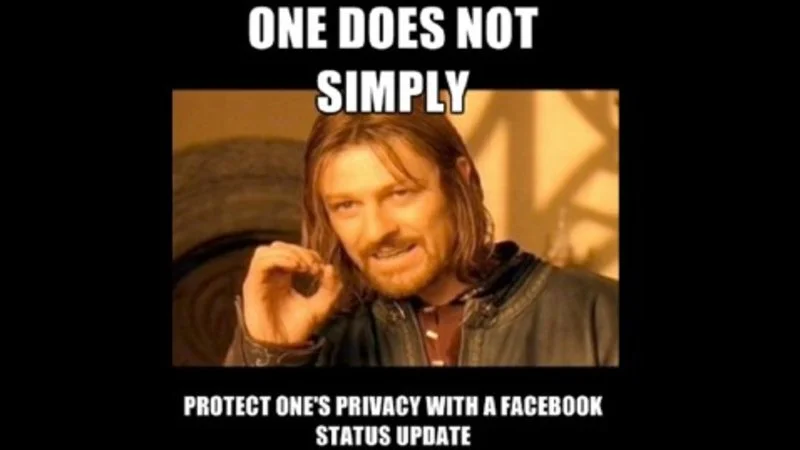
Facebook Privacy Notices — Boromir 'One Does Not Simply' meme about protecting privacy with Facebook status.

Facebook Privacy Notices

2009Hoax / Chain letter / Copypastasemi-active

Published March 31, 2026

Also known as: Facebook Copyright Notice · Facebook Privacy Hoax · Facebook Legal Notice

Facebook Privacy Notices are hoax chain-letter status updates that have circulated on Facebook since 2009, claiming users can protect their personal data and copyright by posting pseudo-legal declarations on their walls. The notices cite irrelevant legal codes like the UCC and the Rome Statute, and falsely suggest that Facebook's status as a publicly traded company means users must "opt out" of data sharing. Despite being debunked dozens of times by Snopes, the BBC, Slate, and Facebook itself, the hoax keeps coming back every time Facebook announces a privacy policy update.

hoax memes copypasta memes facebook memes privacy memes misinformation memes

Overview

The Facebook Privacy Notice is a copy-paste status update written in fake legalese that claims to override Facebook's Terms of Service. A typical version declares the user's "copyright" over all their posted content, forbids Facebook from using their data, and threatens legal action under statutes that have nothing to do with social media privacy. The notices follow a consistent formula: urgent language about new policy changes, a block of pseudo-legal text, and instructions telling friends to copy and paste the message to "protect" themselves2.

The text usually cites "UCC 1-308" (a provision of the Uniform Commercial Code about reserving rights in contracts) and the "Rome Statute" (which established the International Criminal Court for prosecuting genocide and war crimes). Neither has anything to do with Facebook privacy4. Some versions also reference the "Berner Convention," a misspelling of the Berne Convention on copyright1.

Gallery

Origin & Background

Platform
Facebook
Creator
Unknown
Date
2009

The first wave of Facebook privacy notices appeared in December 2009, when Facebook rolled out a major overhaul of its privacy settings6. The changes allowed third-party applications to access more user content and information than before3. The Electronic Frontier Foundation published a detailed analysis of the changes, noting that while some were positive (simpler settings, per-post privacy controls), Facebook's "recommended" defaults were designed to push users toward sharing more publicly3.

In response to the anxiety around these changes, users began posting status updates containing instructions on how to change Facebook settings, some satirical, some sincere6. These early posts evolved into the copy-paste legal notices that would define the hoax for the next decade-plus.

How It Spread

The hoax stayed relatively quiet until mid-2012, when a new wave of notices flooded Facebook. This version focused on copyright ownership, with users declaring that all content on their profiles was legally protected. On June 5th, 2012, the computer security blog Naked Security published an article explaining that the status updates had zero effect on Facebook's Terms of Service6. By November 2012, the problem was big enough that Facebook itself issued a public statement titled "Copyright Meme Spreading on Facebook," reminding users that they already own the copyright to everything they post6.

The hoax surged again in late November 2014, triggered by Facebook announcing privacy policy changes effective January 1st, 20154. A new version of the chain letter spread rapidly, this time adding claims about Facebook being "an open capital entity" and declaring users' rights under "articles L.111, 112 and 113 of the code of intellectual property"4. Slate covered the resurgence, pointing out that the notices "don't do anything" and "don't even make sense," since users already retain copyright to their content but agree to Facebook's data use policies when they create an account4. Snopes ran its own debunking, explaining that "Facebook users cannot retroactively negate any of the privacy or copyright terms they agreed to when they signed up"2.

The BBC reported on the hoax's return in early January 2015, interviewing experts about why people kept falling for it. PC Advisor's managing editor Marie Brewis told the BBC: "People see all their friends talking about something and think it must be true. And everyone wants to be the one who is in the know and to share something before anyone else"1. Dr. Maria Michalis of the University of Westminster predicted the hoax would keep coming back indefinitely: "If you see a friend has posted something you tend to believe it. So stories go viral and they cannot be stopped"1.

BetaNews joined the debunking effort in January 2015, comparing the notices to trying to rewrite a bank loan contract after signing it: "Could you then dig out the paperwork you signed when taking out the loan and start making amendments to it? 'I hereby declare that I no longer have to pay back any of this money.' No. The idea is patently absurd"5.

The hoax later mutated to include Instagram, with nearly identical text swapping "Facebook" for "Instagram" and adding claims that "Channel 9 News talked about the change in Instagram's privacy policy"2. These Instagram versions followed the same pattern of emerging whenever the platform announced any policy update.

How to Use This Meme

This isn't a meme people "use" in the traditional template sense. Instead, people encounter it in the wild when a friend or relative posts the notice on their wall, usually around the same time Facebook or Instagram announces a policy change. The typical lifecycle:

1

Facebook or Instagram announces a terms of service update

2

Someone posts a panicked copy-paste notice claiming legal protections

3

Friends see it, assume it must be legitimate since someone they know shared it, and copy-paste it themselves

4

Fact-checkers and tech journalists publish debunking articles

5

The cycle repeats six months to a year later

Cultural Impact

The Facebook Privacy Notice hoax became one of the longest-running examples of social media misinformation, predating the "fake news" era by several years. It was covered by major outlets including the BBC1, Slate4, Snopes2, and the Washington Post, among others.

The hoax also highlighted genuine confusion about how social media platforms handle user data. Facebook's privacy settings were legitimately complicated. The EFF documented how the 2009 changes were "clearly intended to push Facebook users to publicly share even more information than before," noting that default settings were designed to maximize public sharing3. The broader issue of social media privacy became a major topic of research and regulation, with scholars examining how platforms process personal information and the gap between users' privacy expectations and reality7.

Facebook's own response to the hoax, a public statement in November 2012, was one of the early examples of a tech company directly addressing viral misinformation on its own platform6.

Fun Facts

The Rome Statute, cited in nearly every version of the hoax, deals with genocide, war crimes, and crimes against humanity. It has nothing to do with Facebook squabbles4.

The hoax misspells the Berne Convention as the "Berner Convention" in most versions1.

Facebook spokesman Andrew Noyes directly addressed the notices, stating: "We wanted to take a moment to remind you of the facts. When you post things like photos to Facebook, we do not own them"1.

The only actual way to prevent Facebook from distributing your content is to deactivate your account entirely1.

The phrase "Facebook is now an open capital entity" (referring to Facebook's 2012 IPO) appeared in versions of the hoax for years after the company went public, even though a company's stock market status has no bearing on individual user privacy rights4.

Derivatives & Variations

Instagram Privacy Notice:

Same text with "Instagram" swapped in for "Facebook," often claiming "Channel 9 News" or "Channel 13 News" reported on the changes[2].

Government/Military Privacy Notice:

A variant warning government agencies and law enforcement that they are "strictly prohibited" from monitoring the poster's profile, citing similar bogus legal codes[2].

"Better safe than sorry" version:

A shorter, softer variant that drops most of the legal language but keeps the core claim, often adding "an attorney advised us to post this"[2].

Berne Convention version:

An international variant referencing the "Berner Convention" (misspelling of the Berne Convention on copyright) instead of the UCC, popular among European Facebook users[1].

Frequently Asked Questions

It's a hoax chain-letter status update that falsely claims posting pseudo-legal text on your Facebook wall can override Facebook's Terms of Service and protect your data2.

The first versions appeared on Facebook in December 2009, in response to a major privacy settings overhaul that gave third-party apps more access to user data63.

Nothing, legally. Users cannot retroactively change the terms they agreed to when they signed up, and the legal codes cited in the notice (UCC 1-308, the Rome Statute) are irrelevant to social media privacy4.

You don't, at least not effectively. People copy and paste the text to their walls thinking it provides legal protection, but it has no impact on Facebook's data use policies5.

It resurfaces periodically, usually whenever Facebook or Instagram announces policy changes. Privacy researchers predicted the hoax would keep coming back for years1.

References (11)

  1. 1
    Sharing a copyright notice doesn't exempt users from Facebook's Data Use Policy.article
  2. 2
    Will Posting This Notice Stop Facebook or Instagram from Making Your Posts Public? | Snopes.comarticle
  3. 3
    Facebook's New Privacy Changes: The Good, The Bad, and The Ugly | Electronic Frontier Foundationarticle
  4. 4
    Facebook Privacy Notices - Know Your Memeencyclopedia
  5. 5
    Privacy concerns with social networking servicesencyclopedia
  6. 6
    Facebook Privacy Policy Change - Business Insiderarticle
  7. 7
    Will Posting This Notice Stop Facebook or Instagram from Making Your Posts Public? | Snopes.comarticle
  8. 8
    Sharing a copyright notice doesn't exempt users from Facebook's Data Use Policy.article
  9. 9
    Viral Facebook Copyright Notice is Hoax. What You Should Knowarticle
  10. 10
    The recurring Facebook privacy hoax - BBC Newsarticle
  11. 11
    Stop posting your own Facebook privacy notices - it's completely pointless and looks silly - BetaNewsarticle

Quick Info

Year
2009
Origin
Facebook
Type
Hoax / Chain letter / Copypasta
Status
semi-active
Creator
Unknown
community-created chain letter
Popularity
Niche0/100Viral

More Hoax & Fake News Memes

  • Tourist Guy
  • 1721 Deitz Nuutzen Painting Hoax
  • 4Chan Alien Sighting Hoax
  • Balloon Boy
  • Congresswoman Alexandria Ocasio Cortezs Stolen Shoes Tweet
  • Internet Death Hoaxes
  • Jenkem
  • Manti Teos Girlfriend Hoax Teoing
  • Tampon Eating Hoax
  • This Film Is Dedicated To The Brave Mujahideen Fighters Of Afghanistan
  • "Let's Go! Arctic"
  • 2017 Las Vegas Strip Shooting
View all Hoax & Fake News memes →
Browse MemesTopicsCreatorsTrendingPlayAboutLegalPrivacy

© 2026 meme.com