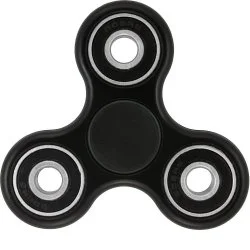
Fidget Spinner
Published March 10, 2026 · Updated March 23, 2026
Also known as: Hand spinner
The fidget spinner is a handheld toy built around a central ball bearing that spins freely when flicked. It exploded into a worldwide craze in early 2017, becoming one of the most viral consumer products of the decade. What started as a niche stress-relief gadget quickly morphed into a full-blown meme, spawning trick videos, school bans, and endless online debates about whether these things actually helped anyone focus.
Overview
A fidget spinner consists of a central ball bearing with two or more weighted lobes extending outward. Flick a lobe and the whole thing rotates smoothly around the center, spinning for anywhere from a few seconds to several minutes depending on the bearing quality. The design distributes mass away from the center, increasing the moment of inertia, which keeps it spinning longer1. Most were made of plastic or metal, ranging from cheap gas station impulse buys to machined titanium collector pieces.
The meme dimension went far beyond the toy itself. Fidget spinners became a cultural lightning rod. YouTube filled up with trick compilations and "world's longest spin" challenges. Schools scrambled to ban them. Parents debated their usefulness. The internet turned the toy into shorthand for everything from ADHD discourse to peak consumer hype culture.
Gallery
Origin & Background
How It Spread
How to Use This Meme
The basic fidget spinner format, both as toy and meme, works like this:
People typically hold the spinner between thumb and middle finger on the central bearing, then flick one of the outer lobes with a free finger. The spinner rotates for an extended period thanks to the low-friction bearing. More advanced users balance spinners on single fingers, toss them between hands, or stack multiple spinners.
As a meme template, fidget spinners commonly appear in ironic and post-ironic contexts. The format includes slapping a fidget spinner shape onto unrelated objects ("Everything is a fidget spinner"), using the spinner as a stand-in for any overhyped trend, or creating increasingly absurd trick videos. The classic setup involves treating the spinner with either extreme reverence or total contempt, with very little middle ground.
Cultural Impact
Fun Facts
By May 2017, no patent had been granted for the generic "fidget spinner" despite the product being a global craze1.
The Torqbar, considered one of the first modern fidget spinners, started as a personal fidget tool for IT meetings before McCoskery began selling it online1.
Catherine Hettinger's 1993 "spinning toy" patent is often cited in fidget spinner origin stories, but her design was fundamentally different, lacking the central ball bearing that defines the modern spinner1.
Fidget spinners hit peak Google Trends interest in May 2017, outpacing searches for major news events during the same period.
The moment of inertia design principle that keeps fidget spinners going is the same physics behind gyroscopes and figure skating spins1.
Derivatives & Variations
DIY fidget spinners:
YouTube tutorials showed people building spinners from skateboard bearings, 3D-printed parts, and household objects[1].
"Everything is a fidget spinner" edits:
Internet users photoshopped the spinner shape onto helicopters, ceiling fans, galaxies, and anything else that rotates.
Fidget spinner trick compilations:
YouTube channels dedicated entirely to spinner tricks became a micro-genre during peak 2017[1].
Ironic fidget spinner merch:
T-shirts, phone cases, and other products leaning into the cringe factor of the trend.
Frequently Asked Questions
References (2)
- 1Fidget spinnerencyclopedia
- 2Fidget Spinner - Urban Dictionarydictionary