Dark Academia

2015Internet aesthetic / subculturesemi-active

Published March 10, 2026 · Updated March 18, 2026

Also known as: DA

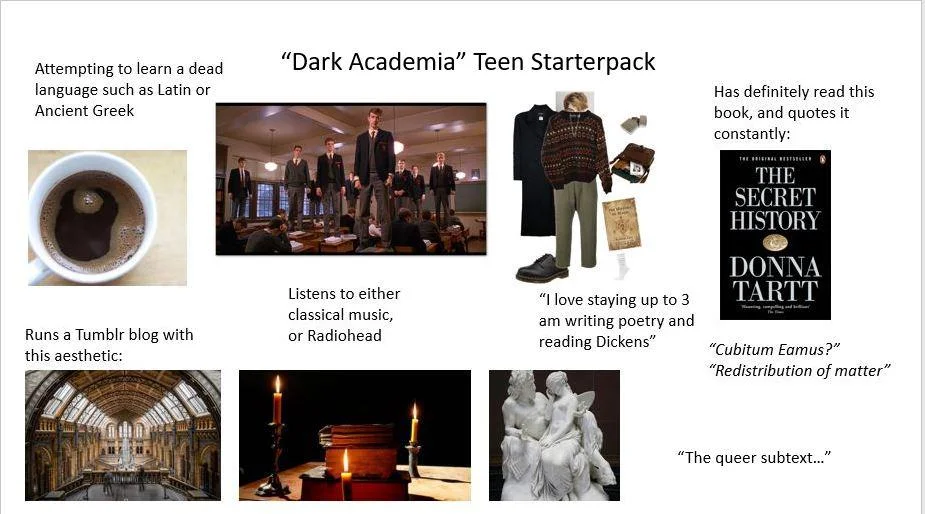
Dark Academia is an internet aesthetic and subculture centered on romanticized visions of higher education, classical literature, and the visual language of Ivy League and English boarding school life. The movement first took shape on Tumblr around 2015 before spreading to Instagram in 2017 and exploding on TikTok during the COVID-19 pandemic in 20204. With its mood boards of tweed blazers, candlelit libraries, and dog-eared copies of Donna Tartt novels, Dark Academia became one of the defining aesthetic movements of the early 2020s internet.

Overview

Dark Academia, a visual and lifestyle aesthetic built around an idealized version of academic life. Think autumn leaves on a Gothic campus, stacks of leather-bound books, handwritten letters, black coffee in a dim library, and the persistent feeling that you might be a character in a Donna Tartt novel. The color palette runs through blacks, browns, dark greens, beiges, and navy blues4. Fashion leans heavily on cardigans, blazers, turtlenecks, plaid skirts, Oxford shoes, houndstooth, and tweed3.

The aesthetic borrows from specific cultural touchstones. Dead Poets Society, Kill Your Darlings, and The Secret History by Donna Tartt are foundational texts4. Oscar Wilde, Lord Byron, Percy Bysshe Shelley, and E.M. Forster all fit the vibe4. Activities associated with the subculture include calligraphy, museum visits, haunting coffee shops, and marathon study sessions4. The overall mood is maximalist and nostalgic, with a streak of melancholy running through it4.

Urban Dictionary captures the spirit bluntly: "essentially a knowledgeable, vintage emo" who looks like "a wise-cracking, pretentious scholar"5.

Origin & Background

Platform
Tumblr (emergence), Instagram (early community building), TikTok (viral spread)
Key People
five.of.swords, f3lixculpa
Date
2015

Dark Academia first appeared on Tumblr around 2015, emerging from a "Harry Potter generation" that had matured and started sharing Gothic revival interior and architectural photography4. The term and community coalesced as users posted dark, moody images of old universities, candlelit rooms, and classical art.

By 2017, the aesthetic had migrated to Instagram, where users five.of.swords and f3lixculpa played key roles in shaping the community3. They shared posts that followed the aesthetic's visual language and explained it to newcomers, which inspired other users to create Dark Academia mood boards based on their content3. These early Instagram accounts established the visual vocabulary that would define the movement: fall tones, parchment textures, blazers, and romanticized campus life.

The aesthetic also built a strong presence on Tumblr, where users shared photographs, poetry, and literary quotes fitting the Dark Academia mood3. Ironic posts poking fun at the aesthetic appeared alongside sincere ones, a pattern that would repeat on every platform the trend touched.

How It Spread

Dark Academia arrived on TikTok in late 2019. One of the earliest examples came on October 13, 2019, uploaded by user caelum.ii3. But the real explosion came in the summer and fall of 2020, driven in large part by the COVID-19 pandemic.

The timing made sense. Schools had shut down, and students were stuck learning from their childhood bedrooms. Dark Academia offered a fantasy of the university experience that many could not access4. As Amelia Horgan wrote in Jacobin, the trend provided a romanticized vision of campus life for students who were instead dealing with Zoom lectures and cramped home study spaces4.

By August 2020, Dark Academia content was racking up serious numbers on TikTok. On August 29, TikToker miss__mae posted a video of a New England town under the #darkacademia hashtag that pulled over 1.6 million views in under two months3. On October 3, user ya.rv posted a Dark Academia video that hit over 2.5 million views in just 13 days3.

Media coverage followed quickly. Refinery29 published a piece in October 2020 connecting the pandemic to the aesthetic's popularity2. Vox covered the trend as part of the broader "aesthetic TikTok" wave, noting its relationship to cottagecore and other mood-board movements1. The New York Times called it a "more approachable" version of cottagecore, arguing that while cottagecore required access to rural living and crafting time, Dark Academia only asked you to put on a blazer and read Dostoevsky1.

Platforms

TikTokPinterestTumblrInstagram
View on Google Trends

Frequently Asked Questions