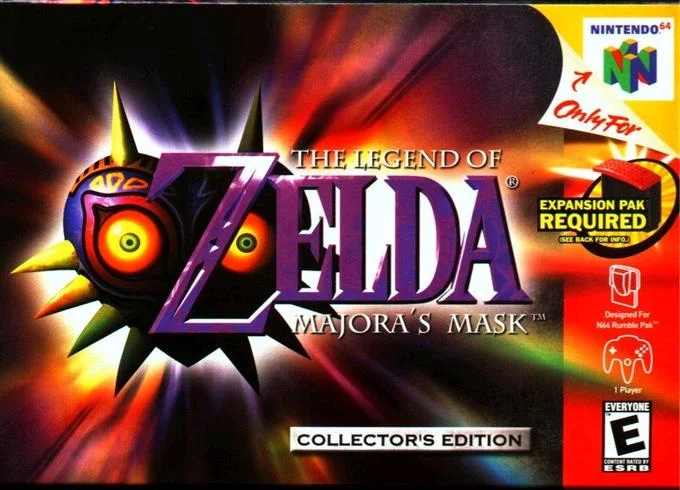
Majora's Mask

2000video game / fandomclassic

Published September 5, 2026

The Legend of Zelda: Majora's Mask is the 2000 Nintendo 64 sequel to Ocarina of Time that traps Link in a doomed parallel world with three days to stop the moon from crashing. Its bleak tone, 72-hour time loop and cursed masks turned it into one of the most obsessed-over Zelda titles online, spawning fake HD trailer hoaxes, viral fan films and years of dead-Link fan theories.

Overview

Majora's Mask is the sixth mainline Legend of Zelda game, built in about a year on the recycled Ocarina of Time engine and released for the Nintendo 64 in 20003. Its hook is a three-day time loop: Link has 72 in-game hours to stop a grinning moon from crashing into the parallel world of Termina, rewinding time with the Song of Time whenever the clock runs out1. The cursed masks Link collects let him transform into a Deku Scrub, a Goron and a Zora, which is why the mask iconography became the game's visual shorthand online.

The fandom's fixation is less about the gameplay than the vibe. Termina is stuffed with dying NPCs, a suicidal moon, and side quests about grief, which is why casual players and YouTube essayists still describe it as the darkest Zelda1. That reputation is what powers most of the memes around it, from the fake HD trailer hoax of 2012 to MatPat's much-mocked 'Is Link Dead in Majora's Mask?' theory2.

Origin & Background

Platform
Nintendo 64 / YouTube (viral fandom spread)
Key People
Nintendo
Date
2000

Nintendo announced Majora's Mask in May 1999 and shipped it in North America on October 26, 2000, reusing Ocarina of Time's engine to cut development to roughly a year2. Urban Dictionary entries written by fans in the mid-2000s already framed it as 'probably the darkest in Zelda history' thanks to the doomed moon over the land players there call Termina (and often misspell as 'Tameria')3.

The game was later bundled onto the 2003 GameCube Collector's Edition disc alongside Ocarina of Time and the original NES Zeldas, then remade as Majora's Mask 3D for the 3DS after being announced in the November 5, 2014 Nintendo Direct and released on February 13, 20152.

How It Spread

The first big meme moment came on June 5, 2012, when YouTuber MajorasMaskZelda uploaded a fan-cut 'Majora's Mask' trailer imagined as a Wii U port4. A day later, user thegr8stever reuploaded it as a supposed leaked E3 2012 trailer, and the reupload racked up millions of views before the hoax was confirmed, drawing coverage from Kotaku and other gaming outlets2.

On November 9, 2013, The Game Theorists dropped 'Is Link Dead in Majora's Mask?', arguing that Termina is purgatory and each mask represents a stage of grief; the video pulled in over 11 million views and became the default entry point for the 'Link is dead' theory that still circulates on r/Zelda2. Three years later, on November 22, 2016, VFX studio EmberLab uploaded 'Terrible Fate,' a CG short retelling how Skull Kid stole Majora's Mask, which passed 3.5 million views and got written up by Polygon, AV Club and GameSpot, plus a shoutout from Nintendo itself2.

Beyond the big videos, the game keeps a steady footprint on 4chan's /v/ board and Reddit's r/Zelda, and the Majora's Mask 3D Facebook page had cleared 35,000 followers by early 20172. Metacritic aggregates its launch reviews at 95/100, and it sold about 3.36 million copies worldwide, numbers fans cite when arguing the cult reputation is earned1.

How to Use This Meme

Online, 'Majora's Mask' is used less as an image macro than as a shorthand. Posters typically drop the heart-shaped mask or the grinning moon into threads about impending doom, invoke the 'Dawn of the Final Day' countdown when something is about to go wrong, or reply with 'you've met with a terrible fate, haven't you?' when a friend has just messed up. The 'Link is dead' theory is also common convention in any Zelda timeline argument2.

Frequently Asked Questions