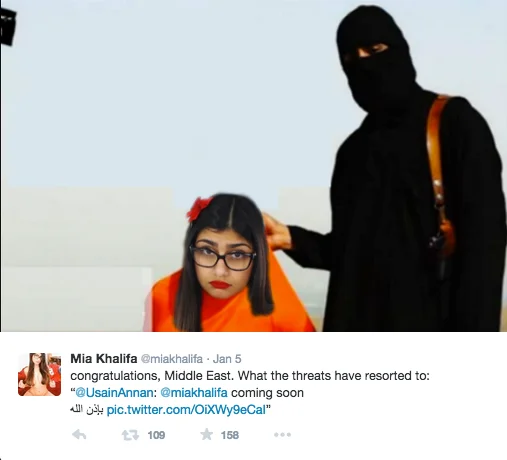
Mia Khalifa Death Threats

2015eventclassic

Published September 6, 2026

In early January 2015, Lebanese-American adult film performer Mia Khalifa faced a wave of Twitter death threats and slut-shaming from conservative Muslims after a scene showed her wearing a hijab. Her sharp, joke-filled clapback tweets turned the harassment into an international news cycle and one of the defining Twitter clapback moments of the mid-2010s.

Overview

Mia Khalifa Death Threats refers to the January 2015 pile-on from conservative Muslim Twitter users against then 21-year-old Lebanese-American adult performer Mia Khalifa, plus her running counter-thread of sarcastic replies that kept the story alive for a full news cycle. The friction started with a scene where she wore a hijab, which critics called disrespectful to Islam, while she framed it in interviews as satire in line with other Hollywood depictions3. What made it memetic was the reply-guy format, a threat came in, she posted a one-liner, screenshots went everywhere.

The story sat at an unusual intersection of adult-industry celebrity, Middle Eastern religious politics, and Twitter reply culture. Her family in Lebanon released a public statement disowning her work, saying they were 'paying the price of living away from our homeland' and that she no longer honored her Lebanese roots2. Reporters covering the story kept cycling through her tweets as fresh material, and outlets from CNN to MTV picked it up within days25.

Origin & Background

Platform
Twitter
Creator
Mia Khalifa
Date
2015

The setup began on November 27, 2014, when a GIF from one of Khalifa's scenes was posted to the /r/NSFW_GIF subreddit, where it collected over 2,100 votes at 90% upvoted across the next two months4. She hit the number-one performer slot on PornHub on December 28, 20144.

The controversy proper kicked off on January 3, 2015, when Beirut publication Lebanese Examiner reported that local newspapers had run critical pieces about her wearing a hijab in adult scenes and displaying an Arabic tattoo of the opening line of the Lebanese national anthem1. Khalifa fired back on Twitter the same day, asking 'Doesn't the Middle East have more important things to worry about besides me? How about finding a president? Or containing ISIS?'1 That tweet pulled more than 1,200 retweets and 1,000 favorites within a week4.

How It Spread

The clapbacks kept coming across the following days. On January 3, Khalifa answered a tweet warning she would 'be the first person in hellfire' with the line 'I've been meaning to get a little tan recently'3. The next day, Twitter user @abdallahbakrr posted that her 'head will be cut soon,' to which she replied 'long as it's not my tits'4. On January 5, user Hussein Annan posted a photoshopped screenshot of an Islamic State decapitation video with Khalifa's face pasted over that of murdered American journalist Steven Sotloff4.

On January 6, 2015, the New York electro-pop duo Timeflies dropped a track titled 'Mia Khalifa' in support of her, one of the fastest music-industry responses to a Twitter news cycle that year56. That same week the Charlie Hebdo attack was unfolding in Paris, and English and French outlets slotted the Khalifa story into their coverage of religious extremism and free expression4. CNN ran a piece on January 7 focused on her family's public statement disowning her career choice2. The Independent covered the death threats and her hijab-scene defense, quoting her line that such scenes 'are satirical'3. Newsweek published a longer sit-down interview the same day in which she said her family was no longer speaking to her4.

How to Use This Meme

This is a news event and clapback moment rather than a reusable template. The pattern people cite from it is the Khalifa reply style, meeting a violent or moralistic threat with a short deflating joke rather than an earnest defense, which became a common reference point when talking about Twitter clapbacks against harassment.

Frequently Asked Questions