Mojave Phone Booth

1997Internet phenomenon / real-world pilgrimage siteclassic

Also known as: Cinder Peak Phone · The Loneliest Phone Booth on Earth

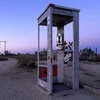
Mojave Phone Booth is a 1997 internet-to-real-world phenomenon centered on a bullet-riddled pay phone in California's Mojave National Preserve, which Doc Daniels publicized online, sparking global pilgrimages of strangers seeking to answer calls in the desert.

The Mojave Phone Booth was a lone, bullet-riddled telephone booth sitting in the middle of California's Mojave National Preserve, roughly 15 miles from the nearest paved road. After an Arizona man named Godfrey "Doc" Daniels discovered it through a zine in 1997 and built a website sharing its phone number, the booth became one of the earliest internet-to-real-world viral sensations, drawing callers from around the globe and pilgrims who camped out just to answer a ringing phone in the desert. Pacific Bell removed it in May 2000 due to environmental concerns, but the number was resurrected in 2013 as a VoIP conference line by a phone phreak named Jered Morgan.

TL;DR

The Mojave Phone Booth was a lone, bullet-riddled telephone booth sitting in the middle of California's Mojave National Preserve, roughly 15 miles from the nearest paved road.

Overview

The Mojave Phone Booth was a Pacific Bell payphone installed decades earlier to service volcanic cinder miners in what later became the Mojave National Preserve2. It sat at a dusty crossroads along a line of wooden power poles, 14 miles from the nearest paved road and about 75 miles southwest of Las Vegas1. The booth's windows had long been blasted out by desert gunslingers, its coin box was deactivated, and it looked like something out of a post-apocalyptic film2. But it worked. And when the internet got hold of its phone number in 1997, this forgotten piece of infrastructure turned into an accidental social experiment. People called from every continent, at all hours, hoping someone might pick up. Others drove out through treacherous dirt roads just to be the one who answered2.

The story starts in May 1997, when an Arizona man named Godfrey Daniels, who went by "Deuce of Clubs" online, received a copy of the independent punk zine *Wig Out!* at a show for the band Girl Trouble5. In the Letters to the Editor section, a Californian identified only as "Mr. N" described finding a telephone booth in the middle of the Mojave Desert, 15 miles from the main highway10. Mr. N had spotted a phone icon on a desert road map, driven out to investigate, and discovered the booth was still operational. He included the number: (619) 733-9969, which later changed to area code 7605.

Daniels became obsessed. He called the number several times a day for about a month, even sticking a note on his bathroom mirror that read "Have you called the Mojave Desert today?"10. Nobody answered. Then one day he got a busy signal, which meant someone was actually using the phone. He dialed frantically until the line opened, and a woman named Lorene picked up6. She was a cinder miner who lived off the grid and used the booth for her own calls7. They chatted, made small talk, and in his excitement Daniels forgot to ask where the booth actually was6.

He tracked it down anyway, drove out with a friend during a lightning storm, and made calls from the booth10. Then he went home and built a website, *The Mojave Phone Booth Site*, publishing the number for the world9. In 1997, that was enough to start something.

Origin & Background

Platform
Deuce of Clubs personal website (tribute site), early web forums (viral spread)
Key People
Godfrey "Doc" Daniels, Mr. N
Date
1997

The story starts in May 1997, when an Arizona man named Godfrey Daniels, who went by "Deuce of Clubs" online, received a copy of the independent punk zine *Wig Out!* at a show for the band Girl Trouble. In the Letters to the Editor section, a Californian identified only as "Mr. N" described finding a telephone booth in the middle of the Mojave Desert, 15 miles from the main highway. Mr. N had spotted a phone icon on a desert road map, driven out to investigate, and discovered the booth was still operational. He included the number: (619) 733-9969, which later changed to area code 760.

Daniels became obsessed. He called the number several times a day for about a month, even sticking a note on his bathroom mirror that read "Have you called the Mojave Desert today?". Nobody answered. Then one day he got a busy signal, which meant someone was actually using the phone. He dialed frantically until the line opened, and a woman named Lorene picked up. She was a cinder miner who lived off the grid and used the booth for her own calls. They chatted, made small talk, and in his excitement Daniels forgot to ask where the booth actually was.

He tracked it down anyway, drove out with a friend during a lightning storm, and made calls from the booth. Then he went home and built a website, *The Mojave Phone Booth Site*, publishing the number for the world. In 1997, that was enough to start something.

How It Spread

The website struck a chord with early internet culture. People began calling the booth and, increasingly, making the trek out to answer it themselves. Daniels made several pilgrimages between August 1997 and July 1999, documenting each trip with photographs on his site.

On September 18, 1999, the *Los Angeles Times* ran a feature story headlined "The Loneliest Phone Booth in the World," reporting that callers included a bored housewife from New Zealand, a German high school student, a Seattle stockbroker, and an Atlanta man who heard about it "from one of the ladies on our pet skunk e-mail list". The Times reporter fielded calls himself while visiting, talking to strangers he'd never otherwise have known existed. Fans decorated the booth with a nude Barbie doll, Band-Aids over bullet holes, and stones spelling out its number visible from the air "so even aliens can find it".

In November 1999, the fan site Cinder Peak Phone launched, giving the booth a new nickname. In January 2000, Salon ran its own feature, calling Daniels an "Internet cowboy" and noting the booth had inspired television commercials, a short story, and an indie film. Art Bell's late-night radio program *Coast to Coast AM* also featured the booth, encouraging listeners to dial the number during broadcasts, which sent waves of simultaneous callers to the desert line.

By early 2000, the phone was ringing dozens of times a day. Visitors answered more than 200 calls daily during peak periods. Two women from New York drove out, stripped naked in the desert heat, and answered 72 calls in four and a half hours, greeting callers with "Mojave Desert. How may I direct your call?".

How to Use This Meme

The Mojave Phone Booth isn't a meme template in the traditional sense. There's no image macro or caption format. Instead, it functions as a shared reference point and a story people retell. The "use" is the call itself: dialing 760-733-9969 and seeing who, if anyone, picks up on the conference line. People also reference the booth in discussions about early internet culture, the romance of analog technology, or the way online communities can transform forgotten physical spaces. The booth's story often gets invoked when talking about internet-to-IRL crossover events, pre-social-media virality, or the loss of quirky internet-era artifacts.

Cultural Impact

The Mojave Phone Booth was one of the first real-world locations to go viral thanks to the internet, years before "going viral" was even a phrase. The *LA Times* covered it twice, in 1999 and 2000. *Salon*, *The Guardian*, and numerous international publications ran features. NPR's *Snap Judgment* dedicated an episode to it, and *99% Invisible* produced a full podcast covering the saga.

The booth inspired the 2006 independent film *Mojave Phone Booth*, which won multiple festival awards including Best Feature at the Stony Brook Film Festival and Audience Award at the Kansas International Film Festival. French artist Sophie Calle created a Gehry-designed phone booth installation in Paris as a direct homage. British novelist J.G. Ballard called the booth's website "accidental poetry" and described it as "a kind of talismanic object".

The Deuce of Clubs website noted that "the Mojave Phone Booth staked its final claim to fame when it became the first (and probably only) Internet meme ever to be targeted for destruction by the United States Government". An online petition was created to protest its removal, though the petition platform has since been retired.

Full History

The booth had been installed in the 1960s, though some accounts place the original installation as early as 1948. California law required telephone companies to provide service to isolated locations even if the lines were unprofitable, and the booth served workers at a nearby volcanic cinder mine near the Cima volcanic field. For decades it sat in obscurity, used only by miners and the occasional desert traveler. Its only company was Joshua trees, telephone poles, and passing coyotes.

The internet changed everything. After Daniels launched his site in 1997, the booth's story spread through early web communities at a pace that now looks quaint but was electric at the time. People forwarded news clippings from international papers and magazines to Daniels, who posted them on his site. The booth became what the *Daily Dot* later called "an incredible social networking platform and connectivity conduit," an accidental prototype of an internet chat room where anonymous strangers could connect through the simple act of picking up a ringing phone in the desert.

One man camped out among the Joshua trees for an entire month and answered five hundred phone calls. Rick Karr, a 51-year-old self-described spiritual wanderer, said he was "instructed by the Holy Spirit" to travel to the desert and answer calls. A USC graduate student named Kaarina Roberto began camping at the site with her husband, answering the phone as it rang through the night, and planned to produce a documentary on the whole thing. One fan even planned to get married at the booth after meeting his fiancee there.

Not everyone was happy. Park rangers confiscated the quartz stones visitors used to spell out the phone number for aerial viewers. Someone stole the phone's receiver at one point. The Mojave National Preserve, established in 1994 under National Park Service management, began fielding reports of litter, off-trail driving, unauthorized camping, and unattended campfires near the booth. Mike Reynolds, a preserve spokesman, said staff found "a ton of trash in the area" and stranded motorists who tried reaching the booth without four-wheel drive.

On May 17, 2000, with no public notice, workers removed the booth. Pacific Bell and the National Park Service issued a joint statement saying "increased public traffic had a negative impact on the desert environment in the nation's newest national park". The phone number was disconnected. Lorene Caffee, owner of the nearby Cima Cinder Mine, was not convinced. "It stinks," she told the *Las Vegas Sun*. "Isn't that what a park is for, for people to visit?".

The removal triggered an outpouring of grief online. Fans kept visiting the concrete slab where the booth once stood, treating it like a tombstone and leaving offerings. Someone constructed an actual headstone for the booth. The National Park Service broke up the concrete pad and removed that too, and blocked attempts to install a commemorative plaque. "Public lands are not there to allow individuals to put whatever they want out there," said park archaeologist Dave Nichols. "But I understand the sentiment, of course".

The booth's story didn't end with its physical destruction. In 2006, director John Putch released *Mojave Phone Booth*, an independent film starring Annabeth Gish and Steve Guttenberg about four Las Vegas strangers drawn to a desert phone booth. The film won awards at HDFest, the Kansas International Film Festival, and the Stony Brook Film Festival. That same year, French conceptual artist Sophie Calle inaugurated a phone booth art installation in Paris inspired by the Mojave booth, designed by architect Frank Gehry.

In August 2013, Jered Morgan, a phone phreak and white-hat hacker known as Lucky225, announced he had acquired the original number. Pacific Bell had claimed its policy was to "permanently retire" the number, but Morgan discovered AT&T had sold the 760-733-99xx block to a competitive local exchange carrier. He ordered the number and set it up as a VoIP conference call line. Anyone dialing 760-733-9969 could now enter a virtual version of the Mojave Phone Booth experience, potentially finding a stranger on the other end or talking into digital emptiness.

In August 2014, NPR's *Snap Judgment* aired a story about Daniels and the booth. That same month, Daniels launched a Kickstarter campaign to publish *Adventures with the Mojave Phone Booth*, a book he'd been working on for over a decade. The book was eventually published in 2018.

Fun Facts

Daniels first learned about the booth from a letter by "Mr. N" in a punk zine called *Wig Out!* that he picked up at a Girl Trouble concert.

The first person to answer Daniels' calls was Lorene, a cinder miner who used the booth as her personal phone since she lived off the grid.

Visitors spelled out the phone number in stones large enough to be seen from the air, which park rangers repeatedly confiscated.

A USC graduate student was producing a documentary about the booth phenomenon when it was removed.

The original area code was 619 before changing to 760, and Pacific Bell claimed the number would be "permanently retired" after removal.

Derivatives & Variations

VoIP Conference Line (2013):

Hacker Jered Morgan (Lucky225) acquired the original phone number and redirected it to an Asterisk VoIP server, creating a conference call line that anyone can join by dialing 760-733-9969[4].

Mojave Phone Booth film (2006):

Independent feature directed by John Putch, starring Steve Guttenberg and Annabeth Gish, telling four interconnected stories about strangers drawn to the desert booth[13].

Sophie Calle Paris installation (2006):

French conceptual artist created a phone booth sculpture in Paris designed by Frank Gehry, inspired by the Mojave booth[9].

Cinder Peak Phone fan site (1999):

A tribute website that gave the booth an alternate name and documented a November 1999 pilgrimage[12].

Adventures with the Mojave Phone Booth (2018):

A book by Godfrey "Doc" Daniels chronicling the full saga, funded through a 2014 Kickstarter campaign[9].

Frequently Asked Questions

MojavePhoneBooth

1997Internet phenomenon / real-world pilgrimage siteclassic

Also known as: Cinder Peak Phone · The Loneliest Phone Booth on Earth

Mojave Phone Booth is a 1997 internet-to-real-world phenomenon centered on a bullet-riddled pay phone in California's Mojave National Preserve, which Doc Daniels publicized online, sparking global pilgrimages of strangers seeking to answer calls in the desert.

The Mojave Phone Booth was a lone, bullet-riddled telephone booth sitting in the middle of California's Mojave National Preserve, roughly 15 miles from the nearest paved road. After an Arizona man named Godfrey "Doc" Daniels discovered it through a zine in 1997 and built a website sharing its phone number, the booth became one of the earliest internet-to-real-world viral sensations, drawing callers from around the globe and pilgrims who camped out just to answer a ringing phone in the desert. Pacific Bell removed it in May 2000 due to environmental concerns, but the number was resurrected in 2013 as a VoIP conference line by a phone phreak named Jered Morgan.

TL;DR

The Mojave Phone Booth was a lone, bullet-riddled telephone booth sitting in the middle of California's Mojave National Preserve, roughly 15 miles from the nearest paved road.

Overview

The Mojave Phone Booth was a Pacific Bell payphone installed decades earlier to service volcanic cinder miners in what later became the Mojave National Preserve. It sat at a dusty crossroads along a line of wooden power poles, 14 miles from the nearest paved road and about 75 miles southwest of Las Vegas. The booth's windows had long been blasted out by desert gunslingers, its coin box was deactivated, and it looked like something out of a post-apocalyptic film. But it worked. And when the internet got hold of its phone number in 1997, this forgotten piece of infrastructure turned into an accidental social experiment. People called from every continent, at all hours, hoping someone might pick up. Others drove out through treacherous dirt roads just to be the one who answered.

The story starts in May 1997, when an Arizona man named Godfrey Daniels, who went by "Deuce of Clubs" online, received a copy of the independent punk zine *Wig Out!* at a show for the band Girl Trouble. In the Letters to the Editor section, a Californian identified only as "Mr. N" described finding a telephone booth in the middle of the Mojave Desert, 15 miles from the main highway. Mr. N had spotted a phone icon on a desert road map, driven out to investigate, and discovered the booth was still operational. He included the number: (619) 733-9969, which later changed to area code 760.

Daniels became obsessed. He called the number several times a day for about a month, even sticking a note on his bathroom mirror that read "Have you called the Mojave Desert today?". Nobody answered. Then one day he got a busy signal, which meant someone was actually using the phone. He dialed frantically until the line opened, and a woman named Lorene picked up. She was a cinder miner who lived off the grid and used the booth for her own calls. They chatted, made small talk, and in his excitement Daniels forgot to ask where the booth actually was.

He tracked it down anyway, drove out with a friend during a lightning storm, and made calls from the booth. Then he went home and built a website, *The Mojave Phone Booth Site*, publishing the number for the world. In 1997, that was enough to start something.

Origin & Background

Platform
Deuce of Clubs personal website (tribute site), early web forums (viral spread)
Key People
Godfrey "Doc" Daniels, Mr. N
Date
1997

The story starts in May 1997, when an Arizona man named Godfrey Daniels, who went by "Deuce of Clubs" online, received a copy of the independent punk zine *Wig Out!* at a show for the band Girl Trouble. In the Letters to the Editor section, a Californian identified only as "Mr. N" described finding a telephone booth in the middle of the Mojave Desert, 15 miles from the main highway. Mr. N had spotted a phone icon on a desert road map, driven out to investigate, and discovered the booth was still operational. He included the number: (619) 733-9969, which later changed to area code 760.

Daniels became obsessed. He called the number several times a day for about a month, even sticking a note on his bathroom mirror that read "Have you called the Mojave Desert today?". Nobody answered. Then one day he got a busy signal, which meant someone was actually using the phone. He dialed frantically until the line opened, and a woman named Lorene picked up. She was a cinder miner who lived off the grid and used the booth for her own calls. They chatted, made small talk, and in his excitement Daniels forgot to ask where the booth actually was.

He tracked it down anyway, drove out with a friend during a lightning storm, and made calls from the booth. Then he went home and built a website, *The Mojave Phone Booth Site*, publishing the number for the world. In 1997, that was enough to start something.

How It Spread

The website struck a chord with early internet culture. People began calling the booth and, increasingly, making the trek out to answer it themselves. Daniels made several pilgrimages between August 1997 and July 1999, documenting each trip with photographs on his site.

On September 18, 1999, the *Los Angeles Times* ran a feature story headlined "The Loneliest Phone Booth in the World," reporting that callers included a bored housewife from New Zealand, a German high school student, a Seattle stockbroker, and an Atlanta man who heard about it "from one of the ladies on our pet skunk e-mail list". The Times reporter fielded calls himself while visiting, talking to strangers he'd never otherwise have known existed. Fans decorated the booth with a nude Barbie doll, Band-Aids over bullet holes, and stones spelling out its number visible from the air "so even aliens can find it".

In November 1999, the fan site Cinder Peak Phone launched, giving the booth a new nickname. In January 2000, Salon ran its own feature, calling Daniels an "Internet cowboy" and noting the booth had inspired television commercials, a short story, and an indie film. Art Bell's late-night radio program *Coast to Coast AM* also featured the booth, encouraging listeners to dial the number during broadcasts, which sent waves of simultaneous callers to the desert line.

By early 2000, the phone was ringing dozens of times a day. Visitors answered more than 200 calls daily during peak periods. Two women from New York drove out, stripped naked in the desert heat, and answered 72 calls in four and a half hours, greeting callers with "Mojave Desert. How may I direct your call?".

How to Use This Meme

The Mojave Phone Booth isn't a meme template in the traditional sense. There's no image macro or caption format. Instead, it functions as a shared reference point and a story people retell. The "use" is the call itself: dialing 760-733-9969 and seeing who, if anyone, picks up on the conference line. People also reference the booth in discussions about early internet culture, the romance of analog technology, or the way online communities can transform forgotten physical spaces. The booth's story often gets invoked when talking about internet-to-IRL crossover events, pre-social-media virality, or the loss of quirky internet-era artifacts.

Cultural Impact

The Mojave Phone Booth was one of the first real-world locations to go viral thanks to the internet, years before "going viral" was even a phrase. The *LA Times* covered it twice, in 1999 and 2000. *Salon*, *The Guardian*, and numerous international publications ran features. NPR's *Snap Judgment* dedicated an episode to it, and *99% Invisible* produced a full podcast covering the saga.

The booth inspired the 2006 independent film *Mojave Phone Booth*, which won multiple festival awards including Best Feature at the Stony Brook Film Festival and Audience Award at the Kansas International Film Festival. French artist Sophie Calle created a Gehry-designed phone booth installation in Paris as a direct homage. British novelist J.G. Ballard called the booth's website "accidental poetry" and described it as "a kind of talismanic object".

The Deuce of Clubs website noted that "the Mojave Phone Booth staked its final claim to fame when it became the first (and probably only) Internet meme ever to be targeted for destruction by the United States Government". An online petition was created to protest its removal, though the petition platform has since been retired.

Full History

The booth had been installed in the 1960s, though some accounts place the original installation as early as 1948. California law required telephone companies to provide service to isolated locations even if the lines were unprofitable, and the booth served workers at a nearby volcanic cinder mine near the Cima volcanic field. For decades it sat in obscurity, used only by miners and the occasional desert traveler. Its only company was Joshua trees, telephone poles, and passing coyotes.

The internet changed everything. After Daniels launched his site in 1997, the booth's story spread through early web communities at a pace that now looks quaint but was electric at the time. People forwarded news clippings from international papers and magazines to Daniels, who posted them on his site. The booth became what the *Daily Dot* later called "an incredible social networking platform and connectivity conduit," an accidental prototype of an internet chat room where anonymous strangers could connect through the simple act of picking up a ringing phone in the desert.

One man camped out among the Joshua trees for an entire month and answered five hundred phone calls. Rick Karr, a 51-year-old self-described spiritual wanderer, said he was "instructed by the Holy Spirit" to travel to the desert and answer calls. A USC graduate student named Kaarina Roberto began camping at the site with her husband, answering the phone as it rang through the night, and planned to produce a documentary on the whole thing. One fan even planned to get married at the booth after meeting his fiancee there.

Not everyone was happy. Park rangers confiscated the quartz stones visitors used to spell out the phone number for aerial viewers. Someone stole the phone's receiver at one point. The Mojave National Preserve, established in 1994 under National Park Service management, began fielding reports of litter, off-trail driving, unauthorized camping, and unattended campfires near the booth. Mike Reynolds, a preserve spokesman, said staff found "a ton of trash in the area" and stranded motorists who tried reaching the booth without four-wheel drive.

On May 17, 2000, with no public notice, workers removed the booth. Pacific Bell and the National Park Service issued a joint statement saying "increased public traffic had a negative impact on the desert environment in the nation's newest national park". The phone number was disconnected. Lorene Caffee, owner of the nearby Cima Cinder Mine, was not convinced. "It stinks," she told the *Las Vegas Sun*. "Isn't that what a park is for, for people to visit?".

The removal triggered an outpouring of grief online. Fans kept visiting the concrete slab where the booth once stood, treating it like a tombstone and leaving offerings. Someone constructed an actual headstone for the booth. The National Park Service broke up the concrete pad and removed that too, and blocked attempts to install a commemorative plaque. "Public lands are not there to allow individuals to put whatever they want out there," said park archaeologist Dave Nichols. "But I understand the sentiment, of course".

The booth's story didn't end with its physical destruction. In 2006, director John Putch released *Mojave Phone Booth*, an independent film starring Annabeth Gish and Steve Guttenberg about four Las Vegas strangers drawn to a desert phone booth. The film won awards at HDFest, the Kansas International Film Festival, and the Stony Brook Film Festival. That same year, French conceptual artist Sophie Calle inaugurated a phone booth art installation in Paris inspired by the Mojave booth, designed by architect Frank Gehry.

In August 2013, Jered Morgan, a phone phreak and white-hat hacker known as Lucky225, announced he had acquired the original number. Pacific Bell had claimed its policy was to "permanently retire" the number, but Morgan discovered AT&T had sold the 760-733-99xx block to a competitive local exchange carrier. He ordered the number and set it up as a VoIP conference call line. Anyone dialing 760-733-9969 could now enter a virtual version of the Mojave Phone Booth experience, potentially finding a stranger on the other end or talking into digital emptiness.

In August 2014, NPR's *Snap Judgment* aired a story about Daniels and the booth. That same month, Daniels launched a Kickstarter campaign to publish *Adventures with the Mojave Phone Booth*, a book he'd been working on for over a decade. The book was eventually published in 2018.

Fun Facts

Daniels first learned about the booth from a letter by "Mr. N" in a punk zine called *Wig Out!* that he picked up at a Girl Trouble concert.

The first person to answer Daniels' calls was Lorene, a cinder miner who used the booth as her personal phone since she lived off the grid.

Visitors spelled out the phone number in stones large enough to be seen from the air, which park rangers repeatedly confiscated.

A USC graduate student was producing a documentary about the booth phenomenon when it was removed.

The original area code was 619 before changing to 760, and Pacific Bell claimed the number would be "permanently retired" after removal.

Derivatives & Variations

VoIP Conference Line (2013):

Hacker Jered Morgan (Lucky225) acquired the original phone number and redirected it to an Asterisk VoIP server, creating a conference call line that anyone can join by dialing 760-733-9969[4].

Mojave Phone Booth film (2006):

Independent feature directed by John Putch, starring Steve Guttenberg and Annabeth Gish, telling four interconnected stories about strangers drawn to the desert booth[13].

Sophie Calle Paris installation (2006):

French conceptual artist created a phone booth sculpture in Paris designed by Frank Gehry, inspired by the Mojave booth[9].

Cinder Peak Phone fan site (1999):

A tribute website that gave the booth an alternate name and documented a November 1999 pilgrimage[12].

Adventures with the Mojave Phone Booth (2018):

A book by Godfrey "Doc" Daniels chronicling the full saga, funded through a 2014 Kickstarter campaign[9].

Frequently Asked Questions