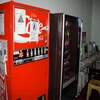
Internet Coke Machine

1982Proto-meme / internet artifactclassic

Also known as: CMU Coke Machine · Carnegie Mellon Coke Machine

Internet Coke Machine is a 1982 internet-connected vending machine at Carnegie Mellon University's CS Department, recognized as one of the earliest IoT devices and foundational internet folklore.

The Internet Coke Machine is a Coca-Cola vending machine at Carnegie Mellon University's Computer Science Department that was connected to the university's network in 1982, making it one of the earliest known internet-connected devices. Built by a group of programmers too lazy to walk to the machine only to find it empty or stocked with warm soda, it became an iconic piece of internet folklore and is widely cited as the original "Internet of Things" device2. The machine's story was formally documented on Know Your Meme in 2010, where it earned recognition as one of the internet's earliest memes5.

TL;DR

The Internet Coke Machine is a Coca-Cola vending machine at Carnegie Mellon University's Computer Science Department that was connected to the university's network in 1982, making it one of the earliest known internet-connected devices.

Overview

The Internet Coke Machine is a vending machine in Carnegie Mellon University's School of Computer Science that was rigged with micro-switches and hooked up to the department's PDP-10 mainframe computer (known as CMUA) in 19821. The system tracked how many bottles were present in each of the machine's six columns and how long each bottle had been sitting there, giving users a way to check remotely whether the machine was stocked and whether the drinks were cold2. It's not a meme in the image-macro sense. It's a proto-meme: a piece of early internet culture that spread through word of mouth, Usenet posts, and finger commands long before the World Wide Web existed.

The story begins with a simple problem: Carnegie Mellon's computer science department had been moved away from the Coke machine, and thirsty programmers got tired of making the trek only to find the machine empty or full of warm bottles2. In 1982, four members of the department built a solution. Mike Kazar wrote the server software, David Nichols handled documentation and user-facing tools, John Zsarnay did the hardware work, and Ivor Durham created the finger interface1.

They installed micro-switches inside the machine to sense how many bottles sat in each of its six columns2. These switches fed data to CMUA, the department's PDP-10 mainframe, where a server program tracked the machine's inventory state in real time, including how long each bottle had been in the machine (a rough proxy for temperature)1. Users could run a simple finger command to check the status before making the walk.

Origin & Background

Platform
Carnegie Mellon University internal network (ARPANET-connected), later WWW (1993)
Key People
Mike Kazar, David Nichols, John Zsarnay, Ivor Durham
Date
1982

The story begins with a simple problem: Carnegie Mellon's computer science department had been moved away from the Coke machine, and thirsty programmers got tired of making the trek only to find the machine empty or full of warm bottles. In 1982, four members of the department built a solution. Mike Kazar wrote the server software, David Nichols handled documentation and user-facing tools, John Zsarnay did the hardware work, and Ivor Durham created the finger interface.

They installed micro-switches inside the machine to sense how many bottles sat in each of its six columns. These switches fed data to CMUA, the department's PDP-10 mainframe, where a server program tracked the machine's inventory state in real time, including how long each bottle had been in the machine (a rough proxy for temperature). Users could run a simple finger command to check the status before making the walk.

How It Spread

Word of the CMU Coke Machine spread organically through the early internet's social channels: Usenet newsgroups, email lists, and the finger protocol. By the early 1990s, it had become something of a legend among the computer science community. A 1994 thread on the alt.hackers Usenet group shows users sharing finger addresses for various internet-connected Coke machines, with the CMU machine listed as the most well-known: "The best known is at CMU (try finger coke@cmu.edu)".

In 1993, the machine got its own web page, making it accessible through the nascent World Wide Web. This was a big deal at the time. The machine went from being a network curiosity accessible only through command-line tools to something anyone with a web browser could check.

The concept inspired copycats at universities worldwide. The University of Western Australia's Computer Club built their own internet-connected Coke machine starting in 1992, using a 68000-based board with 16K EPROM and 64K SRAM, along with custom dispensing software. The alt.hackers thread also listed machines at the University of Wisconsin (finger coke@cs.wisc.edu) and Rochester Institute of Technology (finger drink@csh.rit.edu). Bennet Yee at UC San Diego maintained a dedicated list of internet-accessible Coke machines.

A second-generation interface was installed at CMU in 1995, designed by Greg Nelson (mail/zephyr/finger interface), Rich Caruana (software/power), and Manish Pandey (hardware). A third generation was later developed by Kevin Watkins, Mike Vande Weghe, and Chuck Rosenberg.

The machine's meme status was formally recognized on August 26, 2010, when a user named Cybergatail posted about it on the Know Your Meme forums, documenting its history and significance.

How to Use This Meme

The Internet Coke Machine isn't a meme template in the traditional sense. It's typically referenced as:

- Historical shorthand for the origins of the Internet of Things, often in articles and presentations about connected devices - Hacker culture lore, brought up in discussions about early internet history or the spirit of building things just because you can - A punchline about programmer laziness, where the joke is that someone built a networked monitoring system rather than walk down the hall

People typically reference it by telling the story: programmers at CMU connected a Coke machine to the internet in 1982 because they didn't want to walk to an empty vending machine. The absurdity of the motivation paired with the technical achievement is the core of the humor.

Cultural Impact

The Internet Coke Machine is routinely cited as the first or one of the first "Internet of Things" devices. Long before smart fridges and connected thermostats, a group of grad students proved that any physical object could be networked if someone cared enough about the problem it solved.

The machine influenced how people think about the relationship between physical objects and digital networks. Michael Edson's 2007 museum workshop used the concept of an internet-connected vending machine to teach non-technical professionals that the internet isn't limited to desktop computers and big servers. "Who imagined 20 years ago that the same set of rules created for a nuclear-attack-resistant messaging network could spawn the World Wide Web and MySpace?" he asked.

The concept also spawned a minor tradition at universities worldwide. From Carnegie Mellon to Western Australia to Wisconsin to Rochester Institute of Technology, CS departments connected their vending machines to the internet as a rite of passage. Bennet Yee's curated list of internet-accessible Coke machines at UC San Diego served as an informal directory for this subculture.

Coca-Cola's modern Freestyle machines, deployed in over 2,000 fast food locations across the US and UK as of the mid-2010s, are the corporate descendants of the CMU hack. They track individual machines, monitor inventory, run test marketing, and analyze drinking preferences. As one writer put it: "a Coke Freestyle machine is an Internet Coke Machine on steroids".

Full History

The Internet Coke Machine didn't just appear out of nowhere. It was born from the very specific culture of early 1980s computer science departments, where grad students and researchers lived in their labs and viewed every inconvenience as an engineering problem to solve. Carnegie Mellon's CS department had the infrastructure (a PDP-10 mainframe with network access) and the motivation (warm soda and empty machines).

The machine sat behind a locked door, per university vending policy, which allowed the department to run it independently and set their own prices through a group called DEC/5. All profits went back to the department. At peak consumption, the machine went through about five cases (120 bottles) per day, which works out to a mean time between cokes of just 12 minutes.

Through the late 1980s and early 1990s, the machine's reputation grew through Usenet and word of mouth. It became an internet status symbol, a piece of hacker lore that people cited as proof of what networked computing could do. When the World Wide Web arrived in the early 1990s, the CMU team gave the machine a proper web interface in 1993, making it one of the first "things" on the web.

The idea proved infectious. The University of Western Australia's Computer Club heard about the CMU and MIT machines in 1992 and decided they had to build one too. Getting a machine from Coca-Cola required some creative persuasion: "It took a bit of explaining (these people had never heard of the Internet), but when they understood what we were babbling about, they were (somewhat) enthusiastic about the project". The UWA machine used custom hardware with phototransistors to sense the "sold out" lights and ran dispensing software on a Sun workstation. Users could type "dispense coke" to have the machine search for a non-empty slot and drop a can.

The UWA machine even generated its own mini-controversy. In mid-1995, the son of a Coca-Cola director in Atlanta found the machine online and mentioned it to his father. Coke's knee-jerk reaction was to request the machine be shut down, and the story was picked up by newspapers and radio stations across Australia. The situation was resolved when the Computer Club simply purchased the loaned machine from Coca-Cola for $200.

MIT also had machines called "coke" and "pepsi" on their network, though these were reportedly not actual dispensing machines of any kind. The finger command `pepsi@elab.cs.cmu.edu` reportedly returned the same results as the Coke machine at CMU, suggesting a playful alias.

The concept saw a hobbyist revival in the late 2000s. MIT computer science graduate Chris Varenhorst built his own internet-controlled soda machine, rigging it so that a "secret" circuit gave it unlimited credits, controllable via an iPhone app he wrote. He could dispense a cold Coca-Cola for anyone, anywhere, at any time. When Varenhorst graduated, his former roommates sold the machine on eBay for just $76, with part of the proceeds going to charity.

In 2007, the concept entered the museum education world when Michael Edson presented a paper at Museums and the Web about building internet-enabled soda machines using inexpensive microcontrollers. He used the project as a teaching tool to challenge assumptions about what the internet is: "What if I told you that you could buy a complete Web server that fits in the palm of your hand for $130, and that it's battery powered?"

The commercial world caught up by 2015, when vending machine companies including Coca-Cola began deploying internet-connected platforms at scale. Coca-Cola's Freestyle machines, better known for letting you mix Sprite with Mello Yello Zero, are essentially the Internet Coke Machine concept taken corporate: they track inventory, conduct real-time test marketing, and monitor drinking preferences across thousands of locations.

Fun Facts

The CMU Coke Machine's mean time between cokes (MTBC) was 12 minutes at peak consumption, meaning the department drank roughly 120 bottles per day.

You could finger `pepsi@elab.cs.cmu.edu` and get the same results as the Coke machine, suggesting someone set up a cheeky alias.

The UWA Computer Club's machine had a backdoor: if you unplugged the Sun workstation, attached a terminal, and typed "D6," you could get a free can of Coke.

The machine had to stay behind a locked door to comply with university vending policy, which only allowed self-run machines accessible exclusively to department members.

An Italian blog credits it as "il primo Meme della Storia di Internet" (the first meme in internet history).

Derivatives & Variations

University of Western Australia Coke Machine (1992):

Built by the UWA Computer Club using a 68000-based board, it became Australia's "only Internet connected drink machine" and generated national news coverage when Coca-Cola briefly tried to shut it down[3].

Chris Varenhorst's iPhone Soda Machine (c. 2009):

An MIT grad rigged a cheap vending machine with internet connectivity and an iPhone app for remote dispensing. It sold on eBay for $76 after he graduated[6].

Museum Workshop Soda Machine (2007):

Michael Edson built an internet-enabled vending machine using microcontrollers as a teaching tool for museum professionals, demonstrating physical computing concepts[7].

Multiple university finger-accessible machines:

Machines at the University of Wisconsin, Rochester Institute of Technology, and others were accessible via the finger protocol throughout the 1990s[4].

Frequently Asked Questions

InternetCokeMachine

1982Proto-meme / internet artifactclassic

Also known as: CMU Coke Machine · Carnegie Mellon Coke Machine

Internet Coke Machine is a 1982 internet-connected vending machine at Carnegie Mellon University's CS Department, recognized as one of the earliest IoT devices and foundational internet folklore.

The Internet Coke Machine is a Coca-Cola vending machine at Carnegie Mellon University's Computer Science Department that was connected to the university's network in 1982, making it one of the earliest known internet-connected devices. Built by a group of programmers too lazy to walk to the machine only to find it empty or stocked with warm soda, it became an iconic piece of internet folklore and is widely cited as the original "Internet of Things" device. The machine's story was formally documented on Know Your Meme in 2010, where it earned recognition as one of the internet's earliest memes.

TL;DR

The Internet Coke Machine is a Coca-Cola vending machine at Carnegie Mellon University's Computer Science Department that was connected to the university's network in 1982, making it one of the earliest known internet-connected devices.

Overview

The Internet Coke Machine is a vending machine in Carnegie Mellon University's School of Computer Science that was rigged with micro-switches and hooked up to the department's PDP-10 mainframe computer (known as CMUA) in 1982. The system tracked how many bottles were present in each of the machine's six columns and how long each bottle had been sitting there, giving users a way to check remotely whether the machine was stocked and whether the drinks were cold. It's not a meme in the image-macro sense. It's a proto-meme: a piece of early internet culture that spread through word of mouth, Usenet posts, and finger commands long before the World Wide Web existed.

The story begins with a simple problem: Carnegie Mellon's computer science department had been moved away from the Coke machine, and thirsty programmers got tired of making the trek only to find the machine empty or full of warm bottles. In 1982, four members of the department built a solution. Mike Kazar wrote the server software, David Nichols handled documentation and user-facing tools, John Zsarnay did the hardware work, and Ivor Durham created the finger interface.

They installed micro-switches inside the machine to sense how many bottles sat in each of its six columns. These switches fed data to CMUA, the department's PDP-10 mainframe, where a server program tracked the machine's inventory state in real time, including how long each bottle had been in the machine (a rough proxy for temperature). Users could run a simple finger command to check the status before making the walk.

Origin & Background

Platform
Carnegie Mellon University internal network (ARPANET-connected), later WWW (1993)
Key People
Mike Kazar, David Nichols, John Zsarnay, Ivor Durham
Date
1982

The story begins with a simple problem: Carnegie Mellon's computer science department had been moved away from the Coke machine, and thirsty programmers got tired of making the trek only to find the machine empty or full of warm bottles. In 1982, four members of the department built a solution. Mike Kazar wrote the server software, David Nichols handled documentation and user-facing tools, John Zsarnay did the hardware work, and Ivor Durham created the finger interface.

They installed micro-switches inside the machine to sense how many bottles sat in each of its six columns. These switches fed data to CMUA, the department's PDP-10 mainframe, where a server program tracked the machine's inventory state in real time, including how long each bottle had been in the machine (a rough proxy for temperature). Users could run a simple finger command to check the status before making the walk.

How It Spread

Word of the CMU Coke Machine spread organically through the early internet's social channels: Usenet newsgroups, email lists, and the finger protocol. By the early 1990s, it had become something of a legend among the computer science community. A 1994 thread on the alt.hackers Usenet group shows users sharing finger addresses for various internet-connected Coke machines, with the CMU machine listed as the most well-known: "The best known is at CMU (try finger coke@cmu.edu)".

In 1993, the machine got its own web page, making it accessible through the nascent World Wide Web. This was a big deal at the time. The machine went from being a network curiosity accessible only through command-line tools to something anyone with a web browser could check.

The concept inspired copycats at universities worldwide. The University of Western Australia's Computer Club built their own internet-connected Coke machine starting in 1992, using a 68000-based board with 16K EPROM and 64K SRAM, along with custom dispensing software. The alt.hackers thread also listed machines at the University of Wisconsin (finger coke@cs.wisc.edu) and Rochester Institute of Technology (finger drink@csh.rit.edu). Bennet Yee at UC San Diego maintained a dedicated list of internet-accessible Coke machines.

A second-generation interface was installed at CMU in 1995, designed by Greg Nelson (mail/zephyr/finger interface), Rich Caruana (software/power), and Manish Pandey (hardware). A third generation was later developed by Kevin Watkins, Mike Vande Weghe, and Chuck Rosenberg.

The machine's meme status was formally recognized on August 26, 2010, when a user named Cybergatail posted about it on the Know Your Meme forums, documenting its history and significance.

How to Use This Meme

The Internet Coke Machine isn't a meme template in the traditional sense. It's typically referenced as:

- Historical shorthand for the origins of the Internet of Things, often in articles and presentations about connected devices - Hacker culture lore, brought up in discussions about early internet history or the spirit of building things just because you can - A punchline about programmer laziness, where the joke is that someone built a networked monitoring system rather than walk down the hall

People typically reference it by telling the story: programmers at CMU connected a Coke machine to the internet in 1982 because they didn't want to walk to an empty vending machine. The absurdity of the motivation paired with the technical achievement is the core of the humor.

Cultural Impact

The Internet Coke Machine is routinely cited as the first or one of the first "Internet of Things" devices. Long before smart fridges and connected thermostats, a group of grad students proved that any physical object could be networked if someone cared enough about the problem it solved.

The machine influenced how people think about the relationship between physical objects and digital networks. Michael Edson's 2007 museum workshop used the concept of an internet-connected vending machine to teach non-technical professionals that the internet isn't limited to desktop computers and big servers. "Who imagined 20 years ago that the same set of rules created for a nuclear-attack-resistant messaging network could spawn the World Wide Web and MySpace?" he asked.

The concept also spawned a minor tradition at universities worldwide. From Carnegie Mellon to Western Australia to Wisconsin to Rochester Institute of Technology, CS departments connected their vending machines to the internet as a rite of passage. Bennet Yee's curated list of internet-accessible Coke machines at UC San Diego served as an informal directory for this subculture.

Coca-Cola's modern Freestyle machines, deployed in over 2,000 fast food locations across the US and UK as of the mid-2010s, are the corporate descendants of the CMU hack. They track individual machines, monitor inventory, run test marketing, and analyze drinking preferences. As one writer put it: "a Coke Freestyle machine is an Internet Coke Machine on steroids".

Full History

The Internet Coke Machine didn't just appear out of nowhere. It was born from the very specific culture of early 1980s computer science departments, where grad students and researchers lived in their labs and viewed every inconvenience as an engineering problem to solve. Carnegie Mellon's CS department had the infrastructure (a PDP-10 mainframe with network access) and the motivation (warm soda and empty machines).

The machine sat behind a locked door, per university vending policy, which allowed the department to run it independently and set their own prices through a group called DEC/5. All profits went back to the department. At peak consumption, the machine went through about five cases (120 bottles) per day, which works out to a mean time between cokes of just 12 minutes.

Through the late 1980s and early 1990s, the machine's reputation grew through Usenet and word of mouth. It became an internet status symbol, a piece of hacker lore that people cited as proof of what networked computing could do. When the World Wide Web arrived in the early 1990s, the CMU team gave the machine a proper web interface in 1993, making it one of the first "things" on the web.

The idea proved infectious. The University of Western Australia's Computer Club heard about the CMU and MIT machines in 1992 and decided they had to build one too. Getting a machine from Coca-Cola required some creative persuasion: "It took a bit of explaining (these people had never heard of the Internet), but when they understood what we were babbling about, they were (somewhat) enthusiastic about the project". The UWA machine used custom hardware with phototransistors to sense the "sold out" lights and ran dispensing software on a Sun workstation. Users could type "dispense coke" to have the machine search for a non-empty slot and drop a can.

The UWA machine even generated its own mini-controversy. In mid-1995, the son of a Coca-Cola director in Atlanta found the machine online and mentioned it to his father. Coke's knee-jerk reaction was to request the machine be shut down, and the story was picked up by newspapers and radio stations across Australia. The situation was resolved when the Computer Club simply purchased the loaned machine from Coca-Cola for $200.

MIT also had machines called "coke" and "pepsi" on their network, though these were reportedly not actual dispensing machines of any kind. The finger command `pepsi@elab.cs.cmu.edu` reportedly returned the same results as the Coke machine at CMU, suggesting a playful alias.

The concept saw a hobbyist revival in the late 2000s. MIT computer science graduate Chris Varenhorst built his own internet-controlled soda machine, rigging it so that a "secret" circuit gave it unlimited credits, controllable via an iPhone app he wrote. He could dispense a cold Coca-Cola for anyone, anywhere, at any time. When Varenhorst graduated, his former roommates sold the machine on eBay for just $76, with part of the proceeds going to charity.

In 2007, the concept entered the museum education world when Michael Edson presented a paper at Museums and the Web about building internet-enabled soda machines using inexpensive microcontrollers. He used the project as a teaching tool to challenge assumptions about what the internet is: "What if I told you that you could buy a complete Web server that fits in the palm of your hand for $130, and that it's battery powered?"

The commercial world caught up by 2015, when vending machine companies including Coca-Cola began deploying internet-connected platforms at scale. Coca-Cola's Freestyle machines, better known for letting you mix Sprite with Mello Yello Zero, are essentially the Internet Coke Machine concept taken corporate: they track inventory, conduct real-time test marketing, and monitor drinking preferences across thousands of locations.

Fun Facts

The CMU Coke Machine's mean time between cokes (MTBC) was 12 minutes at peak consumption, meaning the department drank roughly 120 bottles per day.

You could finger `pepsi@elab.cs.cmu.edu` and get the same results as the Coke machine, suggesting someone set up a cheeky alias.

The UWA Computer Club's machine had a backdoor: if you unplugged the Sun workstation, attached a terminal, and typed "D6," you could get a free can of Coke.

The machine had to stay behind a locked door to comply with university vending policy, which only allowed self-run machines accessible exclusively to department members.

An Italian blog credits it as "il primo Meme della Storia di Internet" (the first meme in internet history).

Derivatives & Variations

University of Western Australia Coke Machine (1992):

Built by the UWA Computer Club using a 68000-based board, it became Australia's "only Internet connected drink machine" and generated national news coverage when Coca-Cola briefly tried to shut it down[3].

Chris Varenhorst's iPhone Soda Machine (c. 2009):

An MIT grad rigged a cheap vending machine with internet connectivity and an iPhone app for remote dispensing. It sold on eBay for $76 after he graduated[6].

Museum Workshop Soda Machine (2007):

Michael Edson built an internet-enabled vending machine using microcontrollers as a teaching tool for museum professionals, demonstrating physical computing concepts[7].

Multiple university finger-accessible machines:

Machines at the University of Wisconsin, Rochester Institute of Technology, and others were accessible via the finger protocol throughout the 1990s[4].

Frequently Asked Questions