The Geek Code

1993Signature block code / self-classification systemclassic

Also known as: Geek Code · Code of the Geeks

The Geek Code is a 1993 alphanumeric system created by Robert Hayden that geeks used in email signatures and Usenet posts to encode their personalities, interests, skills, and opinions.

The Geek Code is a system of letters, numbers, and symbols that self-identified geeks used in email signatures and Usenet posts to communicate their personalities, interests, skills, and opinions in a compact, encoded format. Created by Robert A. Hayden at Mankato State University in 1993, it spread across early internet communities as a badge of geek identity during the pre-web Usenet era. The code went through multiple versions over three years and spawned dozens of derivative codes for subcultures ranging from goths to furries, making it one of the earliest examples of internet-native self-classification culture.

TL;DR

The Geek Code is a system of letters, numbers, and symbols that self-identified geeks used in email signatures and Usenet posts to communicate their personalities, interests, skills, and opinions in a compact, encoded format.

Overview

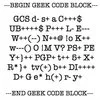
The Geek Code is a structured block of alphanumeric characters and symbols that encodes information about a person's geek identity across dozens of categories. A typical Geek Code block looks like a wall of gibberish to outsiders but reads like a detailed personality profile to anyone who knows the system. Categories cover everything from computer skills and operating system preferences to opinions on Star Trek, political leanings, dress style, education level, relationship status, and even sex life1.

The code uses a base letter for each category (like `C` for computers, `U` for Unix, `t` for Star Trek) followed by `+` or `-` modifiers to indicate degree. `C++++` means you want a cybernetic interface installed in your skull. `C---` means you can barely turn on a computer8. Special modifiers like `$` (getting paid for it), `@` (varies), `?` (no clue what this is), and `!` (refuse to participate) add extra nuance8. The whole thing gets wrapped in `-----BEGIN GEEK CODE BLOCK-----` and `-----END GEEK CODE BLOCK-----` delimiters, mimicking PGP encryption blocks4.

Users would paste their completed code into their Usenet signature or email.sig file, letting other geeks decode their entire personality at a glance10.

Robert A. Hayden, a student at Mankato State University (now Minnesota State University, Mankato), posted the first version of the Geek Code to the Usenet groups alt.geek and rec.humor on August 11, 19935. Version 0.1 had only about five categories1. Hayden later said he created it "as a lark" and never expected it to take off2.

The idea drew from a tradition of coded signatures in online communities. The Bear Code, created on November 23, 1989 by Bob Donahue and Jeff Stoner, was one of the first online flagging systems5. It helped gay men in the bear subculture share physical and sexual information in a compact format. The Smurf Code and Twink Code followed in 19905. These codes themselves may trace back to the handkerchief code, a color-based flagging system from the 1970s that allowed members of sexual subcultures to identify each other in public11.

Hayden took this compact self-description concept and applied it to geek culture broadly. Version 0.2 fixed spelling and bugs, and version 0.3 added a few more categories. Version 1.0 landed on July 17, 1993, just four months later, introducing rules for cross-overs and variables1. Over the next year, Hayden collected roughly 75 suggestions from the community and rolled them into Version 2.0, released July 17, 1994, exactly one year after 1.01.

Origin & Background

Platform
Usenet (alt.geek, rec.humor)
Creator
Robert A. Hayden
Date
1993

Robert A. Hayden, a student at Mankato State University (now Minnesota State University, Mankato), posted the first version of the Geek Code to the Usenet groups alt.geek and rec.humor on August 11, 1993. Version 0.1 had only about five categories. Hayden later said he created it "as a lark" and never expected it to take off.

The idea drew from a tradition of coded signatures in online communities. The Bear Code, created on November 23, 1989 by Bob Donahue and Jeff Stoner, was one of the first online flagging systems. It helped gay men in the bear subculture share physical and sexual information in a compact format. The Smurf Code and Twink Code followed in 1990. These codes themselves may trace back to the handkerchief code, a color-based flagging system from the 1970s that allowed members of sexual subcultures to identify each other in public.

Hayden took this compact self-description concept and applied it to geek culture broadly. Version 0.2 fixed spelling and bugs, and version 0.3 added a few more categories. Version 1.0 landed on July 17, 1993, just four months later, introducing rules for cross-overs and variables. Over the next year, Hayden collected roughly 75 suggestions from the community and rolled them into Version 2.0, released July 17, 1994, exactly one year after 1.0.

How It Spread

By 1994, the Geek Code had migrated from plain-text Usenet posts to HTML web pages, with a second version adding sections for cars, spoken languages, Perl, Windows, Mac, and Cypherpunks. The code was spreading fast enough that people needed tools to work with it. In 1995, Dylan Northrup built the first code generator, letting users click radio buttons and checkboxes instead of memorizing the syntax.

Version 3.x arrived on March 5, 1996, hosted on the domain GeekCode.com. This was a major overhaul that cut non-geeky categories like automobiles and nutrition, replacing them with entertainment sections for X-Files and Dilbert fans. The final code had 34 sections, double the original 17. In his note on the page, Hayden reflected that by 1996 the internet had changed: "the internet of 1996 was still a wild untamed virgin paradise of geeks and eggheads," but the arrival of AOL users and "politicians passing laws about a technology they refused to comprehend" had shifted the culture.

Two decoder tools helped keep the code accessible as it grew more complex. In 1998, Bradley M. Kuhn launched The Geek Code Decoder Page, a script that could translate any code block into plain English. Its claim to fame was that Perl creator Larry Wall used it and posted his decoded Geek Code on his personal website. A second decoder by Anicka and Martin went live around Christmas 2006.

The Geek Code landed on Urban Dictionary in August 2005. Though active discussion of the code tapered off through the late 2000s, it resurfaced periodically. In 2012, The Geek Anthropologist published an analysis noting the code's outdated categories (Babylon 5, DOOM, no mention of Star Wars) and its lack of a gender field, suggesting the code was "written with only men in mind".

The code got a modern revival when the Tel Aviv Makers community released Version 4.x on GitHub on October 18, 2019, updating categories for the current era. Version 5.0 followed, eliminating case-sensitive categories and modifying some letters. The GitHub repository describes the code's goal as encoding "everything that defines a geek's individuality into a compact format that only other geeks can comprehend".

How to Use This Meme

Creating a Geek Code block follows a straightforward process:

1

Pick your Geek Type. Start with `G` followed by one or two letters indicating your field: `GCS` for Computer Science, `GMU` for Music, `GSS` for Social Science, and so on. Multiple types get separated by slashes: `GCS/MU/TW`.

2

Rate yourself in each category. Go through categories like dress (`d`), shape (`s`), age (`a`), computers (`C`), Unix (`U`), Perl (`P`), and so on. Add `+` signs to indicate higher engagement or skill, `-` signs for lower. Stack them: `C++++` is a cybernetics enthusiast, `C---` is someone who struggles with basic computer use.

3

Add modifiers as needed. Use `$` if you get paid for something, `@` if your rating varies, `?` if you have no idea about a category, and `!` before a category to refuse participation entirely. Parentheses indicate ranges: `C+(---)` means you swing between competent and clueless depending on the day.

4

Wrap it in delimiters. Place your assembled string between `-----BEGIN GEEK CODE BLOCK-----` and `-----END GEEK CODE BLOCK-----`.

5

Paste it in your signature. The traditional home for a Geek Code block is an email or Usenet signature file.

Cultural Impact

The Geek Code was one of the earliest internet-native identity systems, predating social media profiles by over a decade. It formalized something that online communities had been doing informally: using compact text to signal who you are and what you're into. The signature block convention described by Usenet standards (two hyphens, a space, and a newline) became the natural home for these codes.

The code's real legacy is the wave of derivative codes it inspired. Starting in 1995, subculture-specific versions began appearing across Usenet. The Goth Code and the Cat Code both launched that year. Between 1996 and 2008, codes were created for furries, fans of Chip 'n Dale: Rescue Rangers, swingers, Buffy the Vampire Slayer fans, hackers, knitters, and people with autism. The Goth Code's 1998 homepage alone linked to over 30 derivative codes including the Zoo Code, Muffdiva Code, Lion King Code, Ska Code, and Dragon Code.

Hayden himself acknowledged the code's place in internet history. Writing on GeekCode.com, he called it "a testament to the history of the Internet, however small a part it may have played". The Geek Anthropologist's 2012 analysis treated it as an artifact worth academic study, noting the impossibility of "creating a mechanism that will perfectly identify, qualify and quantify geekiness".

Fun Facts

Larry Wall, the creator of Perl, posted his decoded Geek Code on his personal website, giving Bradley M. Kuhn's decoder page its biggest claim to fame.

Hayden's original Version 0.1 had only five categories. By Version 3.x, it had 34.

The `geekcode` Linux package is available on Debian and Ubuntu, but it only supports the basic Version 3 code without crossovers or variables.

The Goth Code's 1998 homepage listed over 30 other signature codes, including a Sondheim Code, a Marching Band Code, and something called the Bob Code.

The code's format, with BEGIN/END block delimiters, deliberately mimicked PGP encryption blocks, adding an extra layer of in-joke for the technically inclined.

Derivatives & Variations

The Bear Code

(1989): The predecessor that inspired Hayden's work, created by Bob Donahue and Jeff Stoner for gay bear subculture members to share physical and preference information[5].

The Goth Code

(1995/1998): A subcultural variant with its own encoder/decoder tools, hosted at code.goth.net[14].

The Cat Code

(1995): A system for describing cats using similar alphanumeric conventions, covering breed, color, age, and behavioral traits[15].

The Ranger Code

(1998): Created by Byron "TheBoz" Crowe for fans of Chip 'n Dale: Rescue Rangers, including sections for "degrees of Gadgephilia"[15].

Buffy Geek Code

A fan-created system covering Buffy the Vampire Slayer fandom preferences, including shipping, spoiler tolerance, and character favorites[16].

Furry Code, Hacker Code, Knitter Code, Autism Code

Various subcultural adaptations created between 1996 and 2008[5].

Version 4.x/5.x

(2019+): A community-driven update by the Tel Aviv Makers group on GitHub, modernizing categories and eliminating case sensitivity[3].

Frequently Asked Questions

TheGeekCode

1993Signature block code / self-classification systemclassic

Also known as: Geek Code · Code of the Geeks

The Geek Code is a 1993 alphanumeric system created by Robert Hayden that geeks used in email signatures and Usenet posts to encode their personalities, interests, skills, and opinions.

The Geek Code is a system of letters, numbers, and symbols that self-identified geeks used in email signatures and Usenet posts to communicate their personalities, interests, skills, and opinions in a compact, encoded format. Created by Robert A. Hayden at Mankato State University in 1993, it spread across early internet communities as a badge of geek identity during the pre-web Usenet era. The code went through multiple versions over three years and spawned dozens of derivative codes for subcultures ranging from goths to furries, making it one of the earliest examples of internet-native self-classification culture.

TL;DR

The Geek Code is a system of letters, numbers, and symbols that self-identified geeks used in email signatures and Usenet posts to communicate their personalities, interests, skills, and opinions in a compact, encoded format.

Overview

The Geek Code is a structured block of alphanumeric characters and symbols that encodes information about a person's geek identity across dozens of categories. A typical Geek Code block looks like a wall of gibberish to outsiders but reads like a detailed personality profile to anyone who knows the system. Categories cover everything from computer skills and operating system preferences to opinions on Star Trek, political leanings, dress style, education level, relationship status, and even sex life.

The code uses a base letter for each category (like `C` for computers, `U` for Unix, `t` for Star Trek) followed by `+` or `-` modifiers to indicate degree. `C++++` means you want a cybernetic interface installed in your skull. `C---` means you can barely turn on a computer. Special modifiers like `$` (getting paid for it), `@` (varies), `?` (no clue what this is), and `!` (refuse to participate) add extra nuance. The whole thing gets wrapped in `-----BEGIN GEEK CODE BLOCK-----` and `-----END GEEK CODE BLOCK-----` delimiters, mimicking PGP encryption blocks.

Users would paste their completed code into their Usenet signature or email.sig file, letting other geeks decode their entire personality at a glance.

Robert A. Hayden, a student at Mankato State University (now Minnesota State University, Mankato), posted the first version of the Geek Code to the Usenet groups alt.geek and rec.humor on August 11, 1993. Version 0.1 had only about five categories. Hayden later said he created it "as a lark" and never expected it to take off.

The idea drew from a tradition of coded signatures in online communities. The Bear Code, created on November 23, 1989 by Bob Donahue and Jeff Stoner, was one of the first online flagging systems. It helped gay men in the bear subculture share physical and sexual information in a compact format. The Smurf Code and Twink Code followed in 1990. These codes themselves may trace back to the handkerchief code, a color-based flagging system from the 1970s that allowed members of sexual subcultures to identify each other in public.

Hayden took this compact self-description concept and applied it to geek culture broadly. Version 0.2 fixed spelling and bugs, and version 0.3 added a few more categories. Version 1.0 landed on July 17, 1993, just four months later, introducing rules for cross-overs and variables. Over the next year, Hayden collected roughly 75 suggestions from the community and rolled them into Version 2.0, released July 17, 1994, exactly one year after 1.0.

Origin & Background

Platform
Usenet (alt.geek, rec.humor)
Creator
Robert A. Hayden
Date
1993

Robert A. Hayden, a student at Mankato State University (now Minnesota State University, Mankato), posted the first version of the Geek Code to the Usenet groups alt.geek and rec.humor on August 11, 1993. Version 0.1 had only about five categories. Hayden later said he created it "as a lark" and never expected it to take off.

The idea drew from a tradition of coded signatures in online communities. The Bear Code, created on November 23, 1989 by Bob Donahue and Jeff Stoner, was one of the first online flagging systems. It helped gay men in the bear subculture share physical and sexual information in a compact format. The Smurf Code and Twink Code followed in 1990. These codes themselves may trace back to the handkerchief code, a color-based flagging system from the 1970s that allowed members of sexual subcultures to identify each other in public.

Hayden took this compact self-description concept and applied it to geek culture broadly. Version 0.2 fixed spelling and bugs, and version 0.3 added a few more categories. Version 1.0 landed on July 17, 1993, just four months later, introducing rules for cross-overs and variables. Over the next year, Hayden collected roughly 75 suggestions from the community and rolled them into Version 2.0, released July 17, 1994, exactly one year after 1.0.

How It Spread

By 1994, the Geek Code had migrated from plain-text Usenet posts to HTML web pages, with a second version adding sections for cars, spoken languages, Perl, Windows, Mac, and Cypherpunks. The code was spreading fast enough that people needed tools to work with it. In 1995, Dylan Northrup built the first code generator, letting users click radio buttons and checkboxes instead of memorizing the syntax.

Version 3.x arrived on March 5, 1996, hosted on the domain GeekCode.com. This was a major overhaul that cut non-geeky categories like automobiles and nutrition, replacing them with entertainment sections for X-Files and Dilbert fans. The final code had 34 sections, double the original 17. In his note on the page, Hayden reflected that by 1996 the internet had changed: "the internet of 1996 was still a wild untamed virgin paradise of geeks and eggheads," but the arrival of AOL users and "politicians passing laws about a technology they refused to comprehend" had shifted the culture.

Two decoder tools helped keep the code accessible as it grew more complex. In 1998, Bradley M. Kuhn launched The Geek Code Decoder Page, a script that could translate any code block into plain English. Its claim to fame was that Perl creator Larry Wall used it and posted his decoded Geek Code on his personal website. A second decoder by Anicka and Martin went live around Christmas 2006.

The Geek Code landed on Urban Dictionary in August 2005. Though active discussion of the code tapered off through the late 2000s, it resurfaced periodically. In 2012, The Geek Anthropologist published an analysis noting the code's outdated categories (Babylon 5, DOOM, no mention of Star Wars) and its lack of a gender field, suggesting the code was "written with only men in mind".

The code got a modern revival when the Tel Aviv Makers community released Version 4.x on GitHub on October 18, 2019, updating categories for the current era. Version 5.0 followed, eliminating case-sensitive categories and modifying some letters. The GitHub repository describes the code's goal as encoding "everything that defines a geek's individuality into a compact format that only other geeks can comprehend".

How to Use This Meme

Creating a Geek Code block follows a straightforward process:

1

Pick your Geek Type. Start with `G` followed by one or two letters indicating your field: `GCS` for Computer Science, `GMU` for Music, `GSS` for Social Science, and so on. Multiple types get separated by slashes: `GCS/MU/TW`.

2

Rate yourself in each category. Go through categories like dress (`d`), shape (`s`), age (`a`), computers (`C`), Unix (`U`), Perl (`P`), and so on. Add `+` signs to indicate higher engagement or skill, `-` signs for lower. Stack them: `C++++` is a cybernetics enthusiast, `C---` is someone who struggles with basic computer use.

3

Add modifiers as needed. Use `$` if you get paid for something, `@` if your rating varies, `?` if you have no idea about a category, and `!` before a category to refuse participation entirely. Parentheses indicate ranges: `C+(---)` means you swing between competent and clueless depending on the day.

4

Wrap it in delimiters. Place your assembled string between `-----BEGIN GEEK CODE BLOCK-----` and `-----END GEEK CODE BLOCK-----`.

5

Paste it in your signature. The traditional home for a Geek Code block is an email or Usenet signature file.

Cultural Impact

The Geek Code was one of the earliest internet-native identity systems, predating social media profiles by over a decade. It formalized something that online communities had been doing informally: using compact text to signal who you are and what you're into. The signature block convention described by Usenet standards (two hyphens, a space, and a newline) became the natural home for these codes.

The code's real legacy is the wave of derivative codes it inspired. Starting in 1995, subculture-specific versions began appearing across Usenet. The Goth Code and the Cat Code both launched that year. Between 1996 and 2008, codes were created for furries, fans of Chip 'n Dale: Rescue Rangers, swingers, Buffy the Vampire Slayer fans, hackers, knitters, and people with autism. The Goth Code's 1998 homepage alone linked to over 30 derivative codes including the Zoo Code, Muffdiva Code, Lion King Code, Ska Code, and Dragon Code.

Hayden himself acknowledged the code's place in internet history. Writing on GeekCode.com, he called it "a testament to the history of the Internet, however small a part it may have played". The Geek Anthropologist's 2012 analysis treated it as an artifact worth academic study, noting the impossibility of "creating a mechanism that will perfectly identify, qualify and quantify geekiness".

Fun Facts

Larry Wall, the creator of Perl, posted his decoded Geek Code on his personal website, giving Bradley M. Kuhn's decoder page its biggest claim to fame.

Hayden's original Version 0.1 had only five categories. By Version 3.x, it had 34.

The `geekcode` Linux package is available on Debian and Ubuntu, but it only supports the basic Version 3 code without crossovers or variables.

The Goth Code's 1998 homepage listed over 30 other signature codes, including a Sondheim Code, a Marching Band Code, and something called the Bob Code.

The code's format, with BEGIN/END block delimiters, deliberately mimicked PGP encryption blocks, adding an extra layer of in-joke for the technically inclined.

Derivatives & Variations

The Bear Code

(1989): The predecessor that inspired Hayden's work, created by Bob Donahue and Jeff Stoner for gay bear subculture members to share physical and preference information[5].

The Goth Code

(1995/1998): A subcultural variant with its own encoder/decoder tools, hosted at code.goth.net[14].

The Cat Code

(1995): A system for describing cats using similar alphanumeric conventions, covering breed, color, age, and behavioral traits[15].

The Ranger Code

(1998): Created by Byron "TheBoz" Crowe for fans of Chip 'n Dale: Rescue Rangers, including sections for "degrees of Gadgephilia"[15].

Buffy Geek Code

A fan-created system covering Buffy the Vampire Slayer fandom preferences, including shipping, spoiler tolerance, and character favorites[16].

Furry Code, Hacker Code, Knitter Code, Autism Code

Various subcultural adaptations created between 1996 and 2008[5].

Version 4.x/5.x

(2019+): A community-driven update by the Tel Aviv Makers group on GitHub, modernizing categories and eliminating case sensitivity[3].

Frequently Asked Questions