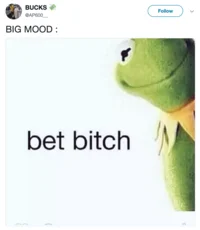
Mood

2015Slang / reaction captionclassic

Also known as: Big Mood · Whole Mood

"Mood" is a one-word internet slang caption used to express that something is deeply relatable. Coined on Black Twitter around 2015, the term replaced longer reaction formats like "TFW" and "when" captions1. Its most popular variant, "Big Mood," blew up in late 2017 and early 2018, adding intensity to the basic format and spreading across Twitter and Tumblr2.

Overview

"Mood" works as a standalone caption on images, GIFs, or videos that match someone's current emotional state. You see a picture of a dog staring at a wall? Mood. A celebrity looking exhausted at an event? Mood. The format is dead simple: post something relatable and slap "Mood" on it3.

What separates "Mood" from older reaction formats like "TFW" (that feel when) is its brevity. Where "TFW" required a setup sentence, "Mood" gets the same point across in a single word1. It can describe how you're feeling right now, what you're craving, or signal agreement with someone else's post. It's "I'm feeling it" compressed into four letters1.

Black Twitter users started using "Mood" as reaction shorthand around 20151. The Daily Dot credits Black Twitter specifically for coining this use of the word, noting it grew as a lowkey alternative to "TFW" and "when" captions that had dominated reaction images for years1.

The term evolved naturally from how Black Twitter had already popularized the "TFW" format2. By late 2015 and early 2016, "Big Mood" started appearing as an intensified version. One early "Big Mood" tweet from January 7, 2016, showed a man pushing a woman and picked up traction2.

Origin & Background

Platform
Twitter (Black Twitter)
Creator
Unknown
Date
2015

Black Twitter users started using "Mood" as reaction shorthand around 20151. The Daily Dot credits Black Twitter specifically for coining this use of the word, noting it grew as a lowkey alternative to "TFW" and "when" captions that had dominated reaction images for years1.

The term evolved naturally from how Black Twitter had already popularized the "TFW" format2. By late 2015 and early 2016, "Big Mood" started appearing as an intensified version. One early "Big Mood" tweet from January 7, 2016, showed a man pushing a woman and picked up traction2.

How It Spread

"Big Mood" picked up speed through 2016 and into 2017. A definition was added to Urban Dictionary on February 4, 20173. YouTube creators started making content around the phrase that same year. Skittlez Juice uploaded an animation titled "Big Mood" on August 22, 2017, which pulled in over 624,000 views2.

On November 16, 2017, Markiplier tweeted "What does 'big mood' mean?" and got over 1,300 retweets and 19,000 likes2. He later turned it into an investigation video that earned more than 742,000 views2.

Tumblr became a major hub for "Big Mood" usage, where the phrase often appeared in post tags. A November 14, 2017 post by oldschoolcelebrities showing Carrie Fisher sitting in a trash can with a bottle of wine, tagged "big mood," picked up over 136,000 notes2.

The real explosion happened around December 2017 and into early 2018. The Daily Dot covered the trend on January 23, 2018, noting one "Big Mood" tweet featuring a smirking cheerleader GIF had racked up more than 150,000 likes1. People started escalating the format with size modifiers: "Huge Mood," "Gargantuan Mood," and even "Big Monday Mood" for more specific vibes1.

By early 2018, "Mood" and "Big Mood" were everywhere on social media. The basic "Mood" format worked as an evolution of reaction culture, while "Big Mood" added comedic exaggeration to the mix1.

Platforms

RedditTwitterTikTokInstagramYouTube

Timeline

2019-01-01

Mood begins gaining traction

2020-01-01

Mood started spreading across social media platforms

2021-01-01

Mood reached mainstream popularity and media coverage

2022-01-01

Brands and companies started using Mood in marketing

2024-01-01

Mood entered the broader pop culture conversation

View on Google Trends

How to Use This Meme

The "Mood" format is about as simple as meme formats get:

1

Find an image, GIF, screenshot, or video that captures a relatable feeling or situation

2

Caption it with "Mood" or "Big Mood"

3

Post it on social media

Create Your Own

Cultural Impact

"Mood" changed how people express relatability online. Before it, reaction images needed setup text like "TFW when you..." or "That feel when..." to work. "Mood" stripped all that away and made the image do the talking1.

The format also marked a shift in reaction culture from specific scenarios ("TFW your boss emails you at 11 PM") to raw emotional identification. You didn't need to describe what was happening. The image was the feeling, and "Mood" was the confirmation3.

The Daily Dot predicted in 2018 that "Big Mood" would stick around "for the next year or more" before going the way of "on fleek" and "it's lit, fam"1. They were partially right about the timeline but underestimated the staying power. "Mood" outlasted its trendier cousin "Big Mood" and became absorbed into standard internet vocabulary.

Fun Facts

"Mood" essentially replaced "I'm feeling it" as the go-to relatability phrase, but cut the word count by 75%1.

Markiplier made a whole video investigating what "Big Mood" means after tweeting about it, and the video got over 742,000 views2.

The Carrie Fisher trash can photo tagged "big mood" on Tumblr became one of the most-noted uses of the phrase, with over 136,000 notes2.

The Deftones used "big mood" in their 1997 song "My Own Summer (Shove It)," though the internet slang usage came independently almost two decades later2.

Google Trends shows "TFW" peaked in March 2017 and declined as "Mood" and "Big Mood" rose to replace it1.

Derivatives & Variations

Big Mood:

The most popular variant, adding intensity to signal especially strong relatability. Blew up December 2017 through early 2018[1].

Huge Mood / Gargantuan Mood:

Escalated versions pushing the intensity even further, used for comedic exaggeration[1].

Whole Mood:

A variant meaning "that describes my entire current state," used similarly to "Big Mood"[3].

Not a Mood:

Ironic inversion used to reject something as un-relatable[3].

Frequently Asked Questions