Shirtstorm
Published September 27, 2026
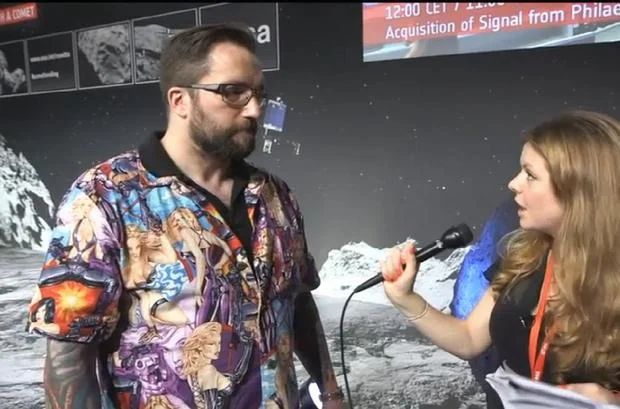
Shirtstorm, also known as Shirtgate, was the November 2014 Twitter blowup over a bowling shirt worn by British physicist Matt Taylor during live coverage of the Rosetta mission's historic comet landing. The garment, printed with cartoon pin-up women in lingerie, drew accusations of casual sexism in STEM and pulled a tearful public apology from Taylor within 48 hours, turning one of humanity's biggest science moments into an early case study in outrage-cycle mechanics.
Overview
Shirtstorm, also spelled Shirtgate, refers to the two-day Twitter firestorm in November 2014 that swirled around European Space Agency scientist Dr Matt Taylor and a loud bowling shirt covered in cartoon women in lingerie and PVC1. The row unfolded almost entirely on Twitter as two competing hashtags, with #shirtstorm carrying the more mocking, lighter energy and #shirtgate framing the shirt as a scandal about sexism in science2. What made the incident stick in meme memory was the collision of scales: a probe touching down on a comet 310 million miles from Earth, hijacked by a debate about one guy's clothes3.
The format of the outrage was hashtag pile-on plus quote-tweet, with critics posting the freeze-frame of Taylor giving interviews in the shirt alongside remarks about STEM's welcome mat for women3. Supporters answered with the same photo but flipped the caption, arguing critics had turned a birthday gift from a female friend into evidence of misogyny4. Boris Johnson, then mayor of London, escalated the tone by comparing Taylor's critics to "Islamist maniacs" in a Telegraph column, which itself became fresh ammunition for both sides5.
Over a decade later Shirtstorm is still cited as a template moment for how quickly a science PR win can be swallowed by a wardrobe argument, and it gets referenced whenever a similar cycle kicks off around a scientist, developer or engineer on camera2.
Gallery
Origin & Background
How It Spread
Timeline
2014-11-12
Philae lander touches down on comet 67P during ESA's Rosetta mission; Matt Taylor gives Nature interviews in the pin-up bowling shirt.
2014-11-12
Rose Eveleth quote-tweets a photo of Taylor with a sarcastic remark about women in STEM; Elly Prizeman posts using #shirtgate and #shirtstorm.
2014-11-13
The Verge, CNN, The Guardian, Daily Mail and Talking Points Memo all publish stories about the shirt.
2014-11-14
Taylor makes a tearful apology during an ESA YouTube briefing, calling the shirt a "big mistake."
2014-11-17
Boris Johnson defends Taylor in a Telegraph column comparing critics to "Islamist maniacs."
How to Use This Meme
As a hashtag, Shirtstorm was typically used two ways. Critics attached #shirtgate to the shirt photo to argue that Taylor's outfit made women in STEM feel unwelcome, often paired with a screenshot from the ESA broadcast1. Mocking users piled onto #shirtstorm to complain about the complaints, treating the outrage itself as the joke and the hashtag as scare quotes around the word "storm"7. The pattern, wardrobe photo plus one-line take, is still borrowed whenever another scientist or engineer gets dragged for on-camera clothing choices.
Frequently Asked Questions
References (10)
- 1
- 2
- 3
- 4
- 5
- 6
- 7
- 8
- 9
- 10