Covington High School Students Confrontation With Native American Activists

2019viral videoclassic

Published August 17, 2026

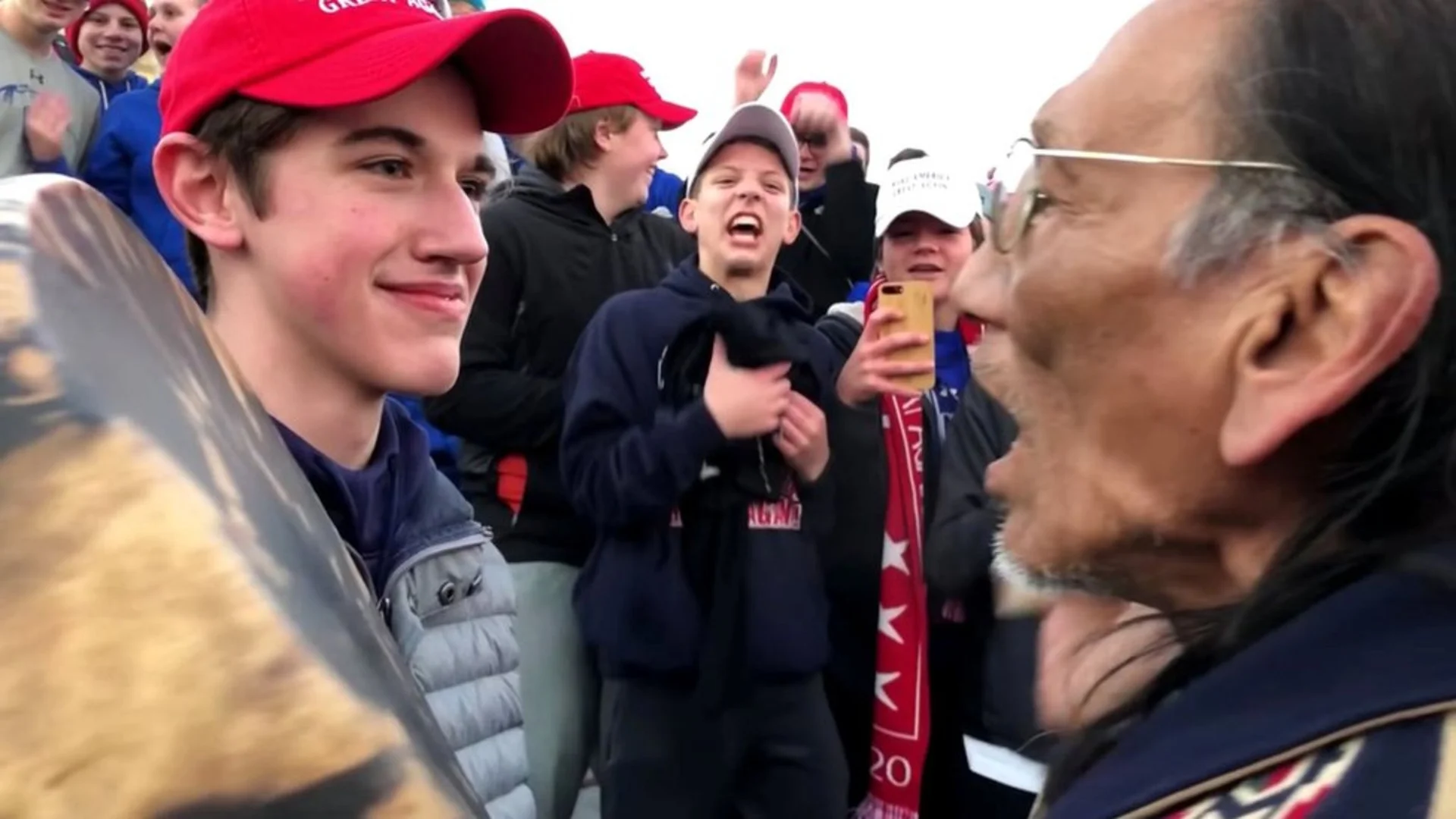
A January 2019 viral video showed Covington Catholic High School students facing Native American activist Nathan Phillips at the Lincoln Memorial in Washington, D.C. The clip triggered a wave of online outrage before longer footage flipped the story, turning the incident into a lightning rod for arguments about media rushes to judgment and ending in multimillion-dollar defamation lawsuits.

Overview

The Covington High School Students Confrontation With Native American Activists refers to a viral January 2019 video showing a group of teenagers from Covington Catholic High School standing near Native American activist Nathan Phillips at the Lincoln Memorial in Washington, D.C.5 The short clip zeroed in on student Nick Sandmann, wearing a red 'Make America Great Again' hat and smiling face-to-face with Phillips as Phillips beat a drum and chanted a prayer song1. Within hours the video was everywhere on Twitter, and the early framing painted the boys as MAGA-hatted bigots harassing a Native American elder5.

Days later, longer footage flipped the story. Extended video showed a small group of Black Hebrew Israelites shouting slurs at the students first, and Phillips walking into the middle of both groups while drumming3. Outlets that piled on early started backpedaling, and the incident turned into a case study in rushing to judgment on partial video. It ended with multimillion-dollar defamation lawsuits filed on behalf of Sandmann6.

Origin & Background

Platform
Instagram (viral spread on Twitter)
Creator
@ka_ya11
Date
2019

On January 18, 2019, Instagram user @ka_ya11 posted footage of a Covington Catholic student in a MAGA hat smiling in front of Nathan Phillips as Phillips drummed and sang a prayer chant5. The students were in Washington, D.C. for the annual March for Life; Phillips was attending the Indigenous Peoples' March. Both events were wrapping up near the Lincoln Memorial when the two groups collided around 5 p.m.1

Phillips, a 64-year-old from Ypsilanti, Michigan, told the Detroit Free Press he stepped between the students and about four Black Hebrew Israelites because he thought a confrontation was going to escalate1. The paper later corrected the story, clarifying that Phillips served in the U.S. Marine Corps Reserve from May 1972 to May 1976 and did not deploy to a war zone, contradicting early reports that called him a Vietnam veteran1.

How It Spread

On January 19, activist Shaun King reposted the clip with a message about 'young kids in MAGA hats' surrounding a Native American elder, and it pulled over 69,500 likes and 22,800 retweets in 48 hours5. That same day actor Chris Evans tweeted that the video was 'appalling' and 'shameful,' pulling more than 213,000 likes over two days5. Author Reza Aslan tweeted a black-and-white screencap asking whether anyone had seen 'a more punchable face than this kid's,' and YouTuber Philip DeFranco uploaded a video condemning the students5.

By January 20, longer video was public and the picture changed fast. Reason writer Robby Soave argued the extended footage showed the students stayed relatively calm while the Black Hebrew Israelites shouted racist, homophobic and bigoted abuse, and that Phillips put himself between the two sides3. DeFranco deleted his original take, saying he should have waited for more details5. CNN reported the January 21 suspension of the @2020fight Twitter account, whose version of the video hit at least 2.5 million views and 14,400 retweets before the takedown4. The account claimed to belong to a California teacher but used a profile photo of Brazilian blogger Nah Cardoso without permission4.

Sandmann gave a written statement through CNN on January 20 saying the Black Hebrew Israelites had called the students 'racists,' 'bigots,' 'white crackers,' 'faggots' and 'incest kids' before Phillips arrived2. He appeared on NBC's Today with Savannah Guthrie on January 23 and did not apologize, saying he 'had every right' to stand where he stood5. President Donald Trump tweeted that the students had been 'treated unfairly with early judgements' and 'smeared by media'5.

How to Use This Meme

The clip is not a template meme. It gets cited as shorthand in arguments about viral video framing, media apologies, and defamation lawsuits, usually paired with the still image of Sandmann's smile facing Phillips's drum3. Commentators still bring it up when a new video goes viral before longer context appears7.

Cultural Impact

The story became a common reference point for critics who argue mainstream outlets rushed to judgment on partial video. Sandmann's family hired attorney L. Lin Wood, and on February 20, 2019, Wood and Todd McMurtry filed a $250 million defamation lawsuit against The Washington Post5. Vulture fired writer Erik Abriss over a January 19 tweet wishing death on Covington students and their parents5. On January 7, 2020, CNN settled its own case with Sandmann at a federal courthouse hearing in Covington, Kentucky; the amount was not disclosed6. The CNN suit had sought $275 million and the Washington Post suit sought $250 million7. Snopes fact-checked viral posts claiming Sandmann had 'won' $275 million, pointing out that the actual settlement figure was not made public8.

Fun Facts

The @2020fight account boosting the video used a photo of Brazil-based blogger Nah Cardoso without her permission, and Twitter suspended it on January 21, 2019 after CNN Business flagged the account4.

Nathan Phillips is a Vietnam-era Marine Corps Reserve veteran but did not deploy; both the Detroit Free Press and The Washington Post issued corrections after early reports called him a Vietnam vet1.

Sandmann sued CNN, NBC Universal and The Washington Post; combined damages sought across the cases hit $800 million6.

Reason writer Robby Soave was one of the first mainstream voices to argue the extended video contradicted the initial framing3.

After settling with CNN in January 2020, Sandmann's only public comment was a tweet reading 'Yes, we settled with CNN.'7

Frequently Asked Questions