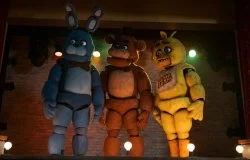
Five Nights at Freddy's Memes

2014Image macros, fan songs, reaction images, YouTube content, copypastaactive

Also known as: FNAF memes · Freddy Fazbear memes

Five Nights at Freddy's (FNAF) is an indie horror game franchise created by Scott Cawthon in 2014 that spawned one of the largest meme ecosystems in gaming history. The series' creepy animatronic characters, jump scares, and deep lore became fuel for image macros, fan songs, copypastas, and YouTube content that spread across every major platform. FNAF memes helped turn a small indie game into a multimedia empire including sequels, a feature film, and an entire subgenre of fan music.

Overview

Five Nights at Freddy's is a point-and-click survival horror game where players work as a night security guard at Freddy Fazbear's Pizza, a Chuck E. Cheese-style restaurant where the animatronic mascots come alive and try to kill you2. The game's simple but terrifying premise, combined with its mysterious backstory about murdered children and haunted robots, made it perfect meme material.

The meme ecosystem around FNAF is massive and varied. It includes jump scare reaction videos from YouTubers, fan-made songs that rack up hundreds of millions of views, image macros featuring the animatronics, deep lore speculation posts, and ironic humor about the franchise's seemingly endless sequels. The animatronic characters, particularly Freddy Fazbear, Bonnie, Chica, and Foxy, became recognizable internet figures in their own right.

Scott Cawthon released the original Five Nights at Freddy's on Steam in the summer of 20141. The game was a breakout indie hit, and its popularity on YouTube through Let's Play videos and reaction content helped it go viral almost immediately. YouTubers screaming at jump scares became some of the earliest and most widespread FNAF meme content.

Within three weeks of the game's release, The Living Tombstone, an electronic rock project led by producer Yoav Landau, uploaded a song simply titled "Five Nights at Freddy's" on August 30, 20143. Landau later explained his approach: "the culture of the internet is about being there first, being the first one to make a meme about a thing"3. He got permission from Cawthon to release the song, with the condition that some profits go to charity3.

Origin & Background

Platform
Steam (game release), YouTube (meme spread)
Creator
Scott Cawthon
Date
2014

Scott Cawthon released the original Five Nights at Freddy's on Steam in the summer of 20141. The game was a breakout indie hit, and its popularity on YouTube through Let's Play videos and reaction content helped it go viral almost immediately. YouTubers screaming at jump scares became some of the earliest and most widespread FNAF meme content.

Within three weeks of the game's release, The Living Tombstone, an electronic rock project led by producer Yoav Landau, uploaded a song simply titled "Five Nights at Freddy's" on August 30, 20143. Landau later explained his approach: "the culture of the internet is about being there first, being the first one to make a meme about a thing"3. He got permission from Cawthon to release the song, with the condition that some profits go to charity3.

How It Spread

The speed of FNAF's spread was unusual even by viral standards. Cawthon released three games in roughly six months, and all three sat in the iTunes top paid games simultaneously at positions 10, 11, and 161. Each new release brought fresh waves of memes, fan art, and YouTube content.

The Living Tombstone's FNAF song hit 69 million YouTube views by March 2016, 220 million by June 2021, and over 372 million by 20243. The song kicked off an entire subgenre of FNAF fan music. Artists like JT Music and CG5 followed with their own game-inspired tracks, with JT Music describing the format as "another way fans could recontextualize and reexperience the game and its story from a different perspective"3. Rolling Stone's CT Jones credited The Living Tombstone's song with creating this musical subgenre, noting it "retain[ed] the hyper-pop influences popularized by Landau"3.

By April 2015, the franchise had grown so fast that Cawthon announced Five Nights at Freddy's 4: The Final Chapter, making it four games in under a year1. Warner Bros. picked up film rights around the same time, with producer Seth Grahame-Smith describing plans for "an insane, terrifying and weirdly adorable movie"1.

The 2023 film adaptation brought FNAF memes back into the spotlight. The Living Tombstone's original song was featured in the end credits, a decision Cawthon had planned since 2016 when he emailed Landau saying "it's important to me that this song is in this film"3. /Film described the song's inclusion as showing the production team "hasn't forgotten the people who made the IP such a valuable sensation in the first place"3.

Platforms

YouTubeRedditTwitter

Timeline

2015-01-01

Meme keeps see steady use

2016-01-01

Five Nights at Freddy's Memes reached mainstream popularity and media coverage

View on Google Trends

How to Use This Meme

FNAF memes come in several common formats:

Jump scare reactions: Record or screenshot someone's genuine terror at one of the game's jump scares. These typically work best as short video clips or reaction image crops.

Animatronic image macros: Use images of Freddy, Bonnie, Chica, or Foxy with captions. The creepy-cute contrast of children's entertainment mascots being murderous robots is the core joke. These often play on the horror of mundane situations.

Lore posting: Write overly detailed, semi-serious analyses of the game's complicated backstory. The FNAF timeline is notoriously convoluted, so memes often mock how deep the rabbit hole goes.

Fan song format: Create or reference one of the many FNAF fan songs. "It's Me," references to the security cameras, and the phrase "Was that the Bite of '87?" are common callbacks.

"Purple Guy" memes: The game's main antagonist, William Afton (the Purple Guy), appears in memes about getting away with crimes, returning from the dead, or being an unstoppable force.

Create Your Own

Cultural Impact

FNAF's meme culture played a direct role in building the franchise into a multimedia property. The game's massive YouTube presence through reaction videos and Let's Play content created a feedback loop where memes drove game sales, and new games created more meme material.

The Living Tombstone's fan song became so culturally significant that it was formally included in the 2023 FNAF movie's end credits3. An 8-Bit Big Band jazz cover was released in 2020, and an orchestral arrangement by Charlie Rosen came out for the song's 10th anniversary in 20243. A "Goth Remix" was released on the same day as the film's North American premiere3.

The franchise's rapid growth from indie game to Warner Bros. film property happened in large part because of its internet-native fanbase1. The meme community created a level of engagement that traditional marketing couldn't match.

Fun Facts

Scott Cawthon released four FNAF games in less than one year, an almost unheard-of pace for a solo developer1.

The Living Tombstone created their iconic FNAF song just three weeks after the game launched3.

Cawthon decided to include The Living Tombstone's song in the eventual movie as early as 2016, seven years before the film released3.

Houston Press's Jef Rouner considered the first FNAF song the weakest of The Living Tombstone's trilogy but still called it "a damned spooky bit of music"3.

The Living Tombstone got into FNAF after previously making songs for the My Little Pony fandom3.

Derivatives & Variations

Five Nights at Freddy's Memes Variations

Different takes on the Five Nights at Freddy's Memes format with modified content

(2014)

Five Nights at Freddy's Memes Mashups

Combinations of Five Nights at Freddy's Memes with other popular memes

(2015)

Five Nights at Freddy's Memes Remixes

Updated versions with current events and references

(2015)

Frequently Asked Questions