Four Stages Of Simulation

2018Image macro / educational meme formatsemi-active

Also known as: Baudrillard's Four Stages · Simulacra Meme · Four Orders of Simulacra

Four Stages Of Simulation is a 2018 image-macro meme format based on Jean Baudrillard's theory, depicting how meme templates progressively degrade from recognizable to increasingly abstract and unrecognizable forms.

Four Stages of Simulation is a meme format based on Jean Baudrillard's 1981 philosophical text *Simulacra and Simulation*, which outlines how signs progressively detach from reality across four stages. The format first appeared on Twitter in May 2018 and picked up steam in 2020, typically used to show how meme templates degrade from their original form into increasingly abstract or unrecognizable versions.

TL;DR

Four Stages of Simulation is a meme format based on Jean Baudrillard's 1981 philosophical text *Simulacra and Simulation*, which outlines how signs progressively detach from reality across four stages.

Overview

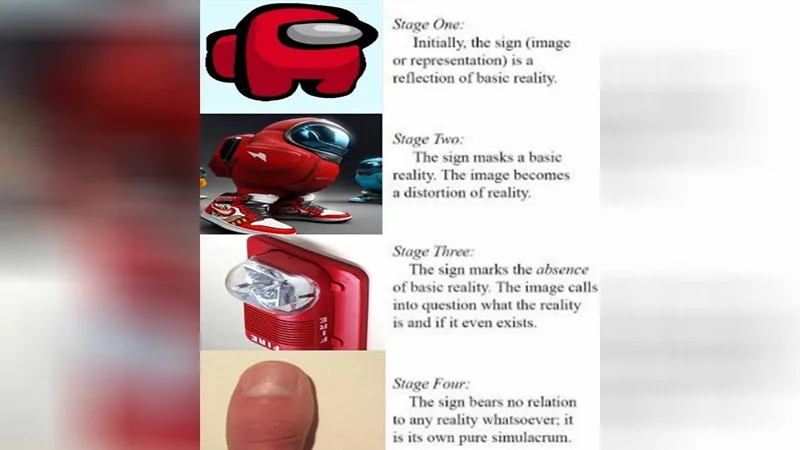
The Four Stages of Simulation format takes Baudrillard's philosophical framework about the relationship between signs and reality and applies it to meme culture. In the original theory, signs move through four stages: faithful representation of reality, distortion of reality, masking the absence of reality, and finally bearing no relation to reality at all2. The meme version typically presents four panels showing a meme template's evolution, from its straightforward original use to increasingly warped, deep-fried, or abstracted versions that no longer resemble the source material1.

The format works because it's both a joke and a genuinely useful lens. Anyone who's watched a meme go from clean image macro to incomprehensible shitpost has lived through Baudrillard's stages in real time.

Jean Baudrillard published *Simulacres et Simulation* in French in 1981, with the English translation following in 19831. The book laid out a theory of how symbols and signs relate to reality, describing four stages of what Baudrillard called the "sign-order"2. The first stage is a faithful copy that reflects reality. The second stage distorts reality, masking and denaturing it. The third stage pretends to represent something real but is actually a copy with no original. The fourth and final stage is "pure simulacrum," where signs have no relationship to any reality and only reflect other signs2.

On May 1, 2018, Twitter user @quincognito_ posted what appears to be the earliest edit applying Baudrillard's framework to internet memes1. The post illustrated how popular formats like Drakeposting, Galaxy Brain, Distracted Boyfriend, and Gru's Plan had each gone through their own version of the four stages, moving from straightforward use to increasingly detached and abstract remixes. The tweet pulled in more than 2,900 retweets and 9,100 likes over the following four years1.

Origin & Background

Platform
Twitter (meme format), Jean Baudrillard's *Simulacra and Simulation* (source concept)
Creator
@quincognito_
Date
2018

Jean Baudrillard published *Simulacres et Simulation* in French in 1981, with the English translation following in 1983. The book laid out a theory of how symbols and signs relate to reality, describing four stages of what Baudrillard called the "sign-order". The first stage is a faithful copy that reflects reality. The second stage distorts reality, masking and denaturing it. The third stage pretends to represent something real but is actually a copy with no original. The fourth and final stage is "pure simulacrum," where signs have no relationship to any reality and only reflect other signs.

On May 1, 2018, Twitter user @quincognito_ posted what appears to be the earliest edit applying Baudrillard's framework to internet memes. The post illustrated how popular formats like Drakeposting, Galaxy Brain, Distracted Boyfriend, and Gru's Plan had each gone through their own version of the four stages, moving from straightforward use to increasingly detached and abstract remixes. The tweet pulled in more than 2,900 retweets and 9,100 likes over the following four years.

How It Spread

Despite @quincognito_'s tweet doing solid numbers, the format didn't catch fire immediately. It took roughly two years for others to pick it up in earnest.

On September 20, 2020, Twitter user @andreeavr posted an edit using the same four-stage layout, though it only received 4 retweets and 19 likes. The format found a warmer reception in philosophy-oriented communities. On October 7, 2020, Reddit user /u/meters_and_liters shared a version on r/PhilosophyMemes, where the source material already had name recognition, earning around a hundred upvotes.

Sometime before December 23, 2020, Twitter user @JanuszMonke created an edit using black Wojaks to illustrate the four stages. The account was later suspended and the original tweet removed, but KnowYourMeme staff member Philipp archived the image on December 23, 2020, where it collected over 9,400 views in two years.

The format crossed over into broader meme spaces as it moved into 2021. On November 8, 2021, the Facebook page Philosophy Matters reposted a version of the format that earned more than 4,700 reactions and 3,000 shares. This was one of the clearest signs the meme had escaped its niche philosophy-meme origins and reached a general audience.

How to Use This Meme

The Four Stages of Simulation format follows a four-panel layout, with each panel representing one of Baudrillard's stages applied to meme culture:

1

Stage 1 (Faithful image): Show the meme in its original, clean form. A standard Drakeposting template, a normal Distracted Boyfriend photo, etc.

2

Stage 2 (Distortion): Show the meme with minor alterations or reinterpretations. The format is still recognizable but starting to drift from its original meaning.

3

Stage 3 (Masks absence): Show a version that pretends to follow the original format but has lost its connection to the source. Deep-fried versions, ironic remixes, or heavily abstracted edits work here.

4

Stage 4 (Pure simulacrum): Show something that bears zero resemblance to the original meme but is somehow still understood as part of the same lineage. This is often the punchline, an image so degraded or transformed that only extremely online viewers would recognize the reference.

Cultural Impact

The format is one of the few memes to directly and accurately reference post-structuralist philosophy, which gave it unusual traction in academic and philosophy-adjacent spaces. Baudrillard's *Simulacra and Simulation* is already well-known in popular culture through *The Matrix*, where a hollowed-out copy of the book appears in the opening scene. The meme format gave a new generation a shorthand way to discuss how internet culture creates layers of meaning that eventually collapse into pure reference.

The concept of simulacra itself deals with how modern society replaces reality with symbols and signs until "human experience is a simulation of reality". Baudrillard argued that simulacra aren't just bad copies of real things but instead "hide that nothing like reality is relevant to people's current understanding of their lives". The meme format, intentionally or not, demonstrates this theory by showing how a meme image can lose all connection to its original context and still function perfectly within internet culture.

Fun Facts

Baudrillard's book was originally published in French as *Simulacres et Simulation* in 1981, two years before English-speaking audiences could read it.

The concept of "precession of simulacra," where signs precede and produce what they claim to represent, is Baudrillard's term for the endpoint of this process.

Guy Debord's 1967 *The Society of the Spectacle* explored similar ideas about mediated reality before Baudrillard, making the philosophical lineage behind this meme decades deep.

The @quincognito_ tweet sat for nearly two years before the format gained broader adoption, a kind of delayed virality.

Derivatives & Variations

Wojak Stages:

@JanuszMonke's black Wojak version applied the four stages to Wojak's evolution from simple MS Paint face to its many abstract variants[1].

Philosophy Memes edits:

Various versions circulated on r/PhilosophyMemes and the Facebook page Philosophy Matters, often using philosophy-specific humor in the fourth stage[1].

Drake/Gru/Distracted Boyfriend breakdowns:

The original @quincognito_ edit itself served as a template, and many subsequent versions followed its lead by charting the degradation of specific popular formats[1].

Frequently Asked Questions

References (3)

  1. 1
  2. 2
    Wachenröderencyclopedia
  3. 3

FourStagesOfSimulation

2018Image macro / educational meme formatsemi-active

Also known as: Baudrillard's Four Stages · Simulacra Meme · Four Orders of Simulacra

Four Stages Of Simulation is a 2018 image-macro meme format based on Jean Baudrillard's theory, depicting how meme templates progressively degrade from recognizable to increasingly abstract and unrecognizable forms.

Four Stages of Simulation is a meme format based on Jean Baudrillard's 1981 philosophical text *Simulacra and Simulation*, which outlines how signs progressively detach from reality across four stages. The format first appeared on Twitter in May 2018 and picked up steam in 2020, typically used to show how meme templates degrade from their original form into increasingly abstract or unrecognizable versions.

TL;DR

Four Stages of Simulation is a meme format based on Jean Baudrillard's 1981 philosophical text *Simulacra and Simulation*, which outlines how signs progressively detach from reality across four stages.

Overview

The Four Stages of Simulation format takes Baudrillard's philosophical framework about the relationship between signs and reality and applies it to meme culture. In the original theory, signs move through four stages: faithful representation of reality, distortion of reality, masking the absence of reality, and finally bearing no relation to reality at all. The meme version typically presents four panels showing a meme template's evolution, from its straightforward original use to increasingly warped, deep-fried, or abstracted versions that no longer resemble the source material.

The format works because it's both a joke and a genuinely useful lens. Anyone who's watched a meme go from clean image macro to incomprehensible shitpost has lived through Baudrillard's stages in real time.

Jean Baudrillard published *Simulacres et Simulation* in French in 1981, with the English translation following in 1983. The book laid out a theory of how symbols and signs relate to reality, describing four stages of what Baudrillard called the "sign-order". The first stage is a faithful copy that reflects reality. The second stage distorts reality, masking and denaturing it. The third stage pretends to represent something real but is actually a copy with no original. The fourth and final stage is "pure simulacrum," where signs have no relationship to any reality and only reflect other signs.

On May 1, 2018, Twitter user @quincognito_ posted what appears to be the earliest edit applying Baudrillard's framework to internet memes. The post illustrated how popular formats like Drakeposting, Galaxy Brain, Distracted Boyfriend, and Gru's Plan had each gone through their own version of the four stages, moving from straightforward use to increasingly detached and abstract remixes. The tweet pulled in more than 2,900 retweets and 9,100 likes over the following four years.

Origin & Background

Platform
Twitter (meme format), Jean Baudrillard's *Simulacra and Simulation* (source concept)
Creator
@quincognito_
Date
2018

Jean Baudrillard published *Simulacres et Simulation* in French in 1981, with the English translation following in 1983. The book laid out a theory of how symbols and signs relate to reality, describing four stages of what Baudrillard called the "sign-order". The first stage is a faithful copy that reflects reality. The second stage distorts reality, masking and denaturing it. The third stage pretends to represent something real but is actually a copy with no original. The fourth and final stage is "pure simulacrum," where signs have no relationship to any reality and only reflect other signs.

On May 1, 2018, Twitter user @quincognito_ posted what appears to be the earliest edit applying Baudrillard's framework to internet memes. The post illustrated how popular formats like Drakeposting, Galaxy Brain, Distracted Boyfriend, and Gru's Plan had each gone through their own version of the four stages, moving from straightforward use to increasingly detached and abstract remixes. The tweet pulled in more than 2,900 retweets and 9,100 likes over the following four years.

How It Spread

Despite @quincognito_'s tweet doing solid numbers, the format didn't catch fire immediately. It took roughly two years for others to pick it up in earnest.

On September 20, 2020, Twitter user @andreeavr posted an edit using the same four-stage layout, though it only received 4 retweets and 19 likes. The format found a warmer reception in philosophy-oriented communities. On October 7, 2020, Reddit user /u/meters_and_liters shared a version on r/PhilosophyMemes, where the source material already had name recognition, earning around a hundred upvotes.

Sometime before December 23, 2020, Twitter user @JanuszMonke created an edit using black Wojaks to illustrate the four stages. The account was later suspended and the original tweet removed, but KnowYourMeme staff member Philipp archived the image on December 23, 2020, where it collected over 9,400 views in two years.

The format crossed over into broader meme spaces as it moved into 2021. On November 8, 2021, the Facebook page Philosophy Matters reposted a version of the format that earned more than 4,700 reactions and 3,000 shares. This was one of the clearest signs the meme had escaped its niche philosophy-meme origins and reached a general audience.

How to Use This Meme

The Four Stages of Simulation format follows a four-panel layout, with each panel representing one of Baudrillard's stages applied to meme culture:

1

Stage 1 (Faithful image): Show the meme in its original, clean form. A standard Drakeposting template, a normal Distracted Boyfriend photo, etc.

2

Stage 2 (Distortion): Show the meme with minor alterations or reinterpretations. The format is still recognizable but starting to drift from its original meaning.

3

Stage 3 (Masks absence): Show a version that pretends to follow the original format but has lost its connection to the source. Deep-fried versions, ironic remixes, or heavily abstracted edits work here.

4

Stage 4 (Pure simulacrum): Show something that bears zero resemblance to the original meme but is somehow still understood as part of the same lineage. This is often the punchline, an image so degraded or transformed that only extremely online viewers would recognize the reference.

Cultural Impact

The format is one of the few memes to directly and accurately reference post-structuralist philosophy, which gave it unusual traction in academic and philosophy-adjacent spaces. Baudrillard's *Simulacra and Simulation* is already well-known in popular culture through *The Matrix*, where a hollowed-out copy of the book appears in the opening scene. The meme format gave a new generation a shorthand way to discuss how internet culture creates layers of meaning that eventually collapse into pure reference.

The concept of simulacra itself deals with how modern society replaces reality with symbols and signs until "human experience is a simulation of reality". Baudrillard argued that simulacra aren't just bad copies of real things but instead "hide that nothing like reality is relevant to people's current understanding of their lives". The meme format, intentionally or not, demonstrates this theory by showing how a meme image can lose all connection to its original context and still function perfectly within internet culture.

Fun Facts

Baudrillard's book was originally published in French as *Simulacres et Simulation* in 1981, two years before English-speaking audiences could read it.

The concept of "precession of simulacra," where signs precede and produce what they claim to represent, is Baudrillard's term for the endpoint of this process.

Guy Debord's 1967 *The Society of the Spectacle* explored similar ideas about mediated reality before Baudrillard, making the philosophical lineage behind this meme decades deep.

The @quincognito_ tweet sat for nearly two years before the format gained broader adoption, a kind of delayed virality.

Derivatives & Variations

Wojak Stages:

@JanuszMonke's black Wojak version applied the four stages to Wojak's evolution from simple MS Paint face to its many abstract variants[1].

Philosophy Memes edits:

Various versions circulated on r/PhilosophyMemes and the Facebook page Philosophy Matters, often using philosophy-specific humor in the fourth stage[1].

Drake/Gru/Distracted Boyfriend breakdowns:

The original @quincognito_ edit itself served as a template, and many subsequent versions followed its lead by charting the degradation of specific popular formats[1].

Frequently Asked Questions

References (3)

  1. 1
  2. 2
    Wachenröderencyclopedia
  3. 3