Schrodinger's Cat

1935catchphrase / image macroclassic

Published September 26, 2026

Schrodinger's Cat started as a 1935 physics thought experiment by Erwin Schrodinger about a cat that is both alive and dead inside a sealed box. Decades later, the paradox jumped into internet culture through Usenet debates, xkcd, and LOLCat image macros, turning a quantum mechanics puzzle into a running joke about boxes, uncertainty, and cats.

Overview

Schrodinger's Cat is the internet's favorite shorthand for anything in two contradictory states at once. The core joke leans on the same setup Erwin Schrodinger sketched in 1935, a cat sealed in a box with radioactive material that is technically both alive and dead until observed2. Online, that setup got flattened into cats in cardboard boxes, wanted posters marked 'Dead and Alive,' and punchlines about not knowing whether something is broken until you check it.

The humor works in two directions. On one side, physics fans use the reference to gatekeep or to poke fun at pop culture explanations that get the paradox wrong, a bit codified by Saturday Morning Breakfast Cereal in a 2012 strip that split the panel between a real professor and a hand-wavy layman3. On the other side, LOLCat culture used the paradox to slap quantum jargon on any cat photo showing an animal half in and half out of a box7. The t-shirt line 'Schrodinger's Cat Is Dead' sold by ThinkGeek in 2004 became the visual template for basically every geek-store joke variation that followed8.

Origin & Background

Platform
Academic physics / Usenet (early online spread)
Creator
Erwin Schrodinger; meme adaptations by various web creators
Date
1935

The thought experiment itself came from Austrian physicist Erwin Schrodinger's 1935 correspondence with Albert Einstein about the Copenhagen interpretation of quantum mechanics1. Schrodinger's setup, a cat in a steel box with a Geiger counter, a radioactive sample, and a flask of hydrocyanic acid rigged to shatter on decay, was designed to argue that applying quantum superposition to a macroscopic animal produces absurd conclusions2. He was making fun of the physics, not endorsing the mental image, but the mental image is what stuck.

The earliest documented online discussion appeared on the Usenet group sci.physics on May 7th, 1990, when university students and academics argued over whether Schrodinger's Cat scaled up to macroscopic objects, drawing 22 replies from 13 posters4. Debate then moved to general forums, including an August 9th, 2000 Straight Dope thread started by user Bear Nenno asking what the experiment actually meant5.

How It Spread

The paradox moved from lecture halls into merchandise on August 19th, 2004, when online retailer ThinkGeek listed a black t-shirt reading 'Schrodinger's Cat Is Dead,' pitched at physics students who were already tired of explaining the joke8. The webcomic xkcd formalized the internet version on January 4th, 2006, in strip #45, titled 'Schrodinger,' with a final panel that is 'both funny and unfunny until read in its entirety'6.

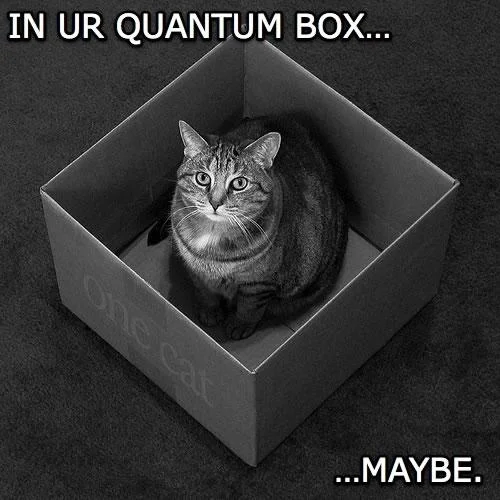
The LOLCat era carried it further. On June 2nd, 2007, I Can Has Cheezburger posted an image macro of a cat inside a cardboard box captioned 'In ur quantum box... maybe,' which became the visual template for cat-plus-superposition jokes7. A June 1st, 2008 Reddit post by user manixrock featured a 'Wanted: Schroedinger's Cat, Dead and Alive' poster9. BuzzFeed ran a 'Sexy Schrodinger's Cat' bit in 2010, Portal 2's Fact Sphere joked in 2011 that Schrodinger invented the paradox to justify killing cats, and Kalapusa's 'Schrodinger's Nyan Cat' remix followed the same year with pixel-art skulls and equations2.

Mainstream recognition arrived on August 12th, 2013, when Google's Doodle marking Schrodinger's 126th birthday featured a cartoon of the cat itself, effectively confirming that the meme version had outgrown the physics classroom2.

How to Use This Meme

The template typically pairs a cat, a box, or an unopened container with a caption invoking superposition, uncertainty, or the 'both X and Y until observed' construction. Common conventions include labeling something 'dead and alive,' claiming a state can only be resolved by looking, or drawing a cat that visibly exists in two forms in the same panel. The reference often appears as a caption on a LOLCat with a physics twist or as a wanted-poster style gag.

Frequently Asked Questions