Home›Memes›Slashdot Effect

Contents

  • Overview
  • Gallery
  • Origin
  • How It Spread
  • How to Use
  • FAQ
  • References
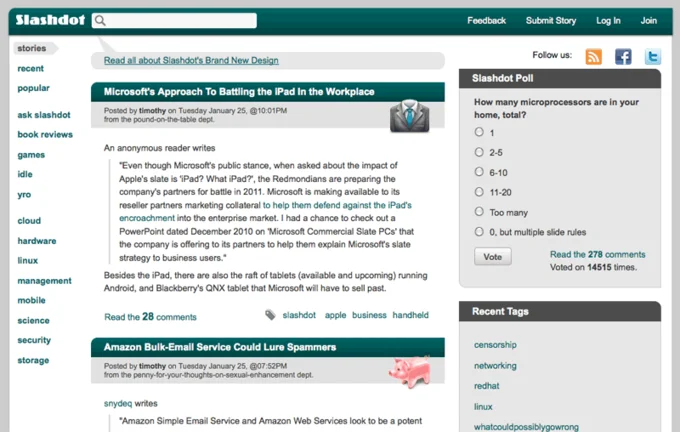
Slashdot Effect — Screenshot of the Slashdot.org website homepage showing tech news articles.

Slashdot Effect

1998catchphraseclassic

Published October 8, 2026

The Slashdot Effect, also called 'Slashdotting' or the 'Hug of Death,' describes servers buckling under a sudden rush of visitors after a link appears on a high-traffic site1. Slashdot readers coined the term in 1998, and it later spawned platform-specific spin-offs like 'Digg Effect,' 'Reddit Effect,' and getting 'FARKed'3.

tech humor memes early internet memes internet slang origin memes late 1990s memes forum era memes

Overview

At its core, the Slashdot Effect names a bandwidth problem that turned into a running joke. When Slashdot's front page sent its tech-heavy readership streaming toward a small academic page, personal blog, or hobbyist server, the target site would slow to a crawl or drop offline inside minutes2. The site that went dark was said to have been 'Slashdotted' or '/.'ed, and the outage pattern was consistent enough that community members ran their own measurement studies on it3.

The tone around the term swung between pride and complaint. Getting Slashdotted meant your post had reached a huge audience, but it also meant your readers hit a timeout page and your hosting bill spiked1. Microsoft IIS servers in particular were called out as prone to collapse under the load, giving the jargon an added anti-Microsoft edge common to the Slashdot community of the era2.

The pattern was easy enough to graph that researchers charted traffic curves showing a steep spike when a story hit the top of the home page, then a decay as newer items pushed it down3. The same shape later showed up under new names on Digg, Reddit, FARK, and the Drudge Report, each with its own verb for the pile-on3.

Gallery

Origin & Background

Platform
Slashdot
Creator
Slashdot community
Date
1998

The term was coined by readers of Slashdot sometime in the second quarter of 19982. Slashdot user John Abbot submitted the first formal definition to the Free Online Dictionary of Computing on October 24, 1998, framing it as the overload that follows a link from a popular site to a smaller server2. Less than a month later, Abbot posted the FOLDOC entry back to Slashdot itself, which stands as the earliest documented use of the phrase on the site3.

The generic concept predates the slang by two decades. Larry Niven's 1973 science fiction short story 'Flash Crowd' imagined cheap teleportation drawing instant mobs to breaking news sites, and 'flash crowd' later got picked up by network researchers to describe traffic spikes before 'Slashdot Effect' took over in geek circles3.

How It Spread

Through 1999 the vocabulary spread from Slashdot into neighboring tech sites and geek culture blogs, and 'Slashdotted' turned into standard shorthand for a referral-driven outage3. On February 1, 1999, Slashdot user Stephen Adler published a paper titled 'The Slashdot Effect' comparing traffic to three academic papers after they were featured on Slashdot, Linux Today, and Freshmeat, treating the pile-on as a measurable event rather than just a complaint3. Urban Dictionary logged its first entry for the term in November 2002, and the Jargon File picked it up by June 20034.

Solutions trailed close behind. In 2004, Edgeos founder Jay Jacobson launched Mirrordot, a project that automatically mirrored any site linked from Slashdot's home page so that readers could still reach the content when the origin server was buried1. Jacobson told Wired he started the project out of personal frustration, saying downtime often lasted a day or two and by then he'd 'lost interest' in the story1. Slashdot itself declined to cache linked sites, citing concern for the target's ad revenue and permission delays that would slow story turnover1.

By 2005, the pattern was easing off. Business coverage pointed to cheaper bandwidth, mitigation tools like Mirrordot, and growing competition from Digg and Reddit as reasons the original Slashdot Effect was fading3. The vocabulary stuck anyway, now applied to any big-site-to-small-site traffic avalanche, including links shared through viral tweets or Google Doodle features3.

Timeline

1973

Larry Niven's short story 'Flash Crowd' introduces the generic concept of sudden crowd pile-ons that later gets applied to web traffic.

1998

Slashdot readers start calling the referral-driven outage pattern the 'Slashdot Effect' sometime in the second quarter.

1998-10-24

Slashdot user John Abbot submits the first formal definition to the Free Online Dictionary of Computing.

1999-02-01

Slashdot user Stephen Adler publishes 'The Slashdot Effect,' a paper measuring referral traffic to three academic papers.

2002-11

The earliest Urban Dictionary entry for 'Slashdot Effect' goes live.

2003-06

The term appears in the online slang glossary Jargon File.

2004-10-01

Wired covers Jay Jacobson's Mirrordot project, which auto-mirrors Slashdot-linked sites to blunt the traffic hit.

2005-03-02

Business coverage notes that the Slashdot Effect is becoming less frequent as bandwidth cheapens and Digg and Reddit rise.

How to Use This Meme

In practice, people use 'Slashdotted' as a past-tense verb for any small site knocked over by a referral spike from a bigger one. Common conventions include 'the site got Slashdotted' when a link floods a server, and swapping in platform names for the modern version, as in 'Reddit hug of death' or 'getting FARKed'3.

Frequently Asked Questions

It's internet jargon for a sudden traffic spike that overloads a smaller server after a link to it appears on a high-traffic site like Slashdot, often knocking the target offline2.

Slashdot readers coined the term in the second quarter of 1998, and user John Abbot submitted the first formal definition to the Free Online Dictionary of Computing on October 24, 19982.

Being 'Slashdotted' means your site crashed or slowed to a crawl because a flood of referral visitors arrived faster than your server could handle them1.

It's used as a past-tense verb, like 'the site got Slashdotted,' and inspired platform-specific variants such as 'Digg Effect,' 'Reddit Effect,' and getting 'FARKed'3.

The original Slashdot version faded after 2005 as bandwidth got cheaper and newer aggregators took over, though the broader 'hug of death' concept is still used3.

References (4)

  1. 1
    https://www.wired.com/2004/10/solution-for-slashdot-effect/
  2. 2
    https://foldoc.org/slashdot
  3. 3
    https://knowyourmeme.com/memes/slashdot-effect
  4. 4
    https://www.urbandictionary.com/define.php?term=Slashdot%20Effect

Quick Info

Year
1998
Origin
Slashdot
Type
catchphrase
Status
classic
Creator
Slashdot community
term coined by readers; definition documented by user John Abbot

Tags

slashdotinternet-historyweb-trafficjargonhug-of-death

Related Memes

  • tldr tldr
  • internet slang
  • pics or it didnt happen
  • the geek code
  • asdf
  • bump

More Tech Humor Memes

  • Sam Altman Fired Memes
  • Threads Launch
  • Bluetooth Connection Issue
  • Buffering Video
  • 10X Engineer
  • Novelty Content Filters
  • Vibe Coding
  • 3D Printing
  • 404
  • Android
  • Apple
  • Augmented Reality
View all Tech Humor memes →
Browse MemesTopicsCreatorsTrendingPlayAboutLegalPrivacy

© 2026 meme.com