We Can Do It

1943Image macro / exploitable template / motivational posterclassic

Also known as: Rosie the Riveter (common misidentification) · We Can Do It poster · Rosie meme

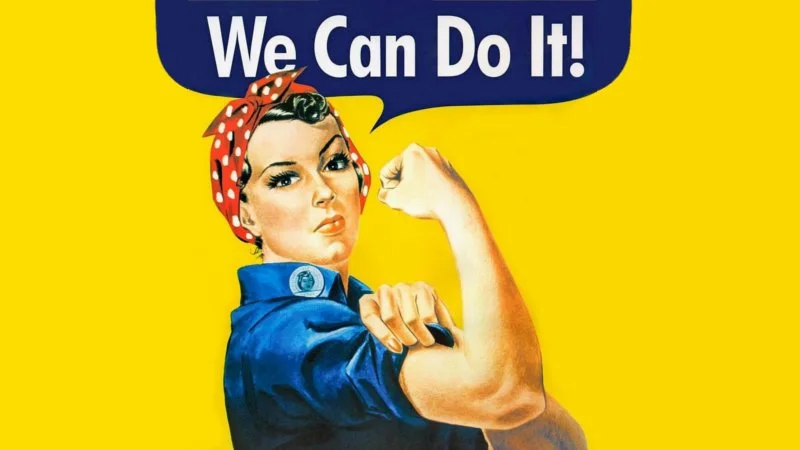
We Can Do It! is a 1943 propaganda poster by J. Howard Miller showing a woman in a polka-dot bandana flexing her bicep, rediscovered in the 1980s as a feminist icon and motivational meme.

The "We Can Do It!" poster is a World War II-era propaganda image created by artist J. Howard Miller in 1943 for Westinghouse Electric, showing a woman in a polka-dot bandana flexing her bicep beneath the bold slogan. Though it was originally an obscure internal factory poster seen by only a few thousand workers for two weeks, it was rediscovered in the early 1980s and became one of the most recognized images in American culture5. Widely (and incorrectly) called "Rosie the Riveter," the poster became a feminist icon, a political campaign tool, and eventually a heavily remixed internet meme used for motivation, parody, and empowerment7.

TL;DR

The "We Can Do It!" poster is a World War II-era propaganda image created by artist J.

Overview

The image shows a determined-looking woman wearing a red polka-dot bandana and blue work coveralls, rolling up her sleeve to flex her right bicep. Above her, bold white text on a dark blue speech bubble reads "We Can Do It!" The woman has painted fingernails, visible eyelashes, and wears a Westinghouse employee badge on her collar10. The poster measures 17 by 22 inches, and no more than 1,800 copies were originally printed5.

Despite its massive modern recognition, this was never meant to be a public recruitment poster. It was one of over 42 internal morale posters Miller designed for Westinghouse, each displayed for just two weeks before being swapped out7. The specific factories targeted were in East Pittsburgh, Pennsylvania and the Midwest, where mostly women were making plasticized helmet liners from Micarta, a phenolic resin invented by Westinghouse5. Those workers produced roughly 13 million helmet liners during the war11.

The collective "we" in the slogan almost certainly referred to Westinghouse employees as a whole, not women specifically10. Most of Miller's other posters in the series featured men and promoted management authority and company unity7.

In 1942, Westinghouse Electric's internal War Production Coordinating Committee hired Pittsburgh artist J. Howard Miller through an advertising agency to create a series of morale-boosting posters4. Miller, who had studied at the Art Institute of Pittsburgh and graduated in 1939, was largely unknown outside this commission5. Professor James J. Kimble later uncovered that Miller was born in 1898 and died in 1985, married to Mabel Adair McCauley7.

The poster project aimed to raise worker morale, reduce absenteeism, direct workers' questions to management, and lower the chance of labor unrest or strikes5. The "We Can Do It!" poster was scheduled for display starting Monday, February 15, 1943, for two five-day work weeks, ending February 287. After those two weeks, it was taken down and replaced by the next poster in the rotation.

The poster had zero public visibility during the war. It was strictly internal to Westinghouse and was not used for recruitment10. As scholars James Kimble and Lester Olson later argued in their 2006 article in *Rhetoric & Public Affairs*, the image functioned more as corporate labor management than feminist empowerment, with "patriotism invoked to circumvent strikes and characterize workers' unrest as un-American"10.

Origin & Background

Platform
Westinghouse Electric factory posters (original), National Archives postcards / Washington Post Magazine (rediscovery), internet forums and social media (meme spread)
Key People
J. Howard Miller, Westinghouse Electric War Production Coordinating Committee
Date
1943 (original poster), 1982 (rediscovery), 2000s (internet meme era)

In 1942, Westinghouse Electric's internal War Production Coordinating Committee hired Pittsburgh artist J. Howard Miller through an advertising agency to create a series of morale-boosting posters. Miller, who had studied at the Art Institute of Pittsburgh and graduated in 1939, was largely unknown outside this commission. Professor James J. Kimble later uncovered that Miller was born in 1898 and died in 1985, married to Mabel Adair McCauley.

The poster project aimed to raise worker morale, reduce absenteeism, direct workers' questions to management, and lower the chance of labor unrest or strikes. The "We Can Do It!" poster was scheduled for display starting Monday, February 15, 1943, for two five-day work weeks, ending February 28. After those two weeks, it was taken down and replaced by the next poster in the rotation.

The poster had zero public visibility during the war. It was strictly internal to Westinghouse and was not used for recruitment. As scholars James Kimble and Lester Olson later argued in their 2006 article in *Rhetoric & Public Affairs*, the image functioned more as corporate labor management than feminist empowerment, with "patriotism invoked to circumvent strikes and characterize workers' unrest as un-American".

How It Spread

The poster sat in obscurity for nearly four decades. The first known postwar reproduction appeared on May 23, 1982, when the *Washington Post Magazine* published "Poster Art for Patriotism's Sake," featuring the image as reproduced by the National Archives. Around the same time, the National Archives began selling postcards of the image, and it quickly ranked among their top ten most requested items.

The key figure in tying the "We Can Do It!" image to the name "Rosie the Riveter" was Helaine Victoria Press, a feminist/labor publishing organization co-founded by Jocelyn Helaine Cohen and Nancy Taylor Victoria Poore. They began distributing National Archives postcards in their 1982-1983 catalog. In 1985, they produced their own version of the postcard and, critically, added "Rosie the Riveter" to the caption on the back, linking the two for the first time. They also made a T-shirt. By 1987-1988, the image had spread through catalogs from the Northland Poster Collective, Syracuse Cultural Workers, and the National Women's History Resources catalog.

The image's copyright had expired (unlike Norman Rockwell's actual "Rosie the Riveter" painting from 1943, which was strictly copyrighted), making it freely reproducible. This legal quirk was a major factor in its explosion. By the 1990s, the poster was everywhere. It made the cover of *Smithsonian* magazine in 1994 and became a U.S. first-class mail stamp in February 1999.

### The Mistaken Identity

In 1994, after seeing the *Smithsonian* cover, Geraldine Hoff Doyle claimed she was the model for the poster. She believed a wartime photograph of a woman operating a lathe was of her, and that the photo had inspired Miller. She was widely honored, including by the Michigan Women's Historical Center and Hall of Fame. But in 2015 and then more definitively in 2017, Dr. James J. Kimble identified the woman in that photograph as Naomi Parker Fraley, who was 20 years old and working in early 1942, before Doyle had even graduated high school. The original photo caption read "Pretty Naomi Parker looks like she might catch her nose in the turret lathe she is operating," dated March 24, 1942. Parker Fraley died in January 2018 at age 96. Whether the photograph actually inspired Miller's poster at all remains unproven.

### Political Adoption and Internet Meme Era

During the 2008 presidential campaign, supporters of Hillary Clinton adapted the imagery for campaign materials. Supporters of Sarah Palin did the same in 2012. In 2010, the poster was reworked by an Australian artist to celebrate Julia Gillard becoming Australia's first female prime minister.

Online, the poster became a go-to template for parody and empowerment. The image's simple composition (woman, flexed arm, bold text) made it ideal for remixing. Users swap out the woman for various characters, change the slogan, or redraw the pose in different art styles. The format works for everything from feminist rallying cries to ironic workplace humor to political commentary.

How to Use This Meme

The "We Can Do It!" format is one of the most straightforward meme templates:

1

Start with the basic composition: a figure (usually a woman) flexing or striking a confident pose

2

Add bold text above or around the figure with a motivational, ironic, or parodic slogan

3

Common variations include replacing the woman with pop culture characters, animals, or public figures while keeping the pose and layout

4

The bandana and work coveralls are often retained as visual shorthand, even when the face changes

5

Text swaps typically play on the original "We Can Do It!" phrasing, either sincerely or sarcastically

Cultural Impact

The poster is one of the ten most-requested images at the National Archives and Records Administration. It appeared on a U.S. first-class mail stamp in 1999 and has been featured at the National Museum of American History.

Politicians on both sides of the aisle have adopted the imagery. Hillary Clinton supporters used it in 2008, Sarah Palin supporters in 2012, and it was reworked for Australia's first female Prime Minister Julia Gillard in 2010.

The Geraldine Doyle / Naomi Parker Fraley identity mystery generated significant media coverage. The *New York Times* published Parker Fraley's obituary in January 2018, identifying her as the most likely inspiration for the broader "Rosie" archetype. Dr. Kimble's six-year investigation into the poster's origins became a story in itself about myth-making in American culture.

Norman Rockwell's original "Rosie the Riveter" painting, often confused with Miller's poster, sold for $5 million in 2002 and is now in the permanent collection at Crystal Bridges Museum of American Art.

The academic study of the poster, particularly Kimble and Olson's 2006 paper, shifted scholarly understanding of how wartime propaganda gets reinterpreted. Their key insight was that the "We Can Do It!" poster was not a feminist statement in its original context but a labor management tool, and its modern meaning was entirely constructed decades later.

Full History

The story of the "We Can Do It!" poster is fundamentally a story about how meaning gets invented after the fact. Nothing about the image's original context suggested it would become a global symbol of anything.

### The Wartime Context

After Pearl Harbor on December 7, 1941, American factories scrambled to increase war production. The workplace was tense. Management and labor unions had spent the 1930s building up resentment, and the sudden demand for production created friction. General Motors produced a propaganda poster in 1942 reading "Together We Can Do It!" and "Keep 'Em Firing!" to align labor and management. Westinghouse followed a similar playbook, commissioning Miller's poster series to manage its workforce. Nearly 19 million women held jobs during WWII, though only about 3 million were new entrants to the workforce; most had previously worked in lower-paying positions.

The cultural landscape included other, far more prominent "Rosie" imagery. The term "Rosie the Riveter" originated from a 1942 song by Redd Evans and John Jacob Loeb, which described a tireless assembly line worker. Norman Rockwell then painted his famous *Saturday Evening Post* cover on May 29, 1943, showing a muscular woman on her lunch break with her foot on a copy of Hitler's *Mein Kampf*. That painting, not Miller's poster, was the famous "Rosie" during the war. Rockwell's version was used in War Bond drives and became hugely popular, but its copyrighted status limited reproduction after the war.

### The 1980s Renaissance

When feminist and labor organizations began looking for strong visual symbols in the late 1970s and early 1980s, the uncopyrighted Miller poster was a perfect find. The National Archives had reproduced it as a postcard sometime in the late 1970s. Connie Field's 1980 documentary *The Life and Times of Rosie the Riveter* revived interest in women's wartime labor, though it didn't use the "We Can Do It!" image in its promotion.

The 1982 *Washington Post Magazine* article brought the poster to wider public attention. From there, feminist distributors like Helaine Victoria Press and organizations like the Northland Poster Collective and Syracuse Cultural Workers put it in catalogs, on T-shirts, and on postcards throughout the mid-to-late 1980s. Each reproduction reinforced the (historically inaccurate) reading of the poster as a feminist call to arms.

By 1994, the image was iconic enough to land on the *Smithsonian* cover. By 1999, it was a postage stamp. Academics began studying it seriously. Kimble and Olson's 2006 paper in *Rhetoric & Public Affairs* was the first rigorous analysis of how the poster's meaning had been constructed retroactively. They documented how the image went from corporate labor management to feminist symbol through a series of misattributions, recontextualizations, and good timing.

### Internet Meme Evolution

Online, the poster's simple visual grammar made it a natural template. The format is highly "exploitable" in meme terms: replace the woman with any character, change the text, and you have a statement. Political campaigns have used it. Brands have used it (including, as one scholar noted, for selling household cleaners). Cosplayers regularly dress as the poster woman at conventions, with the coveralls-and-bandana look becoming a recognizable costume.

The image has been remixed for causes ranging from abortion rights to Bernie Sanders' presidential campaigns to Black WWII welder tributes. Each adaptation strips away more of the original Westinghouse context and layers on new meaning. This is, in a sense, the defining characteristic of the meme: the gap between what it was (a two-week corporate poster for helmet liner factory workers) and what people believe it was (a bold feminist statement from the Greatest Generation).

Fun Facts

The poster was only displayed for two weeks in February 1943 and was seen by, at most, a few thousand Westinghouse factory workers before being replaced by the next poster in the rotation.

Miller designed over 42 posters for Westinghouse. Most featured men and promoted traditional gender roles. One showed a male manager with the text "Any Questions About Your Work?... Ask your Supervisor".

The Westinghouse factories where the poster hung were producing helmet liners from Micarta, a phenolic resin. They made about 13 million liners during the war.

Miller himself remained almost entirely unknown. His birth year (1898) and death year (1985) weren't confirmed until Professor Kimble's research in 2022.

The poster's copyright expired, making it freely reproducible, while Norman Rockwell's more famous wartime "Rosie" painting was copyrighted and couldn't be widely copied. This legal accident is a major reason Miller's version became the iconic one.

Derivatives & Variations

Political campaign variants:

Supporters of Hillary Clinton (2008), Sarah Palin (2012), and other politicians created campaign-specific versions swapping in candidates' faces[4].

Julia Gillard tribute:

An artist reworked the poster in 2010 to celebrate Australia's first female prime minister[7].

Cosplay tradition:

The coveralls-and-bandana look is a popular convention and Halloween costume, with women recreating the pose for photos[4].

Brand parodies:

Companies have adapted the image for advertising, including household cleaning products, repurposing the empowerment message for commercial ends[10].

Black Rosie tributes:

Artists have created versions honoring Black women who worked as welders and riveters during WWII, who were often excluded from the original Rosie narrative[11].

Animated and character edits:

Internet users regularly swap in cartoon, anime, and video game characters in the flexing pose, keeping the layout and text formatting[3].

Frequently Asked Questions

WeCanDoIt

1943Image macro / exploitable template / motivational posterclassic

Also known as: Rosie the Riveter (common misidentification) · We Can Do It poster · Rosie meme

We Can Do It! is a 1943 propaganda poster by J. Howard Miller showing a woman in a polka-dot bandana flexing her bicep, rediscovered in the 1980s as a feminist icon and motivational meme.

The "We Can Do It!" poster is a World War II-era propaganda image created by artist J. Howard Miller in 1943 for Westinghouse Electric, showing a woman in a polka-dot bandana flexing her bicep beneath the bold slogan. Though it was originally an obscure internal factory poster seen by only a few thousand workers for two weeks, it was rediscovered in the early 1980s and became one of the most recognized images in American culture. Widely (and incorrectly) called "Rosie the Riveter," the poster became a feminist icon, a political campaign tool, and eventually a heavily remixed internet meme used for motivation, parody, and empowerment.

TL;DR

The "We Can Do It!" poster is a World War II-era propaganda image created by artist J.

Overview

The image shows a determined-looking woman wearing a red polka-dot bandana and blue work coveralls, rolling up her sleeve to flex her right bicep. Above her, bold white text on a dark blue speech bubble reads "We Can Do It!" The woman has painted fingernails, visible eyelashes, and wears a Westinghouse employee badge on her collar. The poster measures 17 by 22 inches, and no more than 1,800 copies were originally printed.

Despite its massive modern recognition, this was never meant to be a public recruitment poster. It was one of over 42 internal morale posters Miller designed for Westinghouse, each displayed for just two weeks before being swapped out. The specific factories targeted were in East Pittsburgh, Pennsylvania and the Midwest, where mostly women were making plasticized helmet liners from Micarta, a phenolic resin invented by Westinghouse. Those workers produced roughly 13 million helmet liners during the war.

The collective "we" in the slogan almost certainly referred to Westinghouse employees as a whole, not women specifically. Most of Miller's other posters in the series featured men and promoted management authority and company unity.

In 1942, Westinghouse Electric's internal War Production Coordinating Committee hired Pittsburgh artist J. Howard Miller through an advertising agency to create a series of morale-boosting posters. Miller, who had studied at the Art Institute of Pittsburgh and graduated in 1939, was largely unknown outside this commission. Professor James J. Kimble later uncovered that Miller was born in 1898 and died in 1985, married to Mabel Adair McCauley.

The poster project aimed to raise worker morale, reduce absenteeism, direct workers' questions to management, and lower the chance of labor unrest or strikes. The "We Can Do It!" poster was scheduled for display starting Monday, February 15, 1943, for two five-day work weeks, ending February 28. After those two weeks, it was taken down and replaced by the next poster in the rotation.

The poster had zero public visibility during the war. It was strictly internal to Westinghouse and was not used for recruitment. As scholars James Kimble and Lester Olson later argued in their 2006 article in *Rhetoric & Public Affairs*, the image functioned more as corporate labor management than feminist empowerment, with "patriotism invoked to circumvent strikes and characterize workers' unrest as un-American".

Origin & Background

Platform
Westinghouse Electric factory posters (original), National Archives postcards / Washington Post Magazine (rediscovery), internet forums and social media (meme spread)
Key People
J. Howard Miller, Westinghouse Electric War Production Coordinating Committee
Date
1943 (original poster), 1982 (rediscovery), 2000s (internet meme era)

In 1942, Westinghouse Electric's internal War Production Coordinating Committee hired Pittsburgh artist J. Howard Miller through an advertising agency to create a series of morale-boosting posters. Miller, who had studied at the Art Institute of Pittsburgh and graduated in 1939, was largely unknown outside this commission. Professor James J. Kimble later uncovered that Miller was born in 1898 and died in 1985, married to Mabel Adair McCauley.

The poster project aimed to raise worker morale, reduce absenteeism, direct workers' questions to management, and lower the chance of labor unrest or strikes. The "We Can Do It!" poster was scheduled for display starting Monday, February 15, 1943, for two five-day work weeks, ending February 28. After those two weeks, it was taken down and replaced by the next poster in the rotation.

The poster had zero public visibility during the war. It was strictly internal to Westinghouse and was not used for recruitment. As scholars James Kimble and Lester Olson later argued in their 2006 article in *Rhetoric & Public Affairs*, the image functioned more as corporate labor management than feminist empowerment, with "patriotism invoked to circumvent strikes and characterize workers' unrest as un-American".

How It Spread

The poster sat in obscurity for nearly four decades. The first known postwar reproduction appeared on May 23, 1982, when the *Washington Post Magazine* published "Poster Art for Patriotism's Sake," featuring the image as reproduced by the National Archives. Around the same time, the National Archives began selling postcards of the image, and it quickly ranked among their top ten most requested items.

The key figure in tying the "We Can Do It!" image to the name "Rosie the Riveter" was Helaine Victoria Press, a feminist/labor publishing organization co-founded by Jocelyn Helaine Cohen and Nancy Taylor Victoria Poore. They began distributing National Archives postcards in their 1982-1983 catalog. In 1985, they produced their own version of the postcard and, critically, added "Rosie the Riveter" to the caption on the back, linking the two for the first time. They also made a T-shirt. By 1987-1988, the image had spread through catalogs from the Northland Poster Collective, Syracuse Cultural Workers, and the National Women's History Resources catalog.

The image's copyright had expired (unlike Norman Rockwell's actual "Rosie the Riveter" painting from 1943, which was strictly copyrighted), making it freely reproducible. This legal quirk was a major factor in its explosion. By the 1990s, the poster was everywhere. It made the cover of *Smithsonian* magazine in 1994 and became a U.S. first-class mail stamp in February 1999.

### The Mistaken Identity

In 1994, after seeing the *Smithsonian* cover, Geraldine Hoff Doyle claimed she was the model for the poster. She believed a wartime photograph of a woman operating a lathe was of her, and that the photo had inspired Miller. She was widely honored, including by the Michigan Women's Historical Center and Hall of Fame. But in 2015 and then more definitively in 2017, Dr. James J. Kimble identified the woman in that photograph as Naomi Parker Fraley, who was 20 years old and working in early 1942, before Doyle had even graduated high school. The original photo caption read "Pretty Naomi Parker looks like she might catch her nose in the turret lathe she is operating," dated March 24, 1942. Parker Fraley died in January 2018 at age 96. Whether the photograph actually inspired Miller's poster at all remains unproven.

### Political Adoption and Internet Meme Era

During the 2008 presidential campaign, supporters of Hillary Clinton adapted the imagery for campaign materials. Supporters of Sarah Palin did the same in 2012. In 2010, the poster was reworked by an Australian artist to celebrate Julia Gillard becoming Australia's first female prime minister.

Online, the poster became a go-to template for parody and empowerment. The image's simple composition (woman, flexed arm, bold text) made it ideal for remixing. Users swap out the woman for various characters, change the slogan, or redraw the pose in different art styles. The format works for everything from feminist rallying cries to ironic workplace humor to political commentary.

How to Use This Meme

The "We Can Do It!" format is one of the most straightforward meme templates:

1

Start with the basic composition: a figure (usually a woman) flexing or striking a confident pose

2

Add bold text above or around the figure with a motivational, ironic, or parodic slogan

3

Common variations include replacing the woman with pop culture characters, animals, or public figures while keeping the pose and layout

4

The bandana and work coveralls are often retained as visual shorthand, even when the face changes

5

Text swaps typically play on the original "We Can Do It!" phrasing, either sincerely or sarcastically

Cultural Impact

The poster is one of the ten most-requested images at the National Archives and Records Administration. It appeared on a U.S. first-class mail stamp in 1999 and has been featured at the National Museum of American History.

Politicians on both sides of the aisle have adopted the imagery. Hillary Clinton supporters used it in 2008, Sarah Palin supporters in 2012, and it was reworked for Australia's first female Prime Minister Julia Gillard in 2010.

The Geraldine Doyle / Naomi Parker Fraley identity mystery generated significant media coverage. The *New York Times* published Parker Fraley's obituary in January 2018, identifying her as the most likely inspiration for the broader "Rosie" archetype. Dr. Kimble's six-year investigation into the poster's origins became a story in itself about myth-making in American culture.

Norman Rockwell's original "Rosie the Riveter" painting, often confused with Miller's poster, sold for $5 million in 2002 and is now in the permanent collection at Crystal Bridges Museum of American Art.

The academic study of the poster, particularly Kimble and Olson's 2006 paper, shifted scholarly understanding of how wartime propaganda gets reinterpreted. Their key insight was that the "We Can Do It!" poster was not a feminist statement in its original context but a labor management tool, and its modern meaning was entirely constructed decades later.

Full History

The story of the "We Can Do It!" poster is fundamentally a story about how meaning gets invented after the fact. Nothing about the image's original context suggested it would become a global symbol of anything.

### The Wartime Context

After Pearl Harbor on December 7, 1941, American factories scrambled to increase war production. The workplace was tense. Management and labor unions had spent the 1930s building up resentment, and the sudden demand for production created friction. General Motors produced a propaganda poster in 1942 reading "Together We Can Do It!" and "Keep 'Em Firing!" to align labor and management. Westinghouse followed a similar playbook, commissioning Miller's poster series to manage its workforce. Nearly 19 million women held jobs during WWII, though only about 3 million were new entrants to the workforce; most had previously worked in lower-paying positions.

The cultural landscape included other, far more prominent "Rosie" imagery. The term "Rosie the Riveter" originated from a 1942 song by Redd Evans and John Jacob Loeb, which described a tireless assembly line worker. Norman Rockwell then painted his famous *Saturday Evening Post* cover on May 29, 1943, showing a muscular woman on her lunch break with her foot on a copy of Hitler's *Mein Kampf*. That painting, not Miller's poster, was the famous "Rosie" during the war. Rockwell's version was used in War Bond drives and became hugely popular, but its copyrighted status limited reproduction after the war.

### The 1980s Renaissance

When feminist and labor organizations began looking for strong visual symbols in the late 1970s and early 1980s, the uncopyrighted Miller poster was a perfect find. The National Archives had reproduced it as a postcard sometime in the late 1970s. Connie Field's 1980 documentary *The Life and Times of Rosie the Riveter* revived interest in women's wartime labor, though it didn't use the "We Can Do It!" image in its promotion.

The 1982 *Washington Post Magazine* article brought the poster to wider public attention. From there, feminist distributors like Helaine Victoria Press and organizations like the Northland Poster Collective and Syracuse Cultural Workers put it in catalogs, on T-shirts, and on postcards throughout the mid-to-late 1980s. Each reproduction reinforced the (historically inaccurate) reading of the poster as a feminist call to arms.

By 1994, the image was iconic enough to land on the *Smithsonian* cover. By 1999, it was a postage stamp. Academics began studying it seriously. Kimble and Olson's 2006 paper in *Rhetoric & Public Affairs* was the first rigorous analysis of how the poster's meaning had been constructed retroactively. They documented how the image went from corporate labor management to feminist symbol through a series of misattributions, recontextualizations, and good timing.

### Internet Meme Evolution

Online, the poster's simple visual grammar made it a natural template. The format is highly "exploitable" in meme terms: replace the woman with any character, change the text, and you have a statement. Political campaigns have used it. Brands have used it (including, as one scholar noted, for selling household cleaners). Cosplayers regularly dress as the poster woman at conventions, with the coveralls-and-bandana look becoming a recognizable costume.

The image has been remixed for causes ranging from abortion rights to Bernie Sanders' presidential campaigns to Black WWII welder tributes. Each adaptation strips away more of the original Westinghouse context and layers on new meaning. This is, in a sense, the defining characteristic of the meme: the gap between what it was (a two-week corporate poster for helmet liner factory workers) and what people believe it was (a bold feminist statement from the Greatest Generation).

Fun Facts

The poster was only displayed for two weeks in February 1943 and was seen by, at most, a few thousand Westinghouse factory workers before being replaced by the next poster in the rotation.

Miller designed over 42 posters for Westinghouse. Most featured men and promoted traditional gender roles. One showed a male manager with the text "Any Questions About Your Work?... Ask your Supervisor".

The Westinghouse factories where the poster hung were producing helmet liners from Micarta, a phenolic resin. They made about 13 million liners during the war.

Miller himself remained almost entirely unknown. His birth year (1898) and death year (1985) weren't confirmed until Professor Kimble's research in 2022.

The poster's copyright expired, making it freely reproducible, while Norman Rockwell's more famous wartime "Rosie" painting was copyrighted and couldn't be widely copied. This legal accident is a major reason Miller's version became the iconic one.

Derivatives & Variations

Political campaign variants:

Supporters of Hillary Clinton (2008), Sarah Palin (2012), and other politicians created campaign-specific versions swapping in candidates' faces[4].

Julia Gillard tribute:

An artist reworked the poster in 2010 to celebrate Australia's first female prime minister[7].

Cosplay tradition:

The coveralls-and-bandana look is a popular convention and Halloween costume, with women recreating the pose for photos[4].

Brand parodies:

Companies have adapted the image for advertising, including household cleaning products, repurposing the empowerment message for commercial ends[10].

Black Rosie tributes:

Artists have created versions honoring Black women who worked as welders and riveters during WWII, who were often excluded from the original Rosie narrative[11].

Animated and character edits:

Internet users regularly swap in cartoon, anime, and video game characters in the flexing pose, keeping the layout and text formatting[3].

Frequently Asked Questions