Home›Memes›xkcd

Contents

  • Overview
  • Gallery
  • Origin
  • How It Spread
  • How to Use
  • FAQ
  • References
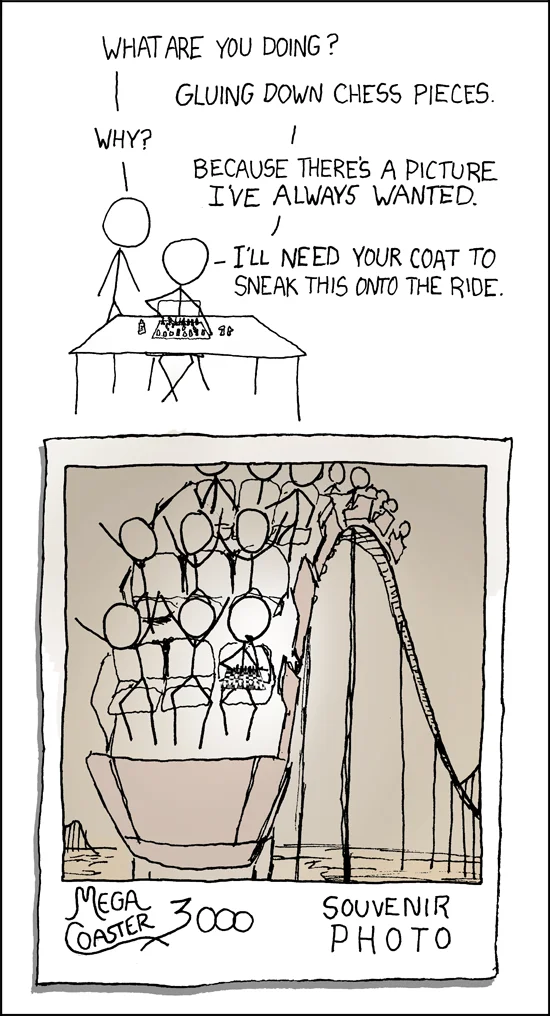
xkcd comic about gluing chess pieces to sneak onto a roller coaster for a souvenir photo

xkcd

2005webcomicclassic

Published October 8, 2026

xkcd is a stick-figure webcomic started by former NASA robotics contractor Randall Munroe in 2005, built around jokes about math, science, programming, and online life. The strip's cult audience among coders and scientists turned specific installments like Little Bobby Tables, Click and Drag, and Password Strength into their own standalone internet memes.

webcomic memes tech humor memes stick figure memes math memes science chart memes

Overview

Each xkcd strip features stick figures acting out jokes about programming, mathematics, physics, linguistics, and online life, with a hover-over title text under the mouse that acts as a second punchline or aside1. Munroe draws from a small cast of visually interchangeable characters: a bald figure sometimes called Cueball, a woman with black hair often referred to as Megan, a Beret Guy, a Black Hat trickster, and a White Hat straight man9. The strip's dry tone and willingness to pack real equations, flowcharts, or research citations into gag panels made it a reference point for programmers and scientists2.

Loading tweet...

Several strips grew past the regular readership into standalone memes. Comic 327, "Exploits of a Mom," introduced Little Bobby Tables, a child whose full name Robert'); DROP TABLE Students;-- is still quoted every time an SQL injection story breaks9. Comic 256, "Online Communities," mapped the social web as a fictional continent sized by population, and the strip spawned a sequel map after the shape of those networks changed6. Comic 936's "correct horse battery staple" argument for passphrases shaped how a generation of security educators taught password choice.

The strip is published under a Creative Commons Attribution-NonCommercial 2.5 license, which lets readers legally reprint, translate, remix, and teach from the comics as long as they don't sell them5. That permissive setup is a big part of why xkcd panels show up in slide decks, textbooks, and conference talks.

Gallery

Origin & Background

Platform
xkcd.com (self-published webcomic)
Creator
Randall Munroe
Date
2005

Randall Munroe, a physics graduate who worked as a robotics contractor for NASA, registered the xkcd.com domain on January 25, 2003. In a 2006 interview with Red Hat Magazine he explained that the four-letter string came from an instant messenger handle he picked specifically because it had no pronunciation and no prior meaning2. For about two and a half years the site sat mostly empty.

In September 2005, Munroe started scanning stick-figure doodles out of his school notebooks and posting them to xkcd.com, and that doodle feed quickly took over the entire site to become its only focus3. From there the strip settled into a Monday, Wednesday, Friday publishing cadence that it still keeps.

How It Spread

By 2007, xkcd was publishing three strips a week and pulling in traffic ranked among the top webcomics online. Specific installments punched well past the regular audience. Comic 1110, "Click and Drag," published in August 2012, replaced the usual single panel with a massive panned explorable image that readers could drag through for an immense hand-drawn landscape, and fans built external zoomable viewers to map it collaboratively7. Comic 961, "Eternal Flame," ran a looping gag coded directly into the strip page itself8.

The strip is quoted in places far from the webcomic audience. Little Bobby Tables from comic 327 is cited in security training slides, conference talks, Urban Dictionary's entry for xkcd itself, and introductory database courses9. A sister wiki, explain xkcd, writes a full annotated entry for every comic Munroe publishes and runs a weekly "Explanation Improvement Project" that revisits older entries, meaning that comics from more than a decade ago still get new attention4.

The xkcd brand also carried into longer formats. Munroe's "What If?" column, which answers absurd physics questions from readers using back-of-the-envelope calculation, grew into a bestselling book series under the same stick-figure house style, feeding more readers back to the main strip.

Timeline

2003-01-25

Munroe registers the xkcd.com domain, named after an instant messenger handle picked because the letters had no pronunciation[2].

2005-09

Munroe starts scanning stick-figure doodles from his school notebooks and posting them to xkcd.com, which quickly becomes the sole focus of the site[3].

2007-10-24

Comic 327 'Exploits of a Mom' is published, introducing Little Bobby Tables and the SQL injection joke that is still quoted in security talks[9].

2007-11-05

Comic 341 'Online Communities' is published, mapping the social web as a continent sized by active population[6].

2012-08-01

Comic 1110 'Click and Drag' is published as a massive panned explorable image, prompting fans to build external zoomable viewers[7].

2011-10-28

Comic 961 'Eternal Flame' runs a looping gag embedded in the strip page itself[8].

How to Use This Meme

References to xkcd typically take the form of linking a specific comic by number for a specific joke. Common conventions include dropping comic 327 whenever SQL injection or input sanitation comes up, pointing to comic 936 in password discussions, and linking comic 256 when mapping any community space online6. Readers often check the volunteer-run explain xkcd wiki when a strip's math, in-joke, or title text lands outside their field, since it writes a breakdown for every published comic4.

Frequently Asked Questions

xkcd is a long-running stick-figure webcomic by Randall Munroe about math, science, programming, and internet culture, published at xkcd.com1.

Munroe registered the domain in January 2003 and began posting scanned stick-figure doodles from his school notebooks in September 20053.

Nothing. Munroe took the four letters from an instant messenger handle he chose specifically because the string had no pronunciation and no prior meaning2.

Readers typically link a specific xkcd by its comic number as shorthand for a joke, often pairing it with the explain xkcd wiki for context4.

Yes. New strips are still published on the same Monday, Wednesday, Friday schedule, and the explain xkcd wiki writes a fresh entry for each one4.

References (9)

  1. 1
    https://xkcd.com
  2. 2
    https://www.redhat.com/magazine/025nov06/features/xkcd/
  3. 3
    https://knowyourmeme.com/memes/xkcd
  4. 4
    https://www.explainxkcd.com/
  5. 5
    https://xkcd.com/license.html
  6. 6
    https://xkcd.com/256/
  7. 7
    https://xkcd.com/1110/
  8. 8
    https://xkcd.com/961/
  9. 9
    https://www.urbandictionary.com/define.php?term=Xkcd

Quick Info

Year
2005
Origin
xkcd.com (self-published webcomic)
Type
webcomic
Status
classic
Creator
Randall Munroe

Tags

webcomicstick-figuresnerd-humorrandall-munroeprogrammingscience

Related Memes

  • fly brain simulations fruit fly brain mapped
  • data visualization
  • all the things
  • connecticut clark
  • cyanide and happiness
  • im not a robot

More Webcomic Memes

  • This Is Fine
  • Dick Butt
  • Wheeze Comic
  • Abuse Goblin
  • Baton Roue
  • Connecticut Clark
  • Cow Tools
  • Ctrl+Alt+Del
  • Cyanide And Happiness
  • Dinosaur Comics
  • Every Third Hetero Couple The Most Racist Man Alive
  • Hark! A Vagrant
View all Webcomic memes →
Browse MemesTopicsCreatorsTrendingPlayAboutLegalPrivacy

© 2026 meme.com