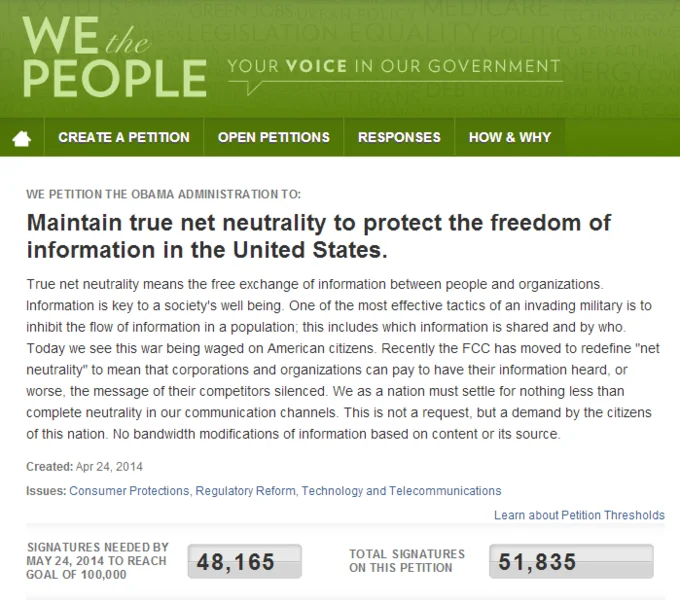
Net Neutrality
Published September 8, 2026
Net Neutrality is the principle that internet service providers must treat all online traffic equally, a term coined by Columbia law professor Tim Wu in a 2003 paper that turned into one of the internet's defining activist fights. From Ask A Ninja explainers in 2006 to John Oliver crashing the FCC website twice, the movement drove a decade of memes, mass comment campaigns, and Reddit frontpage takeovers aimed at FCC chairman Ajit Pai.
Overview
The Net Neutrality argument is over whether ISPs like Comcast, Verizon, and AT&T can block, throttle, or charge extra for specific web services2. Advocates want the internet regulated as a common carrier utility so providers cannot build paid "fast lanes" that favor giants like Netflix or Amazon4. Opponents, led during the Trump era by FCC chairman Ajit Pai, called the rules "heavy handed" and blamed them for hurting broadband investment1.
As a movement, the fight was driven by memes, protest banners, and mass comment tools as much as by legal filings. Reddit frontpage takeovers, John Oliver monologues, "Battle for the Net" widgets, and dogpiles on Senator Ted Cruz gave a dry telecom policy debate a face for mainstream audiences3. The recurring visual grammar involves red alert banners, Ajit Pai image macros casting him as bought by Verizon, and countdown-style calls to phone Congress.
Gallery
Origin & Background
How It Spread
How to Use This Meme
For the activist toolkit that grew out of the movement, the common moves are pinning a red "Battle for the Net" banner on a website or profile, calling or emailing congressional offices using pre-written scripts, and remixing Ajit Pai photographs into image macros that portray him as corrupt or ISP-owned5. The signature format is a dated countdown widget paired with a bright red "internet in danger" call to action, tied to whatever FCC or Senate vote is next on the calendar7.
Cultural Impact
Fun Facts
Legal scholar Lawrence Lessig was making the open-access case for net neutrality as early as 2001, two years before Tim Wu named the concept9.
Vinton Cerf, one of the "fathers of the internet," publicly backed net neutrality in a 2005 letter to Congress that Google posted on its blog9.
John Oliver's Last Week Tonight segments crashed the FCC's comment site in both 2014 and 20174.
The FCC's May 2017 DDoS claim was contradicted by an August 2018 inspector general report showing no attack ever happened7.
On the day of the December 14, 2017 repeal vote, the FCC meeting was briefly evacuated for a security sweep before commissioners returned to finish the vote5.
Derivatives & Variations
Battle for the Net protest banners deployed by Etsy, Reddit, Mozilla, Pornhub, and Tumblr in 2017 and 2018[5]
Ajit Pai image macros portraying the FCC chairman as corrupt or owned by Verizon, which dominated /r/dankmemes and /r/memeeconomy in November 2017[3]
GoFCCYourself.com, the John Oliver-purchased redirect that funneled viewers to the FCC comment form and helped crash the site in May 2017[7]
Frequently Asked Questions
References (9)
- 1
- 2
- 3
- 4
- 5
- 6
- 7
- 8
- 9