Pussy Riot

2011protest art collective / viral videosemi-active

Published September 23, 2026

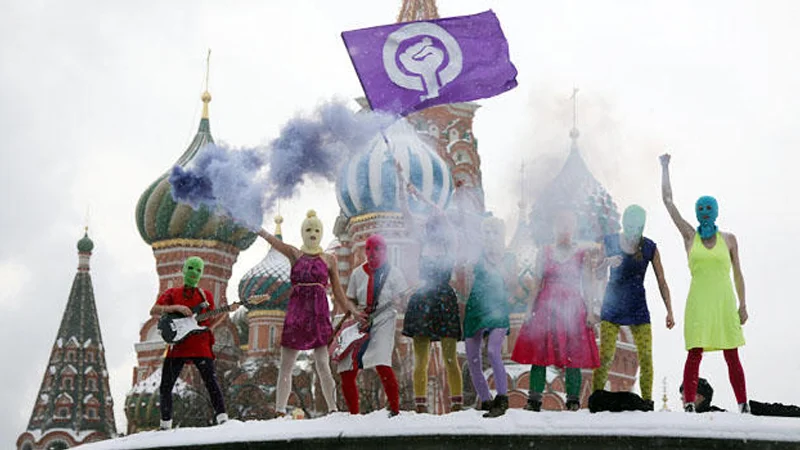
Pussy Riot is a Russian feminist punk protest collective known for staging guerrilla performances in subway stations, Red Square and Orthodox cathedrals, then uploading the footage to YouTube. Their forty-second 'Punk Prayer' set inside Moscow's Cathedral of Christ the Savior in February 2012 triggered a two-year prison sentence for three members and turned the group's neon balaclavas into one of the decade's most circulated protest images.

Overview

The group operates as a rotating cast rather than a fixed lineup, and by 2013 counted roughly twelve performers plus fifteen technicians handling filming and production5. Members stay anonymous on stage under bright wool balaclavas paired with mismatched dresses and tights, a look that later showed up on runway shows, Halloween costume racks and protest signs from Berlin to New York3.

The music itself was almost incidental at first. Early singles like 'Osvobodi Bruschatku' and 'Putin Zassal' only ran two or three minutes and were built to be played once in an unauthorized public spot, filmed, and pushed to YouTube as a bundle titled 'Ubey seksista' ('Kill the sexist')5. That workflow of guerrilla set plus fast upload is what pulled the collective out of the Russian protest scene and into wider circulation once foreign press picked up the 2012 arrests2.

Origin & Background

Platform
YouTube (Moscow street performances)
Key People
Maria Alyokhina, Yekaterina Samutsevich and Nadezhda Tolokonnikova
Date
2011

Pussy Riot was formed in August 2011 by Maria Alyokhina, Yekaterina Samutsevich and Nadezhda Tolokonnikova; Samutsevich and Tolokonnikova had already performed with the absurdist Moscow art collective Voina5. They described the project in interviews as a 'militant, punk-feminist street band' meant to channel the mood around the anti-Putin demonstrations breaking out that autumn.

The first documented performance surfaced on YouTube on November 6, 2011, when user Гараджа Матвеева uploaded footage of masked members singing 'Osvobodi Bruschatku' ('Release the Cobblestones') on a scaffold in a Moscow subway station5. The track samples the Angelic Upstarts' 1978 song 'Police Oppression' and urged listeners to hurl cobblestones in protest of the Russian parliamentary elections. A December 14, 2011 follow-up, 'Smert tyurme, svobodu protestu,' was staged on a garage roof beside the Moscow prison holding Alexey Navalny and Ilya Yashin5.

How It Spread

Global attention arrived through a single clip. On February 21, 2012, five masked members entered Moscow's Cathedral of Christ the Savior and performed 'Punk Prayer: Mother of God Drive Putin Away' on the altar steps until guards escorted them out; the video was uploaded to YouTube the same day7. The song opened with a refrain lifted from Rachmaninoff's 'Bogoroditse Devo, Raduisya' and asked the Virgin Mary to 'become a feminist,' which the Russian Orthodox Church treated as grounds to lobby for a new blasphemy law5.

Criminal charges of hooliganism followed within days. Alyokhina and Tolokonnikova were arrested on March 3, 2012, Samutsevich on March 16, and on August 17, 2012 all three received two-year prison-camp sentences5. Samutsevich walked out on a suspended sentence that October after her lawyer argued she was stopped by guards before she could take her guitar from its case5. Foreign musicians turned the trial into a solidarity story, and after their December 19, 2013 amnesty, Tolokonnikova and Alyokhina appeared on 'The Colbert Report' and shared a Barclays Center stage with Madonna at an Amnesty International concert in February 20145.

The group kept releasing videos aimed at Western politics. Their October 27, 2016 clip 'Make America Great Again,' uploaded to the Pussy Riot YouTube channel just before the U.S. election, passed 2.7 million views by January 20185, and the accompanying 'xxx' EP earned a 6.6 from Pitchfork2. A first proper North American tour, billed as 'a subversive mix of activist art and live set,' kicked off at Chicago's Subterranean on March 6, 2018 and was covered by Pitchfork4, the Chicago Sun-Times3 and Spin. That September, member Pyotr Verzilov was hospitalized in Moscow with symptoms doctors described as consistent with a 'neurotransmitter-blocking' poisoning, which put the collective back in international headlines1.

How to Use This Meme

Pussy Riot isn't a template you remix at home so much as a visual grammar people quote: neon balaclava, plain dress over colored tights, an unauthorized microphone in a public place, and a short punk song aimed at a specific target. Activists and cosplayers still borrow the balaclava look for protest photos and Halloween costumes, and the group's own YouTube uploads7 set the format that copycat performances have followed ever since.

Cultural Impact

The 2012 trial pulled Pussy Riot from a Russian protest circuit into mainstream Western coverage, with Madonna, Paul McCartney and Björk publicly backing the imprisoned members5. After their release, Tolokonnikova worked with TV on the Radio's Dave Sitek on an English-language EP that Pitchfork reviewed as a solo pop pivot rather than a collective statement, a shift former members criticized in an open letter2. The Chicago Sun-Times treated the 2018 U.S. tour as a legitimate touring act rather than a novelty booking, framing the shows as 'activist art and live set'3. Verzilov's suspected poisoning in September 2018 was covered by Meduza and international wires, keeping the group in political news cycles well beyond its original 2012 story1.

Fun Facts

Two of the three founders, Samutsevich and Tolokonnikova, previously performed with the Russian art collective Voina before starting Pussy Riot5.

The 'Punk Prayer' at Christ the Savior lasted roughly five minutes before guards intervened, but only about forty seconds of song made it into the released video5.

Samutsevich avoided prison on appeal because her lawyer proved she was pulled aside by guards before she could take her guitar out of its case5.

The 'xxx' EP included the tracks 'Make America Great Again,' 'Straight Outta Vagina' and 'Organs,' with a follow-up single 'Police State' featuring Chloë Sevigny in the video4.

Pussy Riot's first U.S. tour date sold at $25 a ticket, 17-and-over, at Chicago's Subterranean on March 6, 20183.

Derivatives & Variations

'Punk Prayer: Mother of God Drive Putin Away' YouTube upload (February 21, 2012), the video that spread the cathedral protest worldwide[7].

'Make America Great Again' single and music video (October 27, 2016), the group's first Trump-era release, over 2.7 million YouTube views[5].

The 'xxx' EP (2016), Nadya Tolokonnikova's Dave Sitek-produced release scored 6.6 by Pitchfork[2].

Frequently Asked Questions