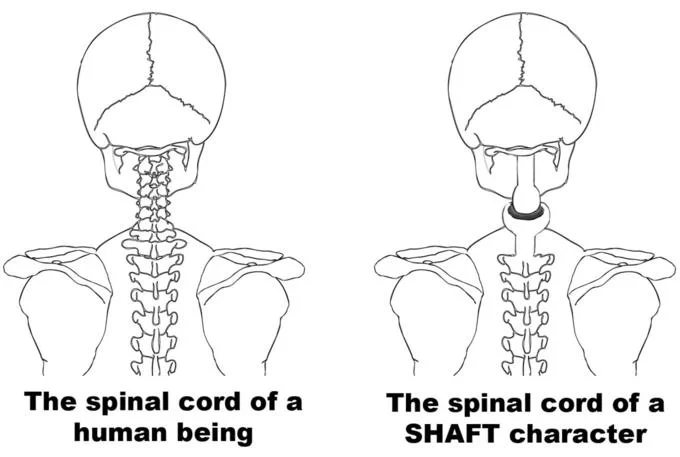
Shaft Head Tilt
Published September 27, 2026
Shaft Head Tilt is an anime posing motif where a character cranes their neck at a nearly impossible angle to peer back over their shoulder, popularized by Japanese animation studio Shaft under director Akiyuki Shinbo. First catching viewer attention through Bakemonogatari in 2009 and spreading globally via Puella Magi Madoka Magica in 2011, it became one of anime's most recognizable stylistic signatures and a staple pose for fan illustrators.
Overview
The pose, known in Japanese as シャフト角度 (Shafuto Kakudo) or the abbreviated シャフ度 (Shafudo), literally translates to "Shaft Angle"3. It is defined by a character twisting their neck backward at a sharp, anatomically unlikely degree to glance suggestively over one shoulder, usually with the chin tucked low3. The angle can push past 90 degrees, giving the impression that the character is watching something behind them without turning their body.
The move is most closely associated with productions from anime studio Shaft, where director Akiyuki Shinbo has worked on nearly every project since 20041. His visual style leans heavily on odd framing, negative space, and stark composition, and the head tilt fits that grammar by creating a jolt of tension in an otherwise still shot2. Fans and illustrators recreate the pose so often on sites like pixiv that "Shafudo" now functions as a searchable tag for the aesthetic3.
Origin & Background
How It Spread
Timeline
2004
Akiyuki Shinbo begins his long collaboration with studio Shaft, embedding his signature framing into the studio's house style[1].
2009
Hitagi Senjougahara's extreme neck crane in Bakemonogatari becomes the first widely noticed instance of the pose[3].
2011
Puella Magi Madoka Magica airs; Japanese viewers dub the pose シャフ度 (Shaft Angle)[3].
2011-08
An r/anime thread titled "SHAFT Head Tilts" popularizes the English nickname "Shaft Head Tilt"[3].
2013-09-06
Voice actor Aoi Yuki performs the pose with a reporter during a morning news segment tied to the Madoka Magica film[3][4].
How to Use This Meme
Artists typically draw the pose with the character's body facing away or to the side while the head cranes back over the shoulder at a sharp angle, often paired with a downward glance and half-lidded eyes for a wry or menacing effect3. On pixiv and Nico Nico Seiga, contributors tag their illustrations シャフ度 so others can browse the format3. In fan discussion, the phrase functions as shorthand for "draw this character in Shinbo's signature crane pose."