Pac-Man

1980video game characterclassic

Published September 20, 2026

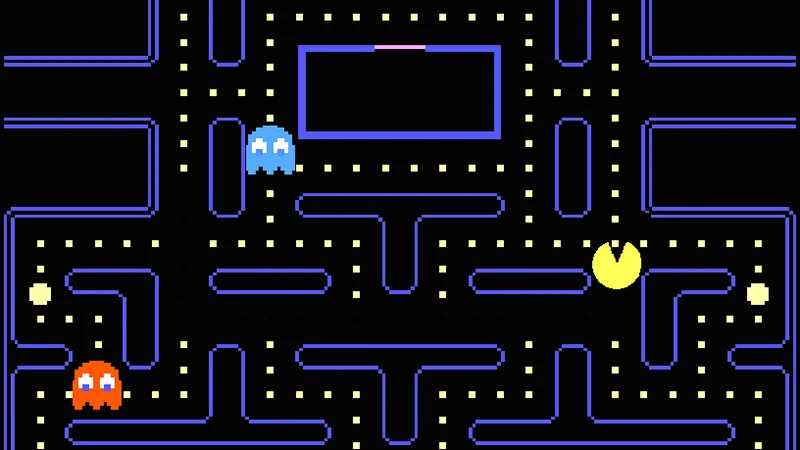
Pac-Man is the 1980 Namco arcade game starring a yellow dot-eating circle chased by four colored ghosts through a blue maze. Designed by Toru Iwatani to pull women and couples into arcades dominated by shooters, it became a media juggernaut with cartoons, a Top 10 pop song, and a Google Doodle that turned the character into gaming's first true mascot.

Overview

Pac-Man is a yellow circle with a wedge cut out for a mouth who chomps white pellets while dodging four ghosts, Blinky, Pinky, Inky and Clyde, through a blue maze1. The gameplay loop is simple: clear every dot on the board before a ghost touches you, grab a power pellet to briefly flip the hunt and eat the ghosts for bonus points2. That readable silhouette and the little 'waka waka' chomp sound made the character instantly recognizable outside the arcade, which is why he ended up on lunchboxes, cereal boxes and magazine covers within a couple of years1.

The design was a deliberate break from the shooter template of the era. Iwatani pitched a 'cute' cast so game centers would feel welcoming to women and couples, not just teenage boys blasting aliens3. The character shape itself came from a pizza with a slice removed, a story Iwatani has repeated in interviews for decades13.

Origin & Background

Platform
Arcade (Namco cabinet)
Creator
Toru Iwatani
Date
1980

Development started at Namco in 1979 under designer Toru Iwatani, who wanted a game that was not another Space Invaders clone1. He built the concept around eating, reasoning that food themes would pull in a female audience the arcade industry was ignoring, and drew the protagonist from the visual of a pizza missing one slice3. The first Pac-Man cabinet was installed on May 22nd, 1980 in a movie theater in Shibuya, Tokyo, and the game was a hit almost immediately3.

Namco (the company) developed and published the title; the meme-status mascot was designed by Iwatani himself, so credit for the character sits with him rather than the corporate byline13. By the year 2000, Pac-Man cabinets alone had generated more than $2.5 billion, roughly $7.16 billion when adjusted for inflation to 20141.

How It Spread

After the May 1980 Shibuya debut, Pac-Man spread from Japanese arcades into North America and then into pop culture at large, appearing on lunchboxes, magazine covers and an animated series1. ABC's Pac-Man cartoon premiered in 1982 and ran through 1983, making it the first cartoon based on a video game2. The character also crossed into music: a novelty single tied to the craze cracked the U.S. Top 10, cementing him as a mainstream figure and not just an arcade curiosity1.

The game's staying power is unusual for an arcade title from 1980. Iwatani told Wired in 2010 that iPhone versions of Pac-Man, largely unchanged from the original, were still a real revenue stream for Namco Bandai three decades later1. On May 21, 2010, Google marked the 30th anniversary by launching its first-ever interactive homepage Doodle, a playable Pac-Man level embedded on google.com1. A CGI reboot, Pac-Man and the Ghostly Adventures, later aired on Disney XD2.

How to Use This Meme

Pac-Man shows up as visual shorthand whenever someone wants to signal 'classic arcade' or 'retro gaming', typically via the yellow wedge silhouette, the four ghosts, or the 'waka waka' onomatopoeia2. Urban Dictionary entries note the sound is often written out as 'waka waka waka' in captions and comments to imitate the chomp4. The character is also a stock costume, tattoo motif and merch print, riding on the same clean silhouette Iwatani drew in 19791.

Frequently Asked Questions